
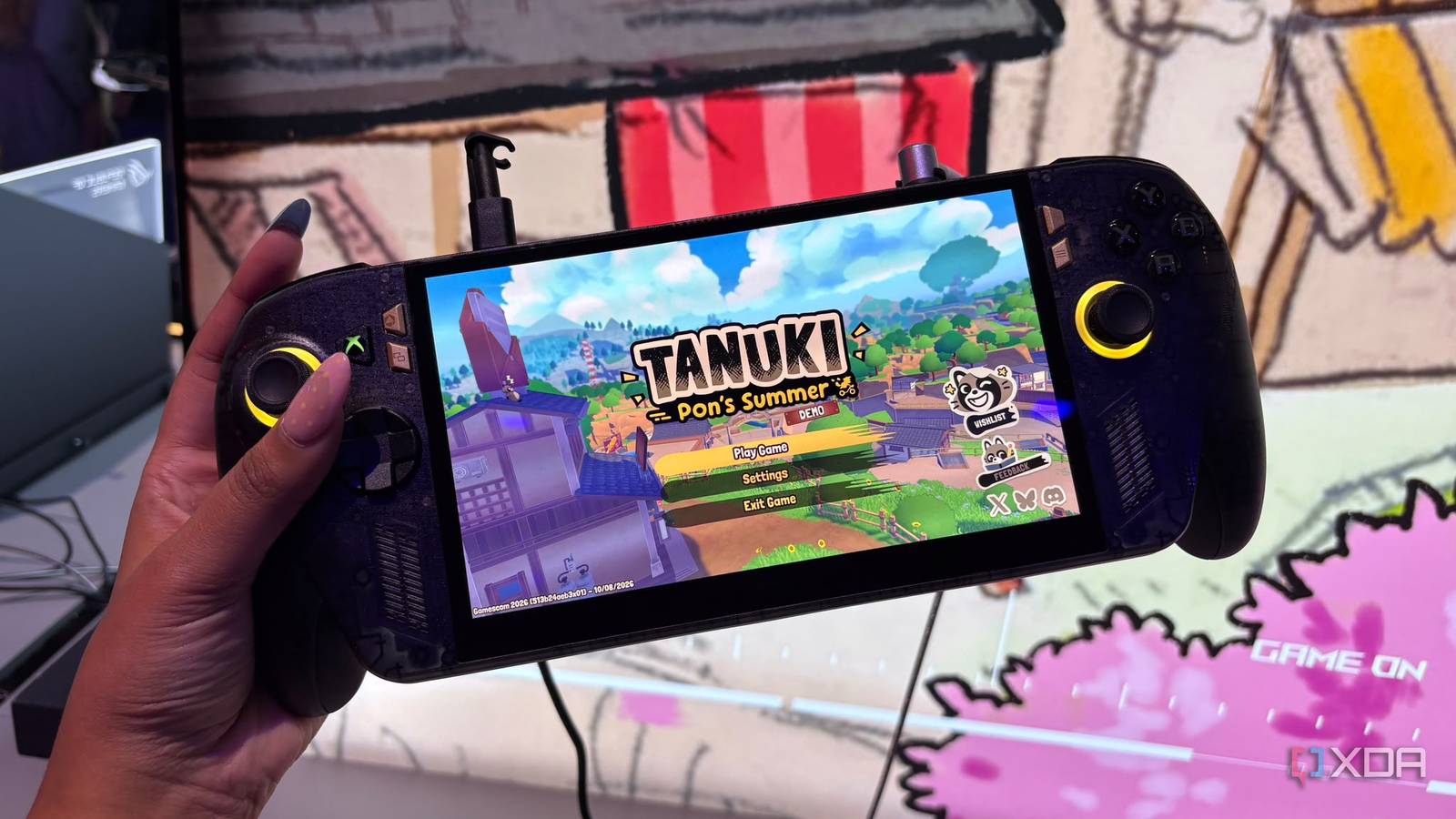
Published Sep 13, 2026, 2:30 PM EDT Jasmine is Software and PC Hardware Author at XDA with years of tech reporting experience ranging from AI chatbots right down to gaming hardware, she's covered just about everything. Whether it's breaking news about the latest AMD NPUs or creating video tutorials on social media platforms, Jasmine has contributed to the world of AI and tech in a variety of ways including interviewing the CEO of Razer, AMD's Director of Product Marketing and the VP of Lenovo. Passionate about gaming and PC technology, she has built countless computers, keyboards and other peripherals - knowing them inside and out. I got some hands-on time with the ROG Ally X20 at Gamescom 2026. I was really excited given that the marketing narrative surrounding AMD's new Ryzen AI Z2 Extreme chip promised a generational leap that handheld gamers have been waiting for since the original debuted three years ago. I feel like, after my experience, I was actually quite let down. Handheld silicon hasn't failed on architectural innovation; it's colliding with the immutable laws of thermodynamics, battery chemistry, and LPDDR5X memory bandwidth. AMD's Ryzen AI Z2 Extreme proves that simply shrinking Zen5 and RDNA 3.5 compute units onto a handheld die cannot overcome a stubborn 15 W to 25 W power envelope. Handheld PC gaming has officially hit the wall of diminishing returns no matter how fantastic the hardware is. Under the hood of the Z2 Extreme This chip lets down the device What does the Z2 Extreme chip actually pack? The silicon architecture, which is Zen5 plus RDNA 3.5 plus XDNA2, is a hybrid core cluster: the Zen5 performance cores paired with the Zen5C dense cores, alongside expanded RDNA 3.5 compute units, up from 12 CPUs to 16 CPUs. It also packs a 50+ top XDNA2 NPU. This essentially allows it to appease Microsoft Copilot Plus PC mandates and theoretically drive local ML-based super resolution. Unfortunately, even when it comes to specifications alone, you can see that there's a bit of a starvation problem due to memory bandwidth bottlenecks. Adding 16 RDNA 3.5 CPUs sounds impressive on a spec sheet, but graphics compute units need to be fed data. In a handheld, both the CPU and GPU share a 128-bit memory bus running LPDDR5X. Even clocked at 750 MT/s or 8533 MT/s, at 15 W to 20W, memory controller power draw eats a disproportionate chunk of the total system-on-chip power budget, starving the shader engines and choking rasterization throughput. Another issue is, of course, the NPU. Dedicating precious die area to an XDNA2 neural processing unit in a dedicated gaming handheld can feel like significant silicon waste. For most users, when you're using the handheld for what it's intended for — gaming — NPU usage will sit at 0% across most titles. You're paying extra for Copilot-focused silicon that does nothing to stabilize 1% low frame times. Let down by real-world testing It pulls ahead when plugged in... which is totally what I want from a gaming handheld During my testing with the Asus ROG Ally X20, I wanted to use the device as if I was in the real world. This meant testing the device at 15W, which is essentially the sweet spot. Handhelds live and die at 15W TDP, the balance point between 2-hour battery life and playable performance. Realistically, it felt like the Z2 Extreme barely pulled ahead of its predecessor, the Z1 Extreme. At 15W, the higher CPU count downclocks aggressively to stay within the power limit, resulting in nearly identical 1080p medium raster performance. Depending on the title, this can range from 30 to 45FPS — nothing spectacular. Trying it at the 25W turbo setting did unlock the higher clock ceilings for RDNA 3.5. You do see an uplift, but this comes at the expense of roaring fan curves, chassis heat (especially around the upper display edge), and a battery drain rate that guarantees sub-75-minute sessions. I lost almost half of my battery playing for just 30 minutes. It really felt like the Z2 Extreme wasn't optimized for real-world use. Yes, it pulls ahead if you're keeping the device plugged in, but this defeats the whole point of a gaming handheld. And as always, there were still seemingly 1% lows and a fair amount of stuttering, which is likely as a result of Windows background scheduler spikes, proving that extra GPU compute units can't fix x86 OS scheduling overhead. The device itself is fantastic Too bad it's let down by the silicon The Asus ROG Ally X20 is actually pretty stunning in its chassis and ergonomics. Unfortunately, cooling physics just can't be cheated. Asus revamped the thermal design for the Ally X20 with thicker vapor chambers and redesigned exhaust vents in order to handle sustained boost spikes. As a result, the device feels noticeably denser when you're holding it, and standing at a convention booth for 30 minutes made the wrist fatigue feel pretty obvious. When you're using a portable console, there is a ceiling for how heavy it can be before it starts to feel like a lap-only device. The OLED screen was definitely the right step forward. It's beautiful to look at and feels stunning, finally allowing Asus to catch up to Valve's Steam Deck OLED. Alongside this, it's also a high-refresh VRR panel, but driving this with an APU that struggles to maintain 60 fps in modern titles means that you're leaning heavily on FSR 3.1 or TSR upscaling (which can result in visual softness and shimmering that negates high-end screen upgrades anyway). As if the concern about battery life wasn't already high enough, this screen only exacerbates it. It's disappointing that such a beautiful panel is let down by the silicone. Upgrading your gaming handheld is not necessary Keep to your current gen device Realistically, the Asus ROG Ally X20 is a superb device which is being held back by a lack of progress when it comes to silicon. It feels like we have really entirely hit a wall with architecture for gaming handhelds. My time with the ROG Ally X20 answered the biggest question in handheld gaming for me: Is the next generation worth waiting for? Unless you're upgrading from an ancient original base model, the Z2 Extreme is an incremental spec bump masquerading as a revolution. You don't need an NPU if you already own a current-gen handheld like the ROG Ally X or Steam Deck OLED. You're probably better off keeping your wallet closed until memory architecture and battery chemistry take a quantum leap forward. The golden age of year-over-year portable PC gains is over.
I tested the ROG Ally X20, and it's gorgeous hardware wasted on a chip that can't deliver
Full Article
Original Source
Read the full article at Xda-developers →KhanList aggregates and links to publicly available news content. We do not host full articles from third-party sources. Always verify important information with original sources.