
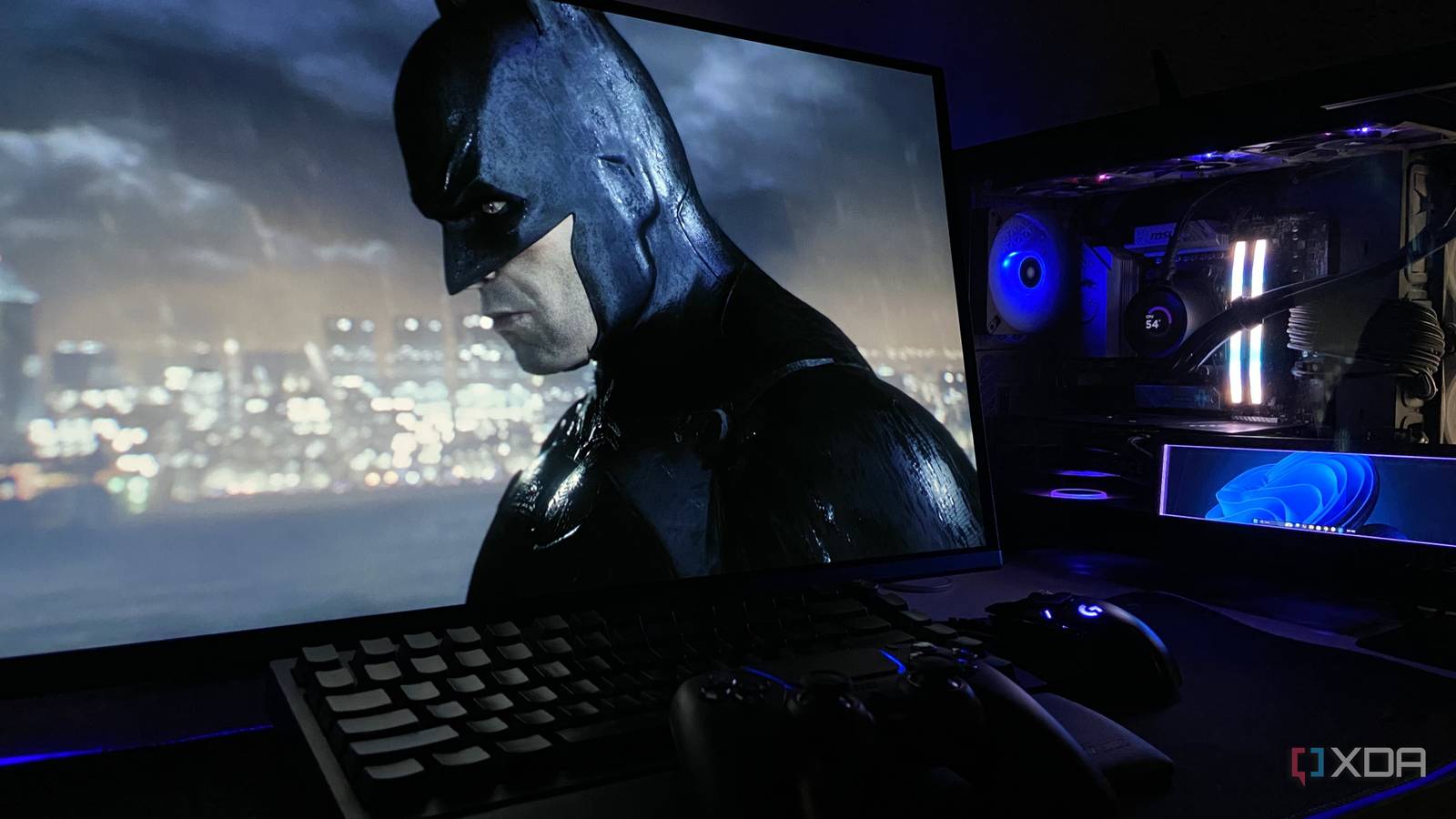
Published Sep 19, 2026, 4:30 PM EDT Abhinav pivoted from a career in banking to pursue his first love in writing. Even while working full-time, he continued contributing as an editor-at-large, a role he has held for more than 7 years. A lifelong tech enthusiast who has built three gaming and productivity powerhouse PCs since 2018, his passion for technology keeps him closely following the semiconductor industry, from NVIDIA and AMD to ARM. His MSc dissertation explored how artificial intelligence will reshape the future of work, reflecting his curiosity about the wider social impact of emerging technologies. It has been almost twenty days since it came out, but the internet is mysteriously torn on the subject of DLSS 5. On one hand, it has been touted as perhaps one of the worst uses of artificial intelligence in gaming, being one that deviates from artistic intent in video game design and slaps a filter on everything that makes it look like an AI interpretation of what the game should be. On the other hand, YouTube videos featuring the use of the new Neural Rendering feature have been stacking up millions upon millions of views. It's clear that whether you love Nvidia's latest "AI black magic" or hate it, there's no ignoring it. So I've decided to stop ignoring it and test it on three of my most beloved old games to see what it can bring to the table. The Witcher 3: Wild Hunt Wind's howling in the uncanny valley With DLSS 5, it finally seems like Geralt's mutations have reached his face after eighty years of monster hunting. This is a game that I have returned to more times than I can count, always finding something I had not seen before, and that is exactly why it sits at the heart of this test. I wanted to know what the world of the Witcher would feel like when it's rendered photorealistically, and whether that made it more immersive or less. It also happens to be the most face-forward title on this list, so it is also where reconstruction is likeliest to read "wrong". Well, so, it did. Geralt, quite simply, was not the Geralt any fan of the trilogy would recognize. The skin is overly defined, waxy, and precisely the uncanny valley nightmare I came searching for. It's a stranger wearing Geralt's face, and every bit of it feels like a masquerade. This should've been enough for me to drop the feature altogether, but Triss absolutely ruined the verdict beyond any standards of measure. In a latern-lit dialogue in the shipyard with Djikstra set within the same universe that failed Geralt so badly, neural rendering flattered her instead. Why? That's something I cannot answer with absolute certainty. I can only speculate as to why, since Nvidia has published next to nothing about what these models were trained on. My best guess is that a conventionally human face gives reconstruction something familiar to reach for, while a mutated Witcher that's pallid and scarred by design sits outside whatever the model considers a face. If that is indeed what's happening, then DLSS 5 is not neutral about art direction at all, which seems to be the one of the primary concerns of the community at large. Batman: Arkham Knight There's finally something creepier than the Joker in Gotham City Batman: Arkham Knight is a game that possibly rivals The Witcher 3 in terms of its contemporary relevance. The game came out in 2015 when I was just readying myself for high school, and the weeks leading to its launch were also the weeks that this game was the only thing that was ever talked about in gaming enthusiast circles. It also predates DLSS, so it takes the cruder inject route rather than the clean swap that others on the list rely on. What the model, and the method produced together, was something that should've bothered me, but it left me impressed instead. Gotham City in particular is where DLSS 5 would shine the best, because it's got everything that photorealism stands to gain immensely from. Rain on the surface, overcast skies, wet asphalt throwing back the lights on the street, and the ominous ambience in general that adds to the eeriness of the atmosphere. Purists would argue that it violates every rule of artistic intent and transgresses a boundary that AI should never, and yet, to me, it produced the Batman the way I always imagined him, being heavier and more flesh than silhouette, with a hint of Ben Affleck in the face that you'll never see me complain about. Perhaps the creepiest thing here is Batman himself, and with a touch of neural rendering, he looks every bit as fearsome as Gotham needs him to be. Metro Exodus The wasteland has got a texture pack from hell, and it oddly suits it When Metro Exodus first came out, I was just a 19-year-old with an Xbox One X, which happened to be the only device in my home with a dedicated GPU. As such, this was a world that I was familiar with before I ever got around to experiencing it on the PC. It's one of the reasons why it's here on this list at all, because the lighting, volumetric skies and particle geometry make it a good measure of what neural rendering can do for an old title. For me, it simply works. This is a first-person shooter that draws most of its vibe from its atmosphere, and that's precisely one aspect that DLSS 5 has a potential to add depth into. The dessicated corpses gain definition, snow breaks into grains, and the leather and buckles on Artyom's gauntlet have an aspect of wear and tear that I had never noticed. For me, it's definitely improved the visuals, and for a game like this, that's an automatic upgrade. ReShade So, is it a nightmare or is it refreshing? It seems to be a bit of both, and which one gamers get depends on what's actually on the screen. You can make it elevate the rain effects, particle geometry, add depth to atmosphere, and make near about any other visual more photoreal in a way that it makes a decade-old title flattering, but if you point it at a face you know too well, it has a chance of handing you a total stranger. It's also definitely worth noting that what I tested was a leaked build injected through ReShade and RenoDX, with one title relying on a cruder route because it came out before DLSS was a thing at all. The official implementation, whenever it arrives properly on my Ada Lovelace GPU, will almost certainly behave differently, and I'm hoping probably better. After all, in all likelihood, Nvidia didn't expect their neural rendering trick reserved for the Blackwell series to be used on old games on a 40-series GPU like this.
I tested the leaked DLSS 5, and it's doing something to old games that Nvidia probably didn't intend
Full Article
Original Source
Read the full article at Xda-developers →KhanList aggregates and links to publicly available news content. We do not host full articles from third-party sources. Always verify important information with original sources.