
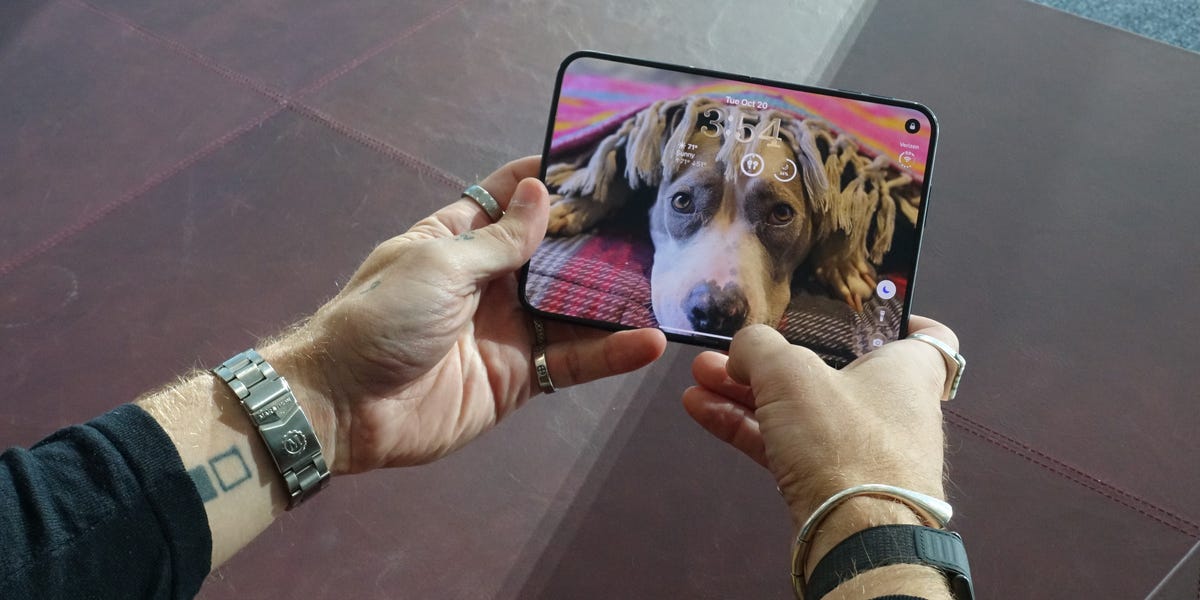
Our product picks are editor-tested, expert-approved. We may earn a commission through links on our site. Why Trust Us?Jason Speakman8 min readINEVITABLY, EVEN THE coolest, most unique tech gadget becomes a day-to-day object. That’s the goal, at least. You want to be so familiar with your devices that they become second nature to use, an accustomed shape you can grasp for in the dark or pull out of your pocket and handle without a second thought. If you never get there, you’re not actually using it enough to be worth the investment.For the first day or two out of my time testing the iPhone Duo, Apple’s debut foldable phone, I doubted I would ever get to that point of comfort. The Duo felt so different than the iPhone 18 Pro Max I had been using for the last month—and from every other iPhone since my first, a 5S in 2013. Reaching for the Duo with its squat dimensions felt awkward, the outer display was harder to scan at a glance, and I didn’t feel compelled to unfold and use the inner displays much at all. Was all this phone even useful?But at some point on day three, something clicked. I stopped automatically holding the phone up to unlock it with my face (the Duo brings back Apple’s fingerprint Touch ID, more on that in a bit). I flipped out the big screen unconsciously to switch through my apps. I still had reservations about exactly how useful this was compared to a slab-style smartphone, but it felt less like a novelty and more like something I could depend on.All that led to one of the most engaging test periods I’ve had in my decade reviewing tech. The iPhone Duo really made me think about more than just its specs, camera, and place in the larger Apple ecosystem; I was reconsidering how and why I use smartphones.ProsSmooth, seamless functionalityMulti-tasking and video whizSolid battery lifeConsAwkward to use on the goCamera isn't as good as the Pro lineExpensive!The iPhone Duo’s DesignTHE FOLDABLE FORM factor isn’t an Apple innovation. While there were plenty of clamshell devices back in the aughts in the days before smartphones (shout out to the LG Voyager), mainstream, modern foldables kicked off in 2019 when Samsung entered the market. Google has been in the game since 2023. Apple, as it often does, stayed out of the space until it was good and ready to bring a polished device to market.I’ve not used any of the other foldable phones as my daily handheld, so I won’t compare them at length. What I will say is that compared to my brief experience with the other devices, Apple’s design is robust. The Duo is made of titanium; it’s substantial to hold and carry without being too hefty. Its screens aren’t as big as some other models (the outer display, which I used the most, is 5.4 inches, while the fully extended size is 7.6 inches), but the hinge—the feature that the Duo really depends on to function properly—does exactly what it’s supposed to do.That mechanism is made out of over 100 pieces, with a 3D-printed cover. Opening and closing the phone is oddly satisfying, with an audible snick when it extends to its full size and a snap when it closes (with a little help from a magnetic array to keep it shut).Jason SpeakmanThe Duo (bottom) compared to the iPhone 18 Pro Max (top L) and the iPhone Air (top R).The inside display has a “nano-textured cover layer,” which Apple says is stiffer than other materials typically used in the industry. In practice, this gives the inner screens a matte look and feel, which is smooth to the touch. And when the Duo is open, the crease is completely imperceptible straight on. I can sometimes spot it when I look from an angle and the display is dark, but how often will I be craning my neck to do that during normal use?Slightly more perceptible is the FaceTime Camera, hidden beneath the display. It’s a small circle on the screen that’s visible when the device is inactive, then almost obscured by color. Once I got used to looking at the layout, I stopped clocking it entirely.The hinge doesn’t just keep the Duo fully open or shut. The device can be oriented in a range of positions beyond just vertical or landscape. Hold it up like a book with a slight crease, rest it on the bedside table, tent-style, or prop it up with the camera facing out to record your workout, sans tripod. There are, at my count, six basic ways to use it.Brett WilliamsThere are some other subtle differences from other recent iPhone models that I initially had to adjust to. The volume buttons are at the top of the device, not the sides. I kept reaching for it on the side of the Duo—but that’s where the lock button with Touch ID is, now that there’s no Face ID. I needed a few days to get used to that layout. Using the inner screen is a bit awkward with one hand on the go, but when I’m seated at home, it’s great.The iPhone Duo’s Performance and CameraEVEN WHEN I wasn’t so sure about the Duo, the one thing I had to acknowledge was how well it functions. The device just works. Basic tasks were speedy from any screen, and soon enough I got used to the shape. Creating videos using Instagram’s Edits app was even easier with the dual setup, since I was able to use the tools typically squished at the bottom of the display on an entirely different screen.Brett WilliamsShifting from one display orientation to the next while running a program is close to seamless. I played the new Marcello Hernández: American Boy stand-up special on Netflix, starting on the outer display. The video continued to run smoothly through every orientation as I folded and flipped it around, on the outer and inner screens.Multitasking on the screens is simple. Open an app, press on the screen, and drag it to one of the sides of the screen. Open another, and drag it that way. Boom: two at once. It’s eminently usable and familiar if you’ve spent any time with other Apple devices.Brett WilliamsA screenshot of a Google Chrome tab and Netflix running together.I didn’t play any games or do much beyond basic video playback and browsing, so I didn’t push the Duo particularly hard. But it did everything I asked of it, and I knew it could handle more, since the device has the same A20 Pro chip as the iPhone 18 Pro line.The cameras on the Duo are solid, but not spectacular after having tested the 18 Pro Max. The rear unit is a 48MP Dual Fusion camera, which can snap really nice photos like this one of my dog. It lacks the variable aperture and Pro Controls of the other model, though—and the zoom isn’t as powerful with the 2x telephoto.Brett WilliamsBut the Duo’s design allows for some fun new photo features. Along with being able to be propped up in ways a standard slab smartphone couldn’t contend with without a tripod, there’s also a setting that allows you to capture pics without setting a timer. That’s called Smart Take. The camera is meant to analyze the frame, recognize subjects posing, and snap a pic. In practice, after I set the device, posed, and left the frame, it captured photos without appearing to process much of anything, snagging shots of my back as I approached my wife and dog to jostle into position. We still got some fun pictures, and I can imagine the feature being majorly useful to me both capturing family pics and workout photos, so I’m pleased with it regardless.Brett WilliamsCaptured by Smart TakeYou can also use the outer display to make taking photos easier. Open up the device, and you can use Duo preview to either give the subject of your photo a quick check to see how they look before you snap a pic (just remind them to shift their eyes back at the lens, not themselves beforehand). You can also turn the camera on yourself and take a nicer selfie than you could with the 12 MP front camera. I found this to be a bit tough to manage with one hand. And for parents, the new Kid Cue uses the display to play an animation of Snoopy to grab their children’s attention before they snap away. I tried to use it on my dog, but she didn’t care.The iPhone Duo’s Battery LifeONE OTHER PERK (or demand) of having so much display real estate is that the Duo has not one, but two batteries. They’re located on either side of the fold and operate simultaneously.Apple estimates the device has “all-day” battery life, up to 24 hours per charge “when both displays are used equally.” I didn’t watch the clock that strictly, but my experience bore those numbers out. I was able to go a full day without needing to juice up; after a normal workday’s use with basic scrolling, video playback, camera use, and audio playback, I still had 43 percent capacity 17 hours later. That’s just enough that I’d be comfortable not powering the phone when I go to sleep (and I did that for at least one night during my testing).When I did need a jolt after not docking the Duo overnight, it worked fast. Apple says a wired charge can fill 50 percent capacity in 20 minutes, while a wireless connection takes 30 for the same amount.Should You Buy the iPhone Duo?AFTER MY INITIAL skepticism, I was won over by the iPhone Duo. It’s undeniably well-made, and I appreciate having a mondo-sized screen at my fingertips for the aimless scrolling, casual video viewing, and basic editing tasks that make up most of my mobile usage. And yes, I did start to feel that grab-it-off-the-nightstand-blind comfort with the device, and I’m growing to like it the more I use it.What I’m not so sure about is whether I prefer the Duo over the iPhone 18 Pro. My guiding principle for choosing smartphones is to pick the best camera over everything else—and that handily goes to the Pro.But more than the camera, my testing period made me stop and think about the form factor. There’s a reason almost every single phone—whether it’s an Apple product or an Android—has looked the same for the last 15-odd years. The quick one-hand tactility and portability are possible with the vertical slab design. I can walk with it in my hand and still use it easily, with all of its display available to me. I can stow it away in my pocket in a moment. It’s pure utility, and the foldable form factor complicates that convention—whether the device is made by Apple or anyone else. Some people are just going to prefer the simplicity of the slab.Jason SpeakmanI also thought about another recent Apple product: The Vision Pro. The VR headset (or in Apple-speak, “spatial computer”) was one of the coolest gadgets I’ve ever tested. I still think if Apple can figure out how to consistently film events in its spatial format, it could change the way people watch sports at home forever. To do that, though, the device needs to be practical enough (and priced at a point) that the general public has reasons to use it every day. More than two years on, the Vision Pro is remembered as more of a pricey misstep than a revolutionary device, and that’s because it never found much use outside the most engaged group of tech enthusiasts.The Duo is far more useful out the gate, don’t get me wrong—but I feel a similar tension. It’s a $2,000 smartphone, and it’s not as straightforward as the more standard, less expensive options. The foldable display is fun and works well, but I still don’t think I’d be missing out if I didn’t have it.That comparison might be helpful to anyone on the fence looking to decide if the Duo is for them. If you’re willing to explore the bounds of what you can do with your phone—and if you’re not constrained by cost—it might just be for you.ProsSmooth, seamless functionalityMulti-tasking and video whizSolid battery lifeConsSlightly awkward to use on the goCamera isn't as good as the Pro lineExpensive!Brett Williams, NASM-CPT, PES, a senior editor at Men's Health, is a certified trainer and former pro football player and tech reporter. You can find his work elsewhere at Mashable, Thrillist, and other outlets.
I Tested the iPhone Duo. Here’s What I Thought.
Full Article
Original Source
Read the full article at Menshealth →KhanList aggregates and links to publicly available news content. We do not host full articles from third-party sources. Always verify important information with original sources.