
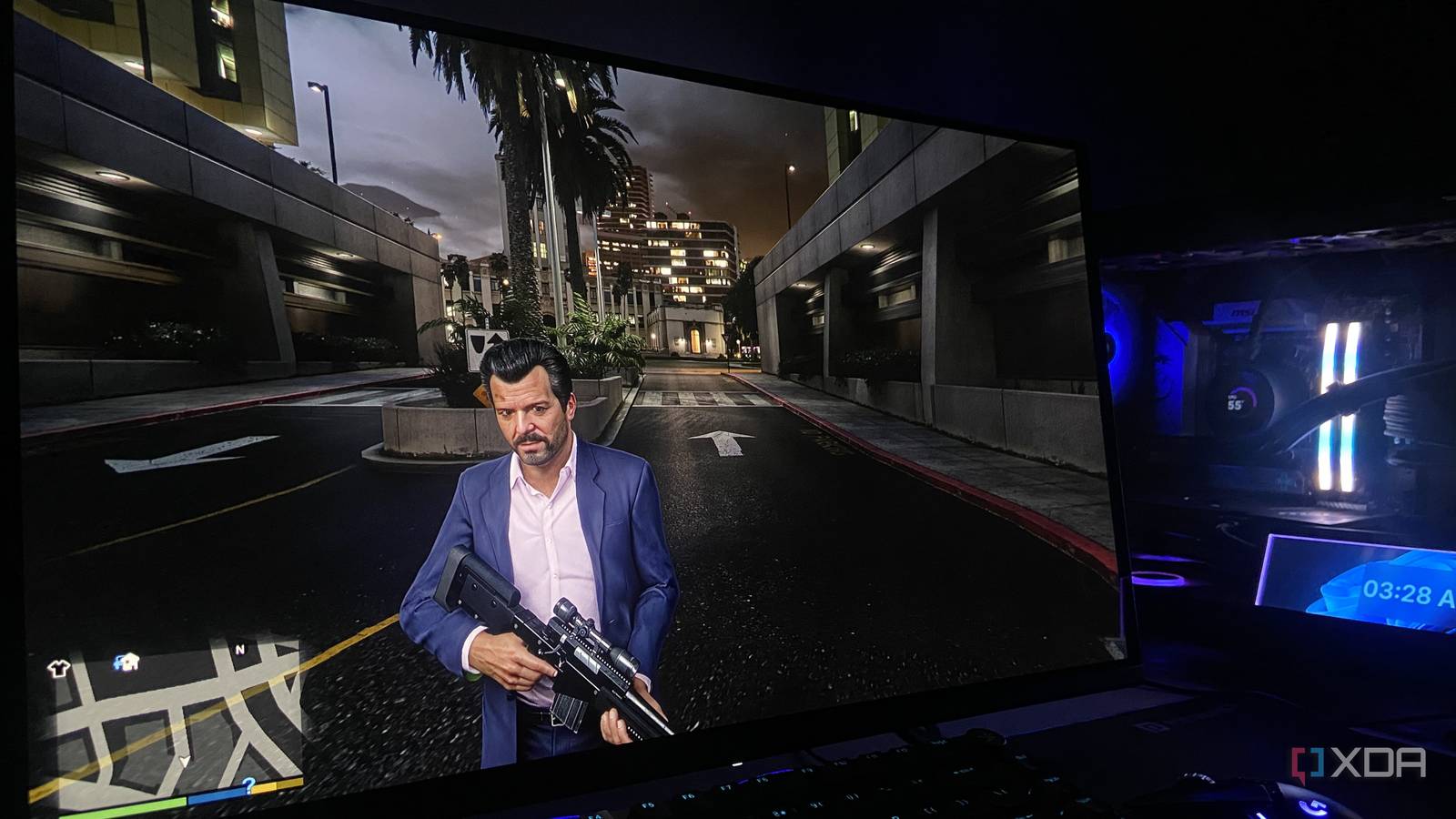
Published Sep 10, 2026, 12:01 PM EDT Abhinav pivoted from a career in banking to pursue his first love in writing. Even while working full-time, he continued contributing as an editor-at-large, a role he has held for more than 7 years. A lifelong tech enthusiast who has built three gaming and productivity powerhouse PCs since 2018, his passion for technology keeps him closely following the semiconductor industry, from NVIDIA and AMD to ARM. His MSc dissertation explored how artificial intelligence will reshape the future of work, reflecting his curiosity about the wider social impact of emerging technologies. A lot has been said about Nvidia's highly contentious DLSS 5, but very little has actually been seen, and even less has been benchmarked. After all, DLSS 5 was never originally supposed to come to my RTX 4070 Ti Super. And yet, it seems like it has arrived all the same, thanks to the efforts of the modding community. That got me thinking about what Team Green's latest generation of GeForce cards is really selling. My tests with a leaked build of Nvidia's latest release left me asking whether DLSS 5 could be worth using at all, even on hardware it's purpose-built for. Just how much of a case does neural rendering actually make for upgrading? The easiest way to find out was to put the build through three of my most beloved titles and see what Blackwell's latest party trick is, and if that's something my experience with gaming on Ada Lovelace is missing. The utility used in the following tests to run DLSS 5 Neural Rendering was rakanki911's DLSS 5 Swapper version 2.2.3, which is a community DLL-swapper that installs the leaked DLSS 5 files alongside RenoDX as well as ReShade. Accordingly, the results should be construed as indicative only as this configuration relies on a pre-release, unofficial build deployed through a third-party injection layer. Grand Theft Auto V Enhanced It came out on the Xbox 360 and PS3, and now it's here GTA V is more than a decade old. It launched in the year 2013 on the Xbox 360 and PlayStation 3. Two years later, it graced the PC in 2015, which was when most high-end builds were running the GTX 980 Ti, the fastest CPU you could get was the Intel Core i7-6700K, and RAM was... well, affordable. By all standards of measure, it's an ancient title in 2026, and yet, there's something almost miraculous that a variant of DLSS 5 does with it that makes you want to experience the streets of Los Santos all over again. There's an undeniable improvement to visual depth in the atmosphere, NPCs, and characters, a grounded sense of realism in weather effects (in this case, rain) and reflective surfaces. It is, however, the city in motion that truly sells it. Just like every other game that appears on this list, I tested GTA V on the same hardware consisting of my RTX 4070 Ti Super paired with a Ryzen 5 7600X and 32GB of DDR5-6000 at 1440p, with each title running its maximum graphics preset with ray tracing enabled. Frame generation and Smooth Motion were disabled to isolate the performance cost of the neural rendering pipeline. In performance, it is worth noting that all three NR presets landed well within 2 FPS of each other, suggesting that the preset has more bearing on visuals than on performance. It can be reasonably expected to experience a 36–38% average FPS cost and a further 31–36% hit on 1% lows regardless of which model is picked. Preset Average FPS 1% Low Avg FPS Δ 1% Low Δ Baseline 96 81 N/A N/A Model A 60 52 -37.5% -35.8% Model B 59 53 -38.5% -34.6% Model C 61 56 -36.5% -30.9% Hogwarts Legacy There's definitely magic here, and it's not coming from charms class Hogwarts Legacy is perhaps where I realized that getting accustomed to neural rendering, when it is eventually officially out for the 40-series, will make it hard to go back to native graphics. And sure enough, after a while, it felt almost unfair to the native presentation. Colors are richer without oversaturation, stonework, fine geometry, and wallpapers gained further depth, and character models appeared more true-to-life. When it comes to performance, the penalty narrowed compared to GTA V Enhanced, with average FPS dropping by 28–35% depending on the model picked. This time, however, the preset ranking flipped slightly, with Model A leading in both average FPS and 1% lows, with Model C being the worst offender in the latter. Preset Average FPS 1% Low Avg FPS Δ 1% Low Δ Baseline 81 64 N/A N/A Model A 58 45 -28.4% -29.7% Model B 53 45 -34.6% -29.7% Model C 56 40 -30.9% -37.5% Control But not my frame rates, not just yet Oddly enough, the same neural rendering pass came across as the most restrained of the three in Control, with effects that weren't nearly as hyperbolic in gameplay as they were in Hogwarts Legacy or GTA V Enhanced, likely because the title's already stylized art direction left a lot less room for added depth and saturation to amount to a huge difference. The clothing, hair, and other finer aspects of the model all accumulated and produced hyperrealistic visuals, which, I must concede, gives rise to the "uncanny valley" effect that was a major theme of the online discourse. These effects relating to tone and structure intensity, however, are user-adjustable with the DLSS 5 Swapper. Control produced the most consistent spread of the three, with average FPS falling 35–37% across every preset. Frame consistency took the hardest hit, though, with 1% lows dropping to as far as 44% under Model A, which is better avoided if visual smoothness matters to one. Other than that, the hit is mostly even across all presets. Preset Average FPS 1% Low Avg FPS Δ 1% Low Δ Baseline 57 54 N/A N/A Model A 37 30 -35.1% -44.4% Model B 36 31 -36.8% -42.6% Model C 36 35 -36.8% -35.2% I'm excited about neural rendering, and I can't believe I'm saying this Although the performance hit absolutely stings, and there's no two ways to go about it, the uplift in tone, depth, and the occasional uncanny hyperrealism are the most genuinely exciting thing I've seen a GPU feature do in a while. It's also worth keeping in mind how early this is, and the fact that all of this is just a leaked build running through a community swapper. Also, as someone with little to no qualms about using frame generation, I'd happily lean on it to reclaim some of what neural rendering costs.
I tested Nvidia's leaked DLSS 5 build on my RTX 40-series across 3 games, and it changed what I thought about neural rendering
Full Article
Original Source
Read the full article at Xda-developers →KhanList aggregates and links to publicly available news content. We do not host full articles from third-party sources. Always verify important information with original sources.