
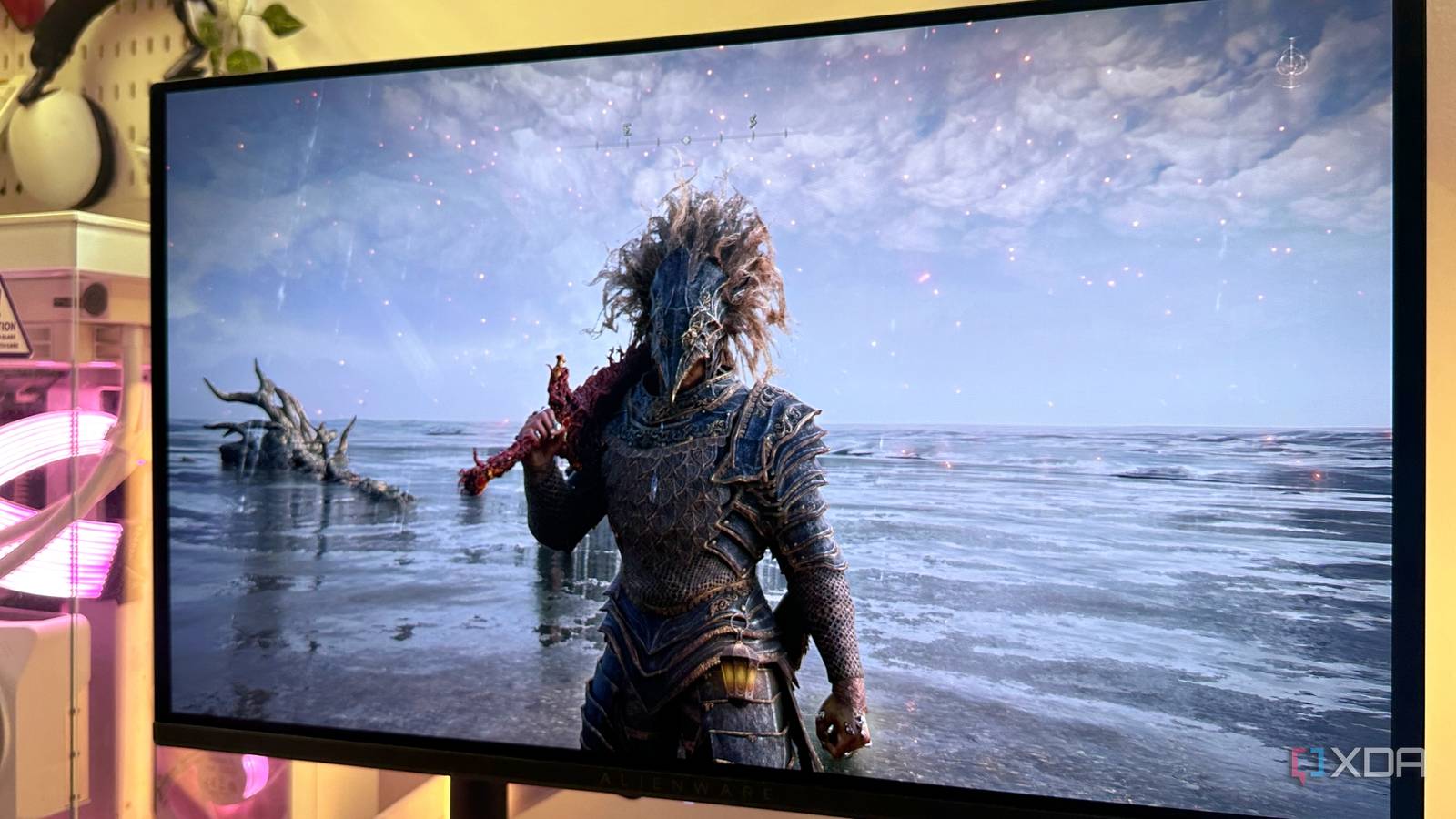
Published Sep 29, 2026, 12:00 PM EDT Gaming has been Samarveer’s greatest passion, and the Literature graduate in him takes immense joy in dissecting games for their themes, messages, and impact. Samarveer holds a deep appreciation of gaming, and considers the platform to be the most immersive and impactful across all media. He can be found engaging with gaming communities online, always ready to debate the finer points of ray tracing or itching to write an 8-page collegiate thesis on any game that impacts him emotionally. I've spent the better part of the last few weeks doing things with DLSS 5 that Nvidia probably never intended. I've shoved it into PS3 games, PS2 titles, over my entire desktop, and, of course, games that were never built with its neural rendering pipeline in mind. Through it all, everything I did only made it more fun to play around with DLSS 5. However, there's a difference between making something work and making it work well. The more games I force DLSS 5 into, the more I'm starting to wonder whether some games are actually better off without it. Sure, that might sound strange after everything I've written about DLSS 5 so far, but a few of my latest experiments have made that difficult to ignore. DLSS 5 isn't designed for every game Supporting it and forcing it are two different things DLSS 5 is still new enough that most games just aren't built around it — yet. There's no doubt that this will change, but right now, a game having official DLSS 5 support means far more than it merely shipping with a new DLL in its installation folder. What native support truly entails is that the developer integrated the technology into the game's rendering pipeline from the very beginning. This is what ensures that the neural rendering has access to the data from the development process itself. After all, DLSS 5 isn't just another upscaler. Its neural rendering makes decisions about how the final image should look, which means the game needs to provide the right information for those decisions to make sense. A developer can therefore build DLSS 5 into the game's rendering pipeline instead of asking it to make sense of an image it wasn't prepared to understand. Workarounds can make a game technically compatible with DLSS 5, but it can't make the game's art direction compatible with it. Obviously, OptiScaler and ReShade have been throwing that distinction out the window, and rather hilariously at that. If a game uses Vulkan or OpenGL rendering, or even exposes compatible DLSS-era infrastructure (through DLSS 4.5), OptiScaler can simply intercept that pipeline and replace the existing rendering path with DLSS 5's neural rendering. That's how a game that wasn't "designed for DLSS 5" can run it anyway. Sure, OptiScaler can make a game technically compatible with DLSS 5, but it can't make the game's art direction compatible with it — a game that simply wasn't ideated, storyboarded, and crafted with neural rendering passes in mind might look "prettier" or "cleaner," but it won't ever gel with DLSS 5 like a natively-built title would. Forcing DLSS 5 into three games gave me bizarre results Prettier really doesn't mean better Elden Ring was the first game where I genuinely understood the problem. For starters, the game never shipped with upscaling support, so I had to inject DLSS 5 into it using ReShade instead of OptiScaler. FromSoftware's world of The Lands Between is already breathtaking, and DLSS 5 only made it cleaner and more refined. I could absolutely appreciate that, but the problem was that it came at a pretty heavy cost for my RTX 4070 Ti. Each one of my 150+ hours in Elden Ring was experienced at the Maximum graphics preset with Ray-Tracing, along with Smooth Motion giving me a steady 120 FPS. With DLSS 5 active, I could only get around 40 FPS, and at that point, I was only negotiating with my GPU for power instead of the image for its quality. Each Neural Rendering pass with DLSS 5 consumed roughly 1.2 GB of VRAM. Black Myth: Wukong was even stranger because there was barely anything to celebrate. The foliage looked broadly the same, the environments retained the familiar UE5 presentation, and I couldn't find the kind of dramatic transformation that would make me fawn over the neural rendering. What did change, though, was my framerate, which dropped from the usual 119 FPS to 54 FPS. For an image that looked almost identical, that performance hit simply wasn't worth the effort. The most interesting of the three was Cyberpunk 2077, though. Faces gained an almost uncanny level of additional detail, but Night City's neon-lit streets, reflective cars, and rain-slick sidewalks lost some of their character. Everything looked a little more washed out, and the game somehow felt less like a game. That's the problem with forcing a rendering technique into a game that wasn't built around it. The technology doesn't understand that some visual imperfections are deliberate, that some softness is atmospheric, or that a neon reflection isn't merely noise waiting to be reconstructed. The performance hit isn't actually the problem DLSS 5 can be made faster, but that's not enough Since it's the beefy RTX 5080 and RTX 5090 cards that have been taking over the internet with their DLSS 5 showcases, I had assumed that the performance hit alone would be enough to make me walk away from this experiment. OptiScaler, though, has a rather clever workaround where it applies DLSS 5's neural rendering layer before Super Resolution. This lets me effectively halve the full cost at the final output resolution, giving me 60+ FPS even with Neural Rendering on at 1440p. Clearly, if OptiScaler's developers are finding ways to make DLSS 5 faster, so will Nvidia, and just a couple of years from now, DLSS 5 is going to be running incredibly smoothly on budget cards, too. The harder problem to solve, however, is what happens when the game is running perfectly well and I still don't want the result. Cyberpunk 2077 doesn't regain its neon-soaked character because I found another 10 FPS. DLSS 5's biggest limitation isn't that it costs too much. It's that sometimes, the original image was already exactly what the game wanted it to be. OptiScaler Maybe I was asking the wrong question Way too many people today, including myself, are trying to find ways to put DLSS 5 into games that I rarely stopped to ask whether those games actually needed it. PC gaming has trained us to treat every new rendering technique like another box that needs ticking or another setting that should be pushed as high as possible simply because the hardware lets us. But there's something wonderfully liberating about finding a game where the correct graphics setting is the one that leaves its original image completely alone. Bottom line: every jagged edge doesn't need reconstructing, and every face doesn't need another layer of detail over it.
I tested DLSS 5 on games it wasn't designed for, and the results proved some visuals are already perfect
Full Article
Original Source
Read the full article at Xda-developers →KhanList aggregates and links to publicly available news content. We do not host full articles from third-party sources. Always verify important information with original sources.