
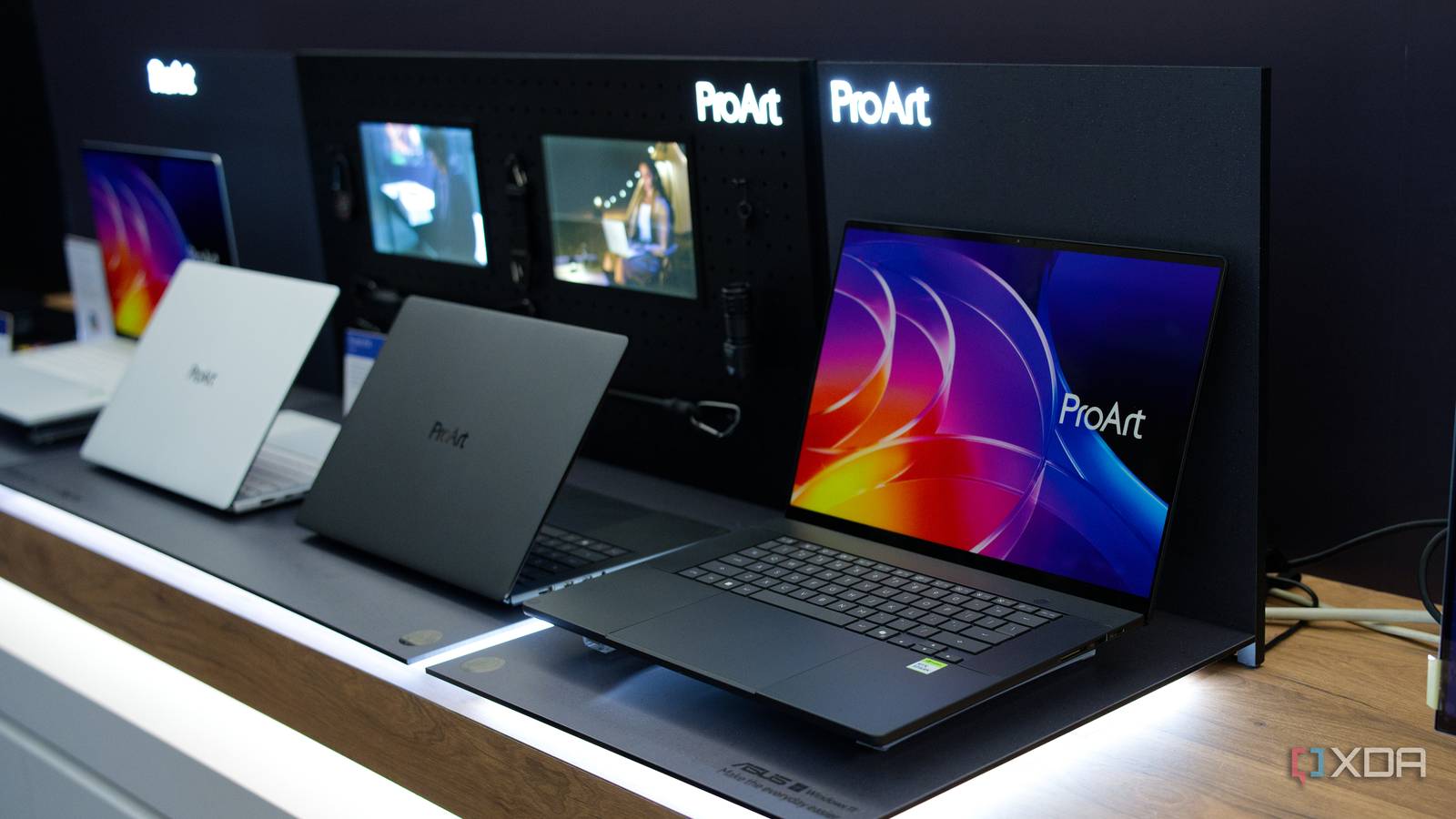
Published Oct 11, 2026, 7:00 AM EDT Holding a degree in Computer Engineering, Rayan is an avid PC hardware enthusiast. Having built his first computer during the pandemic, he's been hooked on the hobby ever since. His greatest passion is getting the most value out of every dollar, whether building a PC for gaming or tailoring one to another use case. He spends much of his time researching and testing new ways to maximize that value, then shares his findings through his writing. 2026 has been one of the driest years for new hardware launches in recent memory. Although AMD and Intel released some new CPUs, they were all simple refreshes, using the same architecture as existing products. On the other hand, Nvidia's highly anticipated RTX 5000 Super series refresh never panned out because the 3GB modules it would have used were ludicrously expensive. Amid all this, I've been looking for an excuse to get excited about hardware again, and one finally arrived in June with the Computex reveal of Nvidia's RTX Spark laptops. These laptops will use the same N1X chip as the DGX Spark platform, which combines an ARM CPU (developed by MediaTek) with an Nvidia GPU about the size of an RTX 5070. RTX Spark finally brings Nvidia's mega APU to laptops N1X gets the form factor it always deserved Although RTX Spark marks the wider consumer release of the N1X chip, it isn't the first implementation, as mentioned above. In January 2025, Nvidia announced Project DIGITS, billed as the "personal AI supercomputer" that can sit on your desk. Nvidia later renamed Project DIGITS to DGX Spark, its term for the family of mini PCs using the N1X chip, and launched them in October 2025. Because DGX Spark ships with Ubuntu, it offers limited gaming support and relies heavily on community hacks and patches. As such, it isn't geared toward the average consumer; instead, it finds a niche among local AI enthusiasts, developers, and researchers. In contrast, RTX Spark laptops support Windows, with big improvements to the Windows on Arm experience already shipping. Laptops also feel like a much more natural form factor for N1X: while a mini PC stays plugged into a wall, a portable device can highlight the efficiency advantage of a tightly integrated, ARM-based SoC. RTX Spark delays actually work in Nvidia's favor Launching with DLSS 5 is a great strategy All in all, I'm much more excited about RTX Spark laptops than I was for DGX Spark mini PCs. The only thing that's tempered my excitement has been the long rollout; we've been hearing rumors about N1X since 2023, and the CPU portion is based on an architecture launched in 2024. AMD's competing solution, Strix Halo, has been available in laptops since March 2025, showing how much extra work it took to get N1X ready for Windows laptops. However, in some respects, this delayed launch actually favors Nvidia. Given that AMD's Strix Halo SoC uses x86 CPU cores, it has an inherent performance and compatibility advantage over N1X for gaming. Even though it gets outclassed in graphics — N1X uses Nvidia's latest Blackwell architecture, while Strix Halo runs on AMD's dated RDNA 3.5 — the performance penalty in games without a native ARM build means it'll be an uphill battle for Nvidia. By pushing the launch back, Nvidia has bought itself time to improve compatibility and performance, working with Microsoft to ship improvements to Prism (the emulator for running x86 programs on ARM). Another area where delaying RTX Spark has given Nvidia an advantage: these laptops will launch alongside DLSS 5. This makes the value equation for gamers shopping between an RTX Spark laptop and a Strix Halo laptop much more interesting: the Strix Halo laptop will generally perform better in games thanks to its x86 CPU, but you're giving up DLSS 5, which could be revolutionary for graphics. Of course, this is purely theoretical for now, since we don't know how well DLSS 5 will run on DGX Spark, or whether it'll even be worth the performance hit. Early DLSS 5 tests on DGX Spark show playable performance Take these unofficial numbers with a grain of salt Given all this, DLSS 5 performance on RTX Spark laptops will be a key factor in whether these machines succeed as general-use devices. That's why I decided to load up Cyberpunk 2077 on a DGX Spark — namely, the ASUS Ascent GX10 Mini PC variant — and inject the modded DLSS 5 files into the game. I pointed Codex to the game directory, gave it the patched .dll files required, and after 30 minutes came back to Cyberpunk 2077 running with DLSS 5 through Optiscaler. Using Proton 10 — the translation layer that lets Windows games run on Linux — along with FEX, the fast x86 emulator for ARM machines, I got around 34 FPS in Cyberpunk 2077 at 1440p with the RT Ultra preset and DLSS 4.5 Balanced. Although that's definitely lower than expected given the N1X chip specs in DGX Spark, keep in mind this is about as far from a native build as you can get, and RTX Spark devices should perform better because they run Windows. When enabling DLSS 5, performance drops from 34FPS to 22FPS, which is only a 35% reduction. Given this implementation's unofficial nature and the complete lack of gaming optimization on DGX Spark, I think Nvidia might be able to coax a 60FPS experience with DLSS 5 out of the RTX Spark. DLSS 5 might be the key to victory for RTX Spark devices A key advantage against stiff competition Now that we know pricing on RTX Spark laptops, it's become clear that AMD has a solid price advantage here. If we compare ASUS' laptops, you'll pay $2,031 for an ROG Flow Z13 with the Ryzen AI MAX+ 395 and 32GB RAM; on the Nvidia camp, you'll have to fork over a whopping $3,099 for the ProArt P14, an RTX Spark laptop with 32 GB RAM and only 512GB of storage (half that of the Flow Z13). Consider also that the AMD system is x86-based, which generally means better compatibility and performance in games. Of course, the RTX Spark system has its own advantages: support for Nvidia's full suite of DLSS technology, superior RT and path tracing performance, and CUDA support. The Strix Halo system, being RDNA 3.5-based, technically doesn't even support FSR 4.1 (though it's generally enabled in AMD's Adrenalin driver, with exceptions in certain games), not to mention its lackluster RT performance. While these are important considerations, I think Nvidia's real advantage here is support for DLSS 5, which could be truly transformative for gaming.
I tested DLSS 5 on a DGX Spark, and it showed me the future is bright for Nvidia's first laptop
Full Article
Original Source
Read the full article at Xda-developers →KhanList aggregates and links to publicly available news content. We do not host full articles from third-party sources. Always verify important information with original sources.