
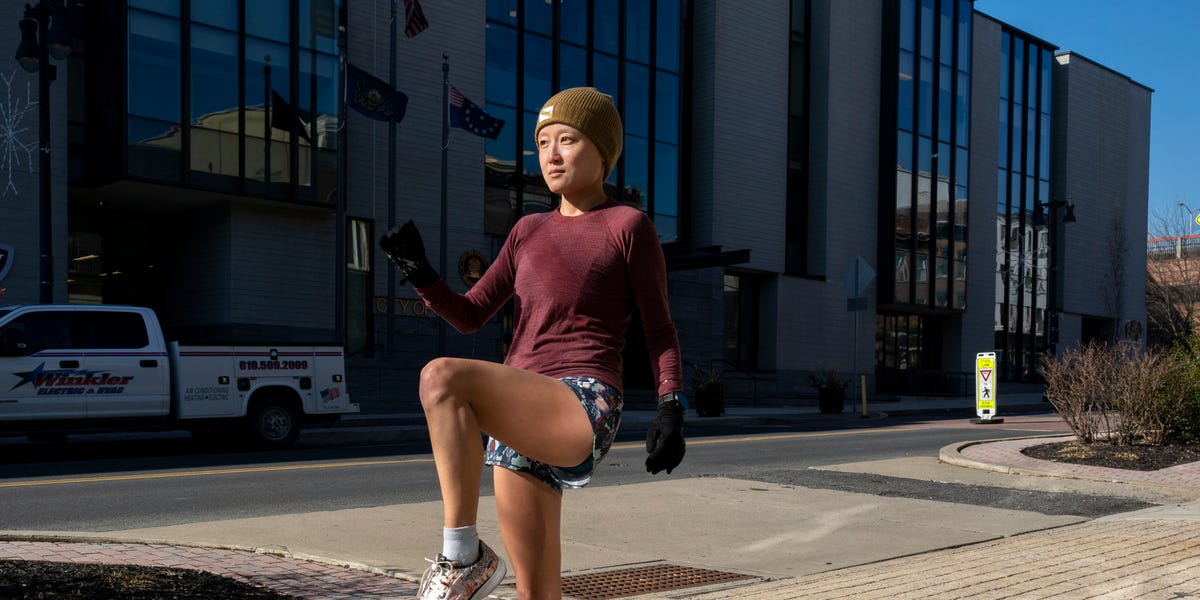
Most physical therapists and sports medicine doctors use the analogy of a train jumping its track to describe what causes runner’s knee pain. Typically, the cause of classic runner’s knee is poor mechanics and form issues, which is a way of saying the cause of the pain is forcing the “train” off its intended “track.” Research shows, however, that sometimes there are other reasons for that annoying knee pain.In fact, if you’re a woman or if you have flat feet, you will be more likely to develop runner’s knee. Guess what? I’m both, and yes, I had—and solved—knee pain.Unfair? Definitely. Fixable? Yes, in a way. Runners can do as I did and respond to both of these situations so that knee pain does not limit their running, and the solutions are not that complicated or time-consuming if you know what to do. However, they are nonnegotiable because even if you don’t currently have knee pain, you’ll want to protect yourself against it in the future.In my own case, exercise and different running shoes made all the difference, and I now run without ever worrying about my knees.🏃🏻♀️ Recognize symptoms, recover safely, and build strength to prevent setbacks with the Runner’s World Guide to Common Running Injuries.Why Women Are More Prone to Runner’s KneeIt has long been known that because women have wider hips in relation to the width of their knees, i.e., the angle (called “Q”) from the hip to the knee, that they are more prone to knee pain. However, the researchers who wrote a 2018 article in Orthopedic Reviews found that females with patellofemoral pain syndrome, i.e., runner’s knee, “demonstrate a decrease in abduction, external rotation and extension strength of the affected side compared with healthy patients.”In other words, it’s not the angle itself that causes the problem, but the lack of flexibility, strength, and mobility, specifically, between their “vastus medialis” (inner front thigh) and lateralis (outer thigh). This may develop because having wider-set hips affects the angle at which these muscles support (or don’t support) the knee.Women are also more prone to issues with their ligaments, which are the flexible bands of tissue that connect bones to one another. Estrogen, the primary female hormone, can make a woman’s ligaments more flexible, which decreases the level of strength and stability to your knees, especially since you are already being affected by the “Q” angle.What Women With Runner’s Knee Need to DoThe solution? Strengthening all of the thigh muscles and stretching the iliotibial (IT) band, a tendon that attaches from the hip to the outer side of the knee. When tight, it can become inflamed and painful, which sometimes shows up as knee pain.I’m a big fan of the curve of my hips, and so wouldn’t trade my Q angle for knees that are built for running. However, I did become a regular “knee exercises” fan, especially to strengthen my quads and inner and outer thighs. I absolutely think these moves are the ones that have helped me over the last couple of years. Just don’t stop doing them once the pain is gone! This is a lifetime solution, not a temporary one.Some helpful exercises for prehab and rehab:Forearm Side Plank With Clamshell Trevor RaabLie on left side with left forearm on the ground and right hand on right hip. Bend both knees 90 degrees with hips about 45 degrees. Stack hips, knees, and feet on top of each other.Lift hips as high as possible without bending at waist, and keeping bottom knee on ground, creating a straight line from shoulders to hips for a modified side plank.Open right knee, rotating through the right hip to lift knee toward ceiling. Glutes should engage.Lower leg, but stay in plank position.Do 10 reps then switch sides. Do two sets on each side. Inner Thigh Leg LiftAmber ReesLie on right side, right palm propping up head and left palm on floor in front of chest for stability. Keeping hips stacked, cross left leg over right, bend knee, and plant left foot on ground in front of right knee. This is the start position. Keep right leg straight and foot flexed to lift leg without compromising form or balance. Lower with control to start position. Do 10 reps then switch sides. Do two sets on each side. Trevor RaabStand with feet hip-width apart, holding a dumbbell in right hand. Bring the arm with the weight above the head, keeping shoulders down and back, chest tall.Step back with right foot, bending both knees about 90 degrees. Front right knee should track over toes and back left knee should hover just off the floor.Push down with the left foot to bring the right leg back to the start position. Repeat for 10 reps each side.Do two sets. Got Flat Feet? You May Develop Knee PainAccording to research, people with flat feet are much more likely to develop knee pain, and, let’s face it, you can’t change your feet. Fortunately, you can change your shoes. This is why most physical therapists and sports doctors ask runners to see them in their shoes. Runners with flat feet need rigid arch support and, possibly, a custom shoe or orthotics.How to tell if you have flat feet? The wet foot test: Step into a shallow pan of water and then step onto a piece of paper (one foot at a time, but do it with both feet).If the arch of your footprint is filled in, your foot likely collapses in when you run, which may affect your knees, creating an injury.Typically, runners with flat feet benefit from stability shoes, which have internal wedges and more substantial midsoles to support the arch.One more thing about shoes if you have flat feet: it’s not how much money you spend on the shoes, but how frequently you rotate and replace them. You need a new pair at least every six months (maybe more if you do a lot of miles).You may notice, as I did, that when I switched from cushioned to stability shoes my Achilles tendon didn’t like the change. It did help me to make my transition gradual by alternating my shoes for a few weeks. Now, though, I solely use stability shoes and while I first missed the bounce that older shoes offered, I have adjusted my running and don’t need the added push-off that I felt from my previous shoes.The Bottom LineThe important thing to know is that if you have knee pain, the underlying cause may not be your knee, but another part of your anatomy. Having a specialist, such as a physical therapist, watch you run is a good first step—pun intended—to fixing the problem, not the symptom.Donna Raskin has had a long career as a health and fitness writer and editor of books and magazine articles. A certified run coach who has practiced yoga for many years, she also loves to lift weights, dance, and go for long walks with her hound dog, Dolly.
I Solved My Runner’s Knee After Discovering Two Risk Factors I Couldn’t Change
Full Article
Original Source
Read the full article at Runnersworld →KhanList aggregates and links to publicly available news content. We do not host full articles from third-party sources. Always verify important information with original sources.