
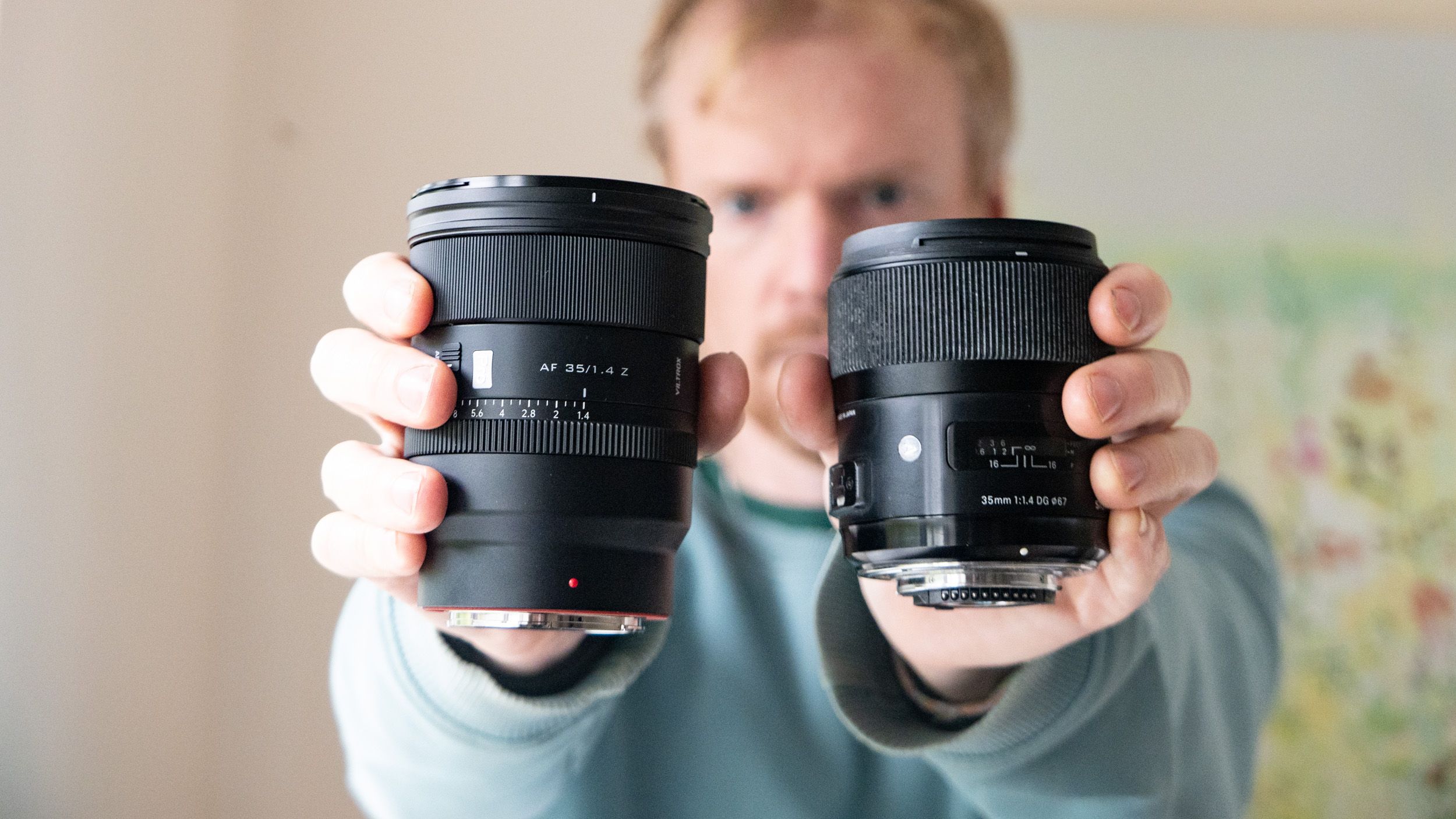
(Image credit: Tim Coleman) If I was to pinpoint one special lens in my photography career, it would have to be the Sigma 35mm f/1.4 DG HSM Art for Nikon F-mount.I picked mine up just before I moved to East Africa where I would work in photo journalism. Sigma had just burst onto the scene with its new ‘Art’ lens in 2012, for a much lower price than Nikon’s proprietary 35mm f/1.4 for its DSLRs, and so I bought one to pair with my Nikon D800 camera.Over four memorable years living in Kenya and travelling the region and neighbouring countries, I estimate that I took more than 75% of my photos with this one lens, many my all-time favorites of people in their environment.More recently, I switched to a mirrorless camera made by the same company — the Z-mount Nikon Z6 II, which has been updated with the Z6 III but remains my primary camera.Viltrox then offered a review sample of its shiny new AF 35mm F1.4 Pro lens, which was unveiled this week in Nikon Z-mount and Sony E-mount versions, but with no word on an L-mount version yet. I’ve already tested Viltrox’s pricier 35mm F1.2 from its flagship ‘Lab’ series, but the latest f/1.4 pro is a specs match to my old lens, so I was keen to see how the two compared.I tried both lenses in various scenarios, shooting like-for-like photos with them using the Z6 II camera (the Sigma lens attached via the Nikon F-mount to Z-mount adapter).Along the way I was asking myself — is mirrorless all that it’s cracked up to be, or could I happily continue with my decade-old-and-more DSLR optic? Here’s what I learned.Sign up for breaking news, reviews, opinion, top tech deals, and more. Image 1 of 4 The adapter (left), Sigma lens (middle) and Viltrox lens (right) (Image credit: Tim Coleman) Handling of each lensI'll start with handling, and Sigma’s lens by itself is physically smaller than Viltrox’s. However, the necessary F-mount to Z-mount adapter to use it with my Z6 II adds bulk and evens matters out.And if I were to use the Sigma lens with my D800 DSLR, well, that's a much bigger camera than the Z6 II. The adapter essentially addresses flange depth (the distance between the camera sensor and the rear of the lens — which is deeper in Nikon's F-mount), while maintaining full autofocus performance.As such, there was no real size or weight advantage to either lens, whatever camera system was used. Nikon also has an affordable 35mm f/1.4 Z-mount lens, mind you, which is smaller than both of these lenses, but in my experience it doesn't match the quality of either lens here.My Sigma lens has taken a beating over its almost 15 years of use in harsh conditions, and it's still going strong. Sure, it looks well-used, but it performs like it did on day one. I wouldn't hold the same hope for the Viltrox lens, aesthetically speaking, at least. It's one of the many Viltrox lenses that I've tested with an exterior that scratches easily. That doesn't affect optical quality, but it did make me mindful of taking care of the lens.Autofocus is a fraction snappier and smoother with the Viltrox lens, but not enough of a reason alone to opt for it. I don't believe that using an F-mount lens through the adapter with a Z-mount mirrorless camera has any adverse affect on autofocus performance. Image 1 of 8 The focus distance in this scene, shot at f/1.4, is fairly close (Image credit: Tim Coleman) Optical quality: any obvious progress?I regularly want to make use of the bright maximum f/1.4 aperture with a lens such as these, in order to decrease depth of field and blur surroundings so that my subjects standout, and for working in dim light with no supplementary lighting. It’s at this setting in particular that the differences in optical quality between the two lenses are acute.The Viltrox lens is optically sharper at f/1.4. Not by much, I must say, and you won't necessarily see the difference even when viewed on a laptop — I'd still class the Sigma lens as very sharp. However, when pixel peeping, the difference is there.And it's when pixel peeping that chromatic aberration (CA) in the Sigma is way more pronounced. The Viltrox lens isn't immune to it, but it handles the distortion much better. The Sigma lens shows longitudinal chromatic aberration (LoCA) at times, too — a lens distortion that is harder to correct. I expected vignetting (where corners are darker) to be worse in the Sigma lens, but in reality performance was roughly on par. Image 1 of 5 Another f/1.4 photo in a good test for bokeh (Image credit: Tim Coleman) Check out my round-up of the best Nikon Z-mount lensesAnd what about bokeh (the out-of-focus quality, typically observed in dappled light)? From my sample images, I'd have to say it's a tie. Both lenses can render buttery smooth bokeh, with similar characteristics; roundish in the center of the frame, becoming slightly more cats-eye in shape towards the corners.The optical quality observations above are made with the lens aperture wide open at f/1.4. In all the situations above, I took sequences at f/1.4, f/1.8, f/2, f/2.8, f/4 and f/5.6 and compared the differences.Stop aperture down to, say, f/4 and f/5.6, and most of the above differences are negligible; sharpness evens out, and lens distortions reduce — only does chromatic aberration remain more pronounced in the Sigma. I've included closeups of images shot at f/5.6 which prove how the quality evens out, below. Image 1 of 4 Viltrox at f/5.6 (Image credit: Tim Coleman) (Image credit: Tim Coleman)Viltrox AF 35mm F1.4 Pro vs Sigma 35mm f/1.4 DG HSM Art: the bottom lineFor photographers, there is surprisingly little to choose between what is an excellent Viltrox AF 35mm F1.4 Pro lens and the 15-year-old Sigma 35mm f/1.4 DG HSM Art.Optical quality differences are more acute at f/1.4; with aperture at its maximum setting, the Viltrox lens is slightly sharper and handles chromatic aberration better. However, you'll only really spot those differences when pixel peeping, and closing down each lens to f/4 and lower, the end results level out.Bokeh is essentially the same in both lenses, although there's a touch of LoCA in the Sigma lens in certain backlit scenarios.The Viltrox AF 35mm F1.4 Pro joins a growing list of lenses from the Chinese company that I can highly recommend. However, comparing it to a 15-year-old Sigma legend, that's designed for a mostly discontinued camera system, has only shown me that DSLRs and their best optics are still a decent option today. I for one will happily continue using my Sigma lens for photography.Follow TechRadar on Google News and add us as a preferred source to get our expert news, reviews, and opinion in your feeds. Tim joined the TechRadar team as Cameras Editor in 2023 and has enjoyed more than 15 years as a tech journalist specializing in camera gear. He's previously worked at Amateur Photographer, for a photo accessory manufacturer and as a freelance photographer and video producer, with clients including Studio 44 and Canon. He also started a media team in Nairobi, Kenya, where he lived for a few years volunteering for a faith-based organisation. Tim is married, father of three children, and loves being active, primarily running since hanging up his football boots.
I shot the same scenes with a pro Viltrox prime lens and a DSLR icon — can you spot the difference?
Full Article
Original Source
Read the full article at Techradar →KhanList aggregates and links to publicly available news content. We do not host full articles from third-party sources. Always verify important information with original sources.