
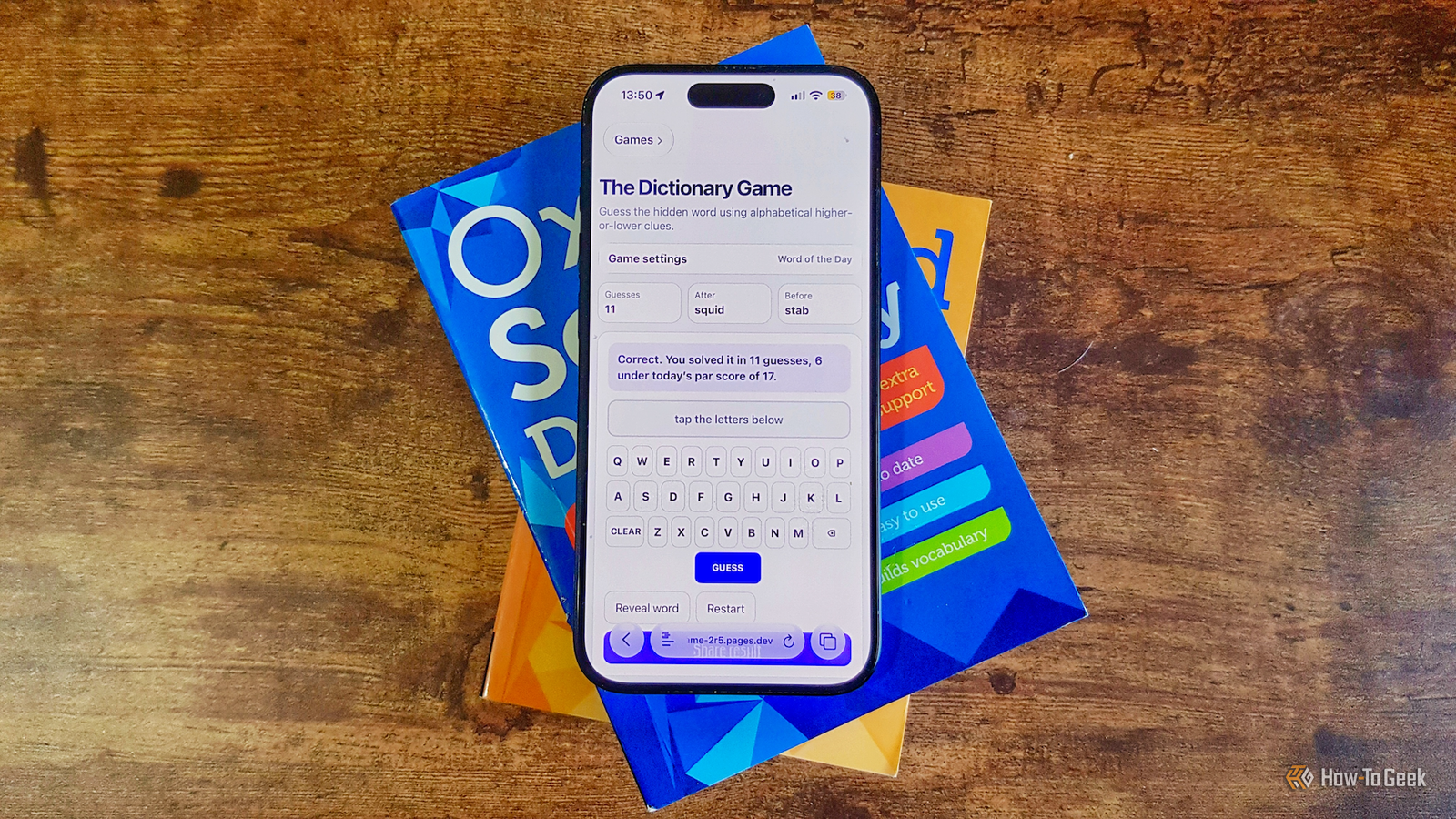
Published Nov 6, 2026, 5:01 PM EST Adam has a degree in Engineering and has a life-long interest in technology. He has been writing for over a decade for various print and online publications, with a focus on consumer tech. He joined How-To Geek in 2024 while working at Pocket-lint. As well as being a long-term fan of Apple products, he also has a strong interest in smart home tech, running a Home Assistant server at home to automate all his smart home devices. He believes that the ideal smart home should work with minimal interaction from the user, with automations running as if by magic rather than requiring you to push buttons on a control panel. You can find more of his work on Muck Rack. There are several puzzles that I complete each morning over breakfast, including Connections and the Guardian crossword. Wordle used to be part of that list, but I grew bored with it. I decided to see if I could vibe-code my own game based on a simple word game I'd made up back in college. I used to be a Wordle obsessive I would play multiple variations per day When Wordle first burst onto the scene, it felt like everyone was playing it. I became a little bit obsessed, and each morning I would play the classic Wordle, along with harder versions such as Quordle and Octordle. I eventually got bored with them, and now the only variant I still play is Hardle, which is a combination of Wordle and the classic peg-based game Mastermind. I wanted something to fill the Wordle-shaped hole in my breakfast routine, and I remembered a game I made up in college. It's incredibly simple. One person thinks of a word, and the other players try to guess what the word is. After each guess, they're told whether the word they're trying to find is higher or lower in the dictionary than their guess. If the word is "monkey" and they guess "horse," then they're told that the answer is higher. Considering that the target word can be any word at all, you can get to the target surprisingly quickly if you guess sensibly. It's a simple idea, but it's surprisingly fun to play. I wondered if I could get ChatGPT to build me a version of the game that you could play online, just like Wordle. Five minutes was enough to make my game playable Turning the idea into a website was easier than I imagined I was sure that an AI chatbot would be able to build the game, as the concept is fairly simple, but I was interested to see how it would handle some of the challenges. I was expecting the first version to be pretty rough and require a lot of changes. I used GPT-6 Sol in Codex, explained the rules, and asked if it would be able to build a web app of the game. It came back immediately with a concept for the game that included a daily challenge mode and a host mode when one person enters the word to find, and the other person uses the app to try to guess it. I asked it to build the idea and make it playable in a browser, and in just a couple of minutes it had generated the necessary files. I took the game for a spin, and it worked almost exactly as I imagined. Codex had even created a way to share your score on the daily challenge game by automatically saving your score to the clipboard along with a series of arrow emojis showing whether your guesses resulted in a higher or lower response, which you can then paste into a chat. Choosing the right word lists was the hardest part I had to remove some offensive words from the daily answers The initial result was far better than I'd expected, but it wasn't perfect. I had fewer than 100 possible answers divided into Easy, Medium, and Hard, and you could type a random string of letters as your guess, and it would be accepted, which wasn't in the spirit of the original game. The first fix was to add a large dictionary for checking guesses, but the first option Codex used included a lot of typos, so words such as "disscussive" were accepted as real words. After discussion, it ended up adding SCOWL level 85, a broad spellchecker list of just over 250,000 words that includes words commonly used in word games, but missing some more obscure words. The second fix was to build a separate list for the daily challenge words. This is based on the SUBTLEX-US list, which includes word frequency data from movie and TV subtitles. The daily challenge list uses words with a count of at least 20 appearances in SUBTLEX-US, and removes words with different UK/US spellings and any potentially offensive words. There's no limit on how long the word of the day can be, and it includes plurals and variations of the same root word to make it as close as possible to "anything from the dictionary." My friends and family are hooked The game is incredibly simple, but also very addictive, and you're welcome to give it a try. I shared it with a few friends and family members, and people soon started playing it every day. We now have a WhatsApp group where everyone posts their scores every day to see who's got the word in the fewest guesses. There's even a separate WhatsApp community set up for discussing the game and the word of the day without giving it away in the main group chat. One friend has become completely obsessed to the point that his wife describes him as having "gone even more wrong." He has been logging the scores of every player and producing charts and tables of statistics. You can see which players have the highest difference from the average, the average scores per month, and even how many times people have managed to become part of the legendary Single Digits Club, in which you guess the word in fewer than 10 guesses. The whole game runs locally on your device, and you can see stats showing how you did on previous days and the length of your streak. The Dictionary Game is now the first game I play as part of my morning puzzle routine. All it took was an idea, an AI chatbot, and a little tweaking. Vibe-coding doesn't always have to create slop There is an enormous amount of AI slop out there. Vibe-coding has enabled anyone with access to a chatbot to build apps and other software, and a lot of it really is bad. This game was completely vibe-coded, but the result is something I find genuinely enjoyable to play. Some may still consider it slop, but there's a whole group of people who are thoroughly enjoying a game that was written entirely by AI.
I replaced my Wordle addiction with a game I vibe-coded in five minutes
Full Article
Original Source
Read the full article at Howtogeek →KhanList aggregates and links to publicly available news content. We do not host full articles from third-party sources. Always verify important information with original sources.