
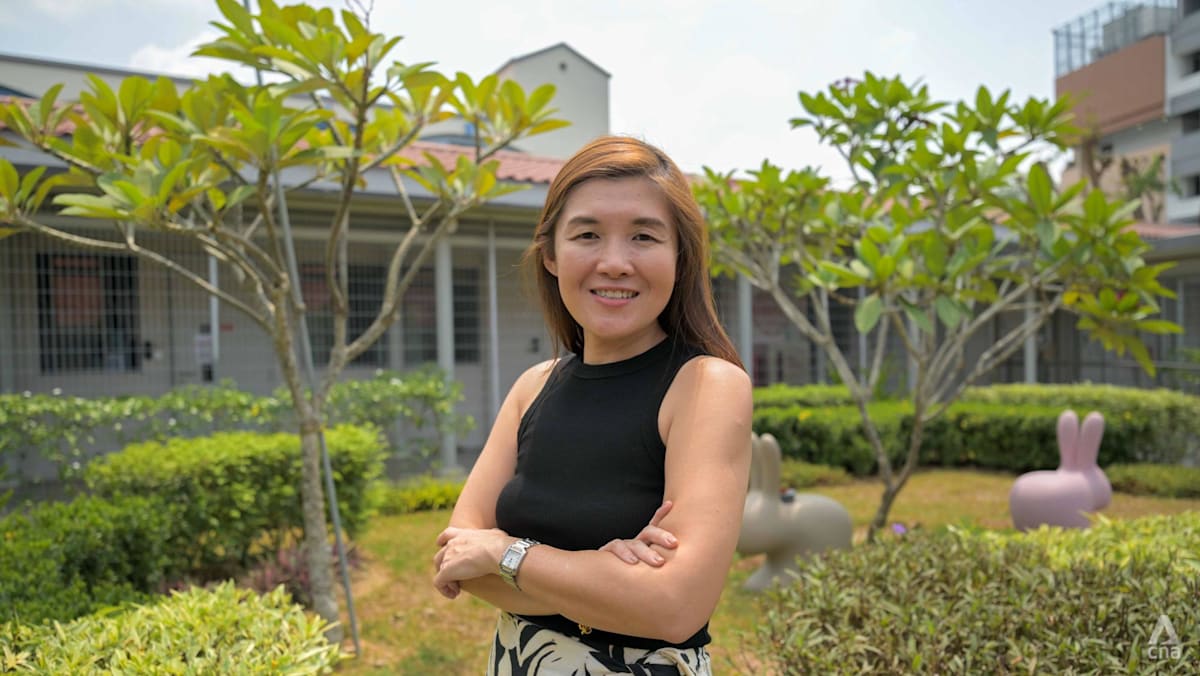
In 2002, Ms Valerie Wong, then 19, was an intern at a banking institution in the central business district. She was earning S$700 (US$548) a month, more than many of her peers received for similar internships and attachments at the time. It was a "fancy pants" job at an office near Millenia Walk, one that put her in the same league as well-dressed office workers who patronised expensive gyms and dining establishments.It was on the pathway to everything she had ever wanted. It was also the "most dreadful month" of her life. Ms Wong, now 43, had chosen to study finance in a bid to make her family proud. She was pursuing a polytechnic diploma in banking and finance at the time. But she recalls sitting alone during lunch hours at her internship thinking: "This is what I've been asking to do … How come I feel so disconnected?" Ms Wong is now on a very different path as the head of HCSA Dayspring, a therapeutic group home in Potong Pasir for teenage girls who have suffered complex trauma, abuse or neglect. When I visit on a weekday afternoon, Dayspring is quiet. Most of its 20 or so residents – all girls aged 12 to 18 – had not yet returned from school, explained Ms Wong. She led me to a garden that filled out the foyer, with a lemon tree and an orange swing. Next to those, she pointed out a time capsule marking Singapore's 60th birthday, filled with 60 letters of well-wishes for trauma survivors. From the way Ms Wong lights up when she talks about her work rehabilitating teen girls who have suffered complex trauma, it's clear that she's proud of the path she's on now as a mental health practitioner. But while many may praise her for these endeavours, her choice of career wasn't always received with unabashed support – especially, and perhaps most surprisingly, from her own family.When I asked whether her parents were initially on board with her pivot from finance to psychology, Ms Wong laughed and answered quickly: "No way.""My parents were business people. They always had this thought: 'You study (psychology) because it's your interest'." Despite her parents' initial objection to pursuing a career in mental health, Ms Wong went on to pursue higher education in psychology in Australia and eventually became a counselling psychologist. HCSA Dayspring on Aug 25, 2026. (Photo: CNA/Lim Li Ting) STUDYING TO BE A PSYCHOLOGIST As a child, Ms Wong and her younger sister grew up largely in the care of their grandmother as both their parents were working – including her father, who was often busy at his business seven days a week. Having observed members of her extended family undertaking all sorts of careers, from church workers to nurses and business owners, she was initially torn on what path to follow. Ms Wong has a distinct memory of sitting at a big table with her relatives shortly after completing her O-Level exams, with everyone discussing what she should pursue next. "Somebody who's in marketing would say: 'This is the best'. Someone whose brother was in engineering would say engineering is the best," she recalled.She eventually settled on banking and finance, which sounded safe and practical. But at 17, she witnessed a schoolmate – who was grappling with depression – abruptly disappear from classes and meet-ups with friends. Ms Wong recalls herself and her friends spending anywhere from 20 minutes to half a day trying to get in touch with this schoolmate, often to no avail."She would make an appointment with us and not turn up, or we'll end up having to call her for 20 minutes, half a day, just to find out: 'Hey, what's going on?" Watching her friend cycle through periods of depression over the years, her moods and weight fluctuating with her highs and lows, spurred Ms Wong to find out more about this struggle. "It was real. This is not somebody just going through a break-up, or teenage (angst) or a change of job. "It was something that she really suffered from, so that also got me curious. What is this? What is mental health?" Over the years, Ms Wong would occasionally share mental health interventions she learnt with her friend, with whom she still keeps in touch, and learnt from her friend's experience as a recipient of mental health services.When she wanted to learn psychology, Ms Wong said the societal understanding of mental health was a far cry from what it is today. As a teen, she recalls mental illness often being stigmatised and associated with Woodbridge Hospital, since renamed the Institute of Mental Health. This was at the core of many "difficult conversations" Ms Wong had with her parents, who initially urged her not to pursue formal studies in mental health and to limit her interest to volunteerism instead.She recalled her parents putting her up to meeting various people for guidance, including a priest and a psychologist, in a bid to dissuade her."In the end, I felt that these sessions were never about counselling me. It was actually for my parents." Ms Valerie Wong, after graduating from her Bachelor of Arts (BA) Psychology and Sociology at the University of Sydney in 2006. (Photo: Valerie Wong) In the end, Ms Wong's determination won over her parents. With their support, she pursued a bachelor's degree in psychology and sociology at the University of Sydney, later returning to Australia to do a master's in applied psychology at the University of Queensland. She would go on to work as a psychologist in Australia for close to four years before returning to Singapore, where she served as a senior counselling psychologist at the Ministry of Social and Family Development (MSF) before eventually joining charity HCSA Community Services in 2024.WORKING WITH TRAUMA As a young psychologist, Ms Wong conducted fieldwork in rural communities in halfway houses in Australia and worked with patients dealing with addictions at the Singapore Anti-Narcotics Association.One common thread she noticed in her fieldwork was that various diagnoses of bipolar disorder or alcoholism often belied a story of trauma – a tragic adversity at childhood that was not addressed.Her early days at MSF took a toll as she saw report after report of traumatic situations that others would not be privy to, given that psychologists tend to operate solo."I remember sitting in (the) office, looking at stacks of reports, and I was flabbergasted. I'm like, what in the world?" Head of HCSA Dayspring Valerie Wong on Aug 25, 2026. (Photo: CNA/Lim Li Ting) Working with primary school-aged children in her early 30s, Ms Wong was seeing a side of Singapore many might never encounter. "I thought it was so sad that just a 20-minute drive from my house, there were children living … with no parents, in environments that are so overly simple."It took Ms Wong years to get to a point where she was able to read and listen to trauma stories day in and day out without burning out. What makes her work particularly complex is that she must consider not just the child at the centre of the case, but the whole family or household. As a trauma-informed practitioner, she is trained to understand what lies behind the behaviour of both child and family, such as a parent who might hit their child, and help other professionals see the subtler effects of trauma.She highlighted that the national discourse typically focuses on "big" issues such as physical or sexual abuse and domestic violence. However, for the girls that end up in Dayspring, much of the adversity they face may not be recorded in any headline-making statistic – being removed from their home at a young age, growing up with limited financial circumstances, having a parent with a mental health condition, and so on. "We may think this happens to just a very specific small group of the population. But it's actually not very true." Casting back to her old schoolmate who struggled with depression, Ms Wong recalls how her friend's pains seemed acute despite coming from a good home with a family that offered her support. "All these other women and people that have mental health struggles, with no support and no insights, no friends – I can imagine how lonely that journey must be.""WHY ARE WE HERE?"At the home, the girls receive intensive treatment for around 18 to 20 months, and are later reintegrated into their families or the community where possible.At times, bearing witness to the girls' struggle to make sense of the pain, grief and trauma they've endured can be overwhelming, acknowledged Ms Wong."After 10 years, I've read a lot of stories, I've seen a lot of cases. Every now and then, you still read a case, and then you're like: 'Oh my gosh, I can't breathe'."Despite the emotionally and mentally taxing nature of her work, giving up has never crossed her mind. "Some days it will be like: 'Why are we here? (Then we do it), and it's like: 'So good, let's do it again'."Many of the home’s alumni have told her that due to their difficult family backgrounds, Ms Wong's home had provided many sentimental firsts for them: opening presents, celebrating festivities such as Christmas or Chinese New Year with others, or even simply having a meal together. We may think this happens to just a very specific small group of the population. But it's actually not very true. Beyond residential placement – followed by six months of after-care support – the home's OWENA Alumni Programme allows former residents to receive continued support as they reintegrate into society. Ms Wong takes plenty of heart from "graduates" of the home returning to volunteer or bring current residents gifts once they have jobs of their own, or stepping forward to share their stories to encourage corporate donors to support the home's work. "From a child welfare protection standpoint … nobody wants to stay in (a) children's home," said Ms Wong. "But the fact that (my alumni) are willing to come back tells me there's something right that the home is doing, and (my thought is then) how do we then multiply that."Running a residential home, Ms Wong said, is very different from meeting patients in a clinic. She spends her days – and often nights too – receiving and assessing data points on the girls' conditions and needs, meeting with them at the home and attending to their basic psychological needs."I see myself as being that consistent adult who needs to show up for these young ladies, so we can help them through that journey."She also serves as an advocate for the home in fundraising efforts and meeting would-be corporate donors. One misconception she often encounters outside of the home and with volunteers is an expectation that children and teens undergoing adversity will present in a certain way."A common comment would be: 'Oh, she looks so normal. She's all dressed up like any other teenager'. But what do you expect?"Ms Wong has also heard pointed comments about someone from a lower-income background spending on seemingly non-essential items such as bubble tea. "What they didn't (see) was that bubble tea was the only thing she had for the whole day. So that bubble tea, for four bucks, was the happiest thing that she could have that day."She added: "That's how we all cope with life. We don't always show how we feel." Ms Valerie Wong (far right) and a team of staff at the opening of HCSA Dayspring's campus at Wan Tho Avenue in 2025. (Photo: Valerie Wong) "I RECEIVE MORE THAN I'VE GIVEN" In the past, Ms Wong's parents were reluctant to support her choice of career not only for the stigma surrounding it, but also what they perceived as significantly lower earning potential given the high cost of her studies."There's not much return as compared to an engineering, a finance or a business degree," she said.Having seen the impact of Ms Wong's work on people in need and their loved ones over the years, her parents have since come around. She recalls a conversation she had with her father about 10 years ago: "In a very casual passing remark, he said: 'I'm sorry, because in those years, I thought that you weren't serious about it'." These days, Ms Wong has a "very strong" relationship with her parents, who often pitch in to look after her two children while she is busy running the residential home. Her family has also attended a charity gala she organised for the home and seen her grow from a specialist role to a leadership role, providing support and encouragement along the way.Her work with teen girls has also taught her many valuable lessons that she takes home as a parent to a seven-year-old boy and five-year-old girl of her own. "Beyond family, it's so important for a girl to understand that she's worthy and what she has – what we call self-confidence and self-esteem." Ms Wong added that her work has taught her how even little things can greatly impact the way young children see themselves and relate to each other – for instance, the language parents use around and to their children. "I receive way more than I've given," she said with a smile.
'I receive way more than I've given': The psychologist helping teenage girls through trauma others may not see
Full Article
Original Source
Read the full article at Channelnewsasia →KhanList aggregates and links to publicly available news content. We do not host full articles from third-party sources. Always verify important information with original sources.