
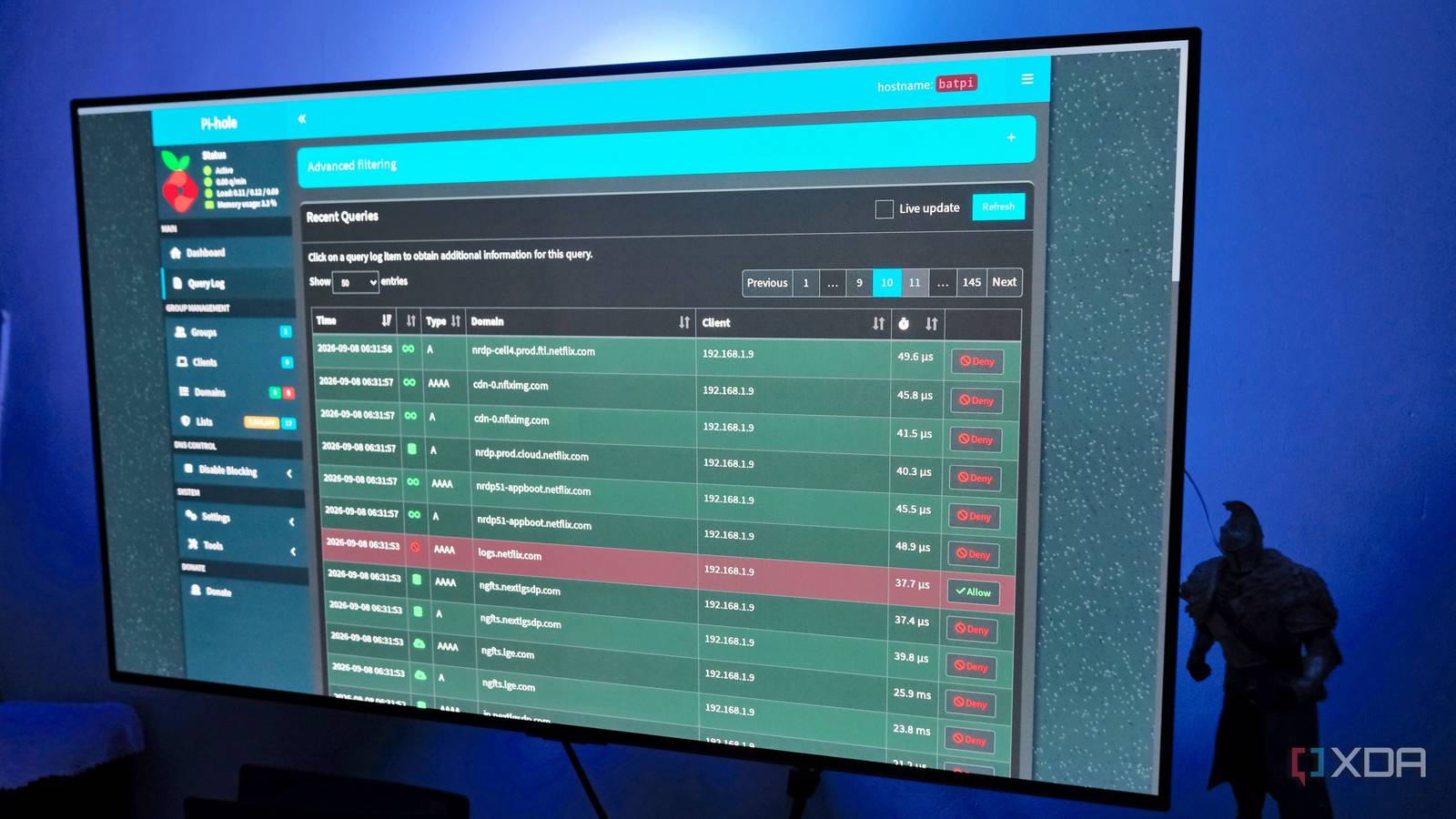
Published Sep 8, 2026, 3:30 PM EDT Samir Makwana is a technology journalist and editor from India since past 18 years and his work appears on MakeUseOf, HowToGeek, GSMArena, BGR, GuidingTech, The Inquisitr, TechInAsia, TechWiser, and others. He has written news, features, and gadget reviews for national technology media publications. His passion is to help people with their technology problems and gadget purchases. For that, he has worked for some of the biggest international technology publications, covering news, explainers, how-to guides, listicles, and product-buying guides. He has worked as an editor and managed teams since 2015. His expertise broadly covers computers, smartphones, game consoles, headphones, smart home products, browsers, and apps. A few weeks ago, I pulled a Raspberry Pi 4 out of the drawer to run good ol' Pi-hole on it. Next, I pointed my LG C2 to the Pi-hole instance and monitored how often the smart TV phoned home. While I don’t run Pi-hole full-time on my network anymore, I wanted to check what my smart TV was up to. The query log revealed that the TV was phoning home and sending out other requests. After a little bit of research, I encountered Gamers Nexus' investigation of LG’s Automatic Content Recognition practices in their smart TVs. That made me go back to the Pi-hole’s query log specifically for my C2. Turns out, phoning home was one of the many things my smart TV did, even when it was off. It felt like my TV was tracking my viewing habits and devices in my home. The investigation gave me a reason to look again I set a static IP for C2 to get proper logs I set a DHCP reservation for my LG C2 on my ASUS RT-AX88U, so its address stays consistent no matter how many times I restart the TV or the router. Then, I configured C2’s network settings to use Pi-hole’s IP address instead of the one that my router hands out. That’s my setup without any VLAN or separate subnet for it. Just Pi-hole doing DNS resolution on the Pi 4 for one device, which I could then filter the query log down to. I’ve run this exact setup before and came away feeling most uncomfortable with how much the C2 talked even with the screen off, while Gamers Nexus’ investigation focused on the firmware level, vulnerabilities, and the possibility of turning the TV into a listening device. I don’t have the tools or access for that. Instead, I have logs from a DNS resolver, which I began accumulating for a few days. And let me tell you, they revealed some wild insights into what smart TVs do all the time. ACR dominated the query log, not ads My first assumption was that most of the blocked queries would be ad exchanges feeding the promotional titles on C2’s home screen. But that wasn’t the case. When sorting the query log by domain category, ad-related traffic accounted for under a third of total requests. The rest was almost entirely Automatic Content Recognition (ACR) pinging back at regular intervals. These requests were logged even when I was playing a game on my PS5 or streaming something from my Jellyfin server on the same TV. That lines up with what they found on LG Ad Solutions’ side of the business, including LG executives telling advertisers that the company can identify who’s in the household. They can also track viewing across devices with more precision than the settings menu suggests. The Pi-hole query log didn’t show the request contents because DNS doesn’t work that way. It did reveal that those frequent requests were making ACR the busiest traffic category on the TV connection. The TV was active even with the screen off A fixed schedule of requests is all my setup proved The one place I’m careful not to oversell what Pi-hole’s query log shows is the standby traffic. The Gamers Nexus video raises concerns about microphone access and audio logging that continues even after you’ve disabled the option. They found that the microphone continues to work even when the visible controls are turned off. A DNS resolver can’t confirm or rule out any of that. It sees domain requests but can’t determine the data those requests carry. What it did show is that query volume from the C2’s IP address never dropped to zero. It settled into a steady interval in which the same handful of domains checked every few minutes, even after I’d stopped using the TV for the night. Whether the traffic carries viewing data, a device inventory of my home, or something else entirely isn’t something DNS logging can answer. But “asleep” and “quiet” turned out to be two different things on this TV, and only one of them was true. Streaming apps piled on traffic of their own Prefetch metadata behind the scenes to load thumbnails and menus Filtering out the ad traffic and ACR requests still left a layer of requests coming from the streaming apps. Netflix pinged its catalog and thumbnail CDN frequently, even when the app wasn’t in use. Amazon followed the same pattern for Prime Video. None of that is unusual, because prefetching data so that menus load faster is a fair trade-off. Every streaming app installed on my TV is another source of unattended traffic. That was separate from whatever the TV’s own OS kept doing. I learned the hard way that blocking every request coming from the smart TV was a mistake. That’s because I added a block list specifically for smart TVs to Pi-hole. That broke several things. The C2’s home screen stuttered, thumbnails wouldn’t load, and a couple of apps hung on launch. The solution was to identify each app’s CDN domain for thumbnails in the query log and add it to the allowlist. That meant adding a single entry to the allowlist rather than the entire blocklist category. The DNS told part of the story The few days’ worth of Pi-hole’s query logs answered my question: is my TV quiet when it’s not doing anything? No, it’s not even close. The TV’s software was very active, pumping out requests for various things. Gamers Nexus’ investigation states that the firmware, hardware access, and security holes that make the TV a listening device aren't just theoretical. For what it’s worth, ACR isn’t unique to LG. TV brands like Samsung, Sony, Vizio, and Roku build some version of it into their smart TVs and platforms. I haven’t pointed a Pi-hole at any of them to see how it compares. If you want to see what your TV is doing on your home network, you’ll need to point it at a Pi-hole instance. After that, you’ll need enough patience to audit the query log instead of just looking at the Queries Blocked number and moving on. Pi-hole OS Linux Price model Free
I ran Pi-hole to see what my smart TV was doing, not to block its ads
Full Article
Original Source
Read the full article at Xda-developers →KhanList aggregates and links to publicly available news content. We do not host full articles from third-party sources. Always verify important information with original sources.