
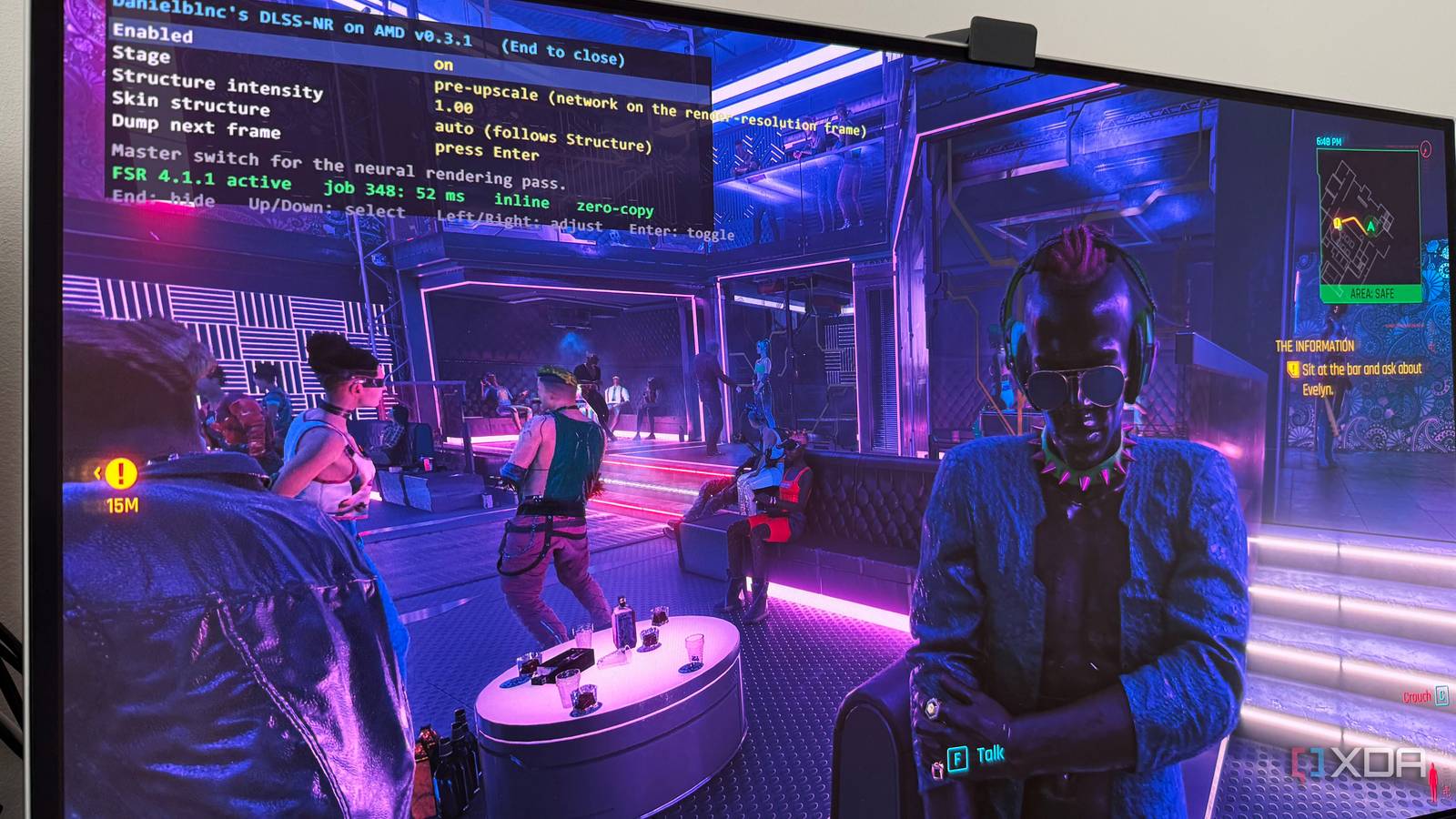
Published Sep 22, 2026, 12:01 PM EDT His love of PCs and their components was born out of trying to squeeze every ounce of performance out of the family computer. Tinkering with his own build at age 10 turned into building PCs for friends and family, fostering a passion that would ultimately take shape as a career path. Besides being the first call for tech support for those close to him, Ty is a computer science student, with his focus being cloud computing and networking. He also competed in semi-pro Counter-Strike for 8 years, making him intimately familiar with everything to do with peripherals. DLSS 5's neural renderer is one of the most controversial software features ever unveiled for a graphics card, and being that it's an Nvidia technology, it's no surprise that it's meant to be exclusive to their RTX graphics cards. However, like in other instances of vendor or model-specific driver tech, users have found a way around it, and you can run DLSS 5 on your Radeon GPU. It's not a reskin or an FSR feature, but the full-fat neural renderer running on your AMD silicon. It's incredibly heavy and drags performance to a crawl in my experience, but as a proof of concept, it's fascinating. What DLSS 5 is actually doing It's not an upscaler and isn't frame generation Credit: Nvidia One of the more confusing things for the average PC gamer is the naming scheme of Nvidia's DLSS suite of technologies. When people refer to "DLSS 5", they're talking about the neural rendering technology that was unveiled some months ago, and recently made its way into NBA 2K27 in early September 2026 for RTX 50 Series GPUs. What they're not talking about is an upscaler, like what DLSS 4.5 brought with the new transformer model. DLSS 5 also does not currently refer to any frame generation tech. DLSS 5's neural renderer sits at the very end of the rendering pipeline. Once a game finishes a frame, DLSS 5 takes that frame's color output and motion vectors, works out what's currently on screen, and then adds lighting and material detail. NVIDIA designed it to be deterministic and to process strictly one frame in and one frame out, using motion vectors to keep the result stable so a character's face doesn't shift from frame to frame. Game developers get two dials to tweak how their game interacts with DLSS 5: Structure Intensity governs high-frequency detail like ambient occlusion, reflections, and subsurface scattering, while Tone Intensity handles broader lighting and color response. The model itself is contained within a DLL file that has been found and pulled from NBA 2K27, and that's where the magic starts on the Radeon cards. How you can try it for yourself DLSS 5 on a Radeon card is more of a proof-of-concept than anything you'd actually use DLSS-NR on AMD officially targets the Radeon RX 9000 Series, with the RX 9070 XT being the developer's test card. Users have reported it working on RDNA 3 cards like the RX 7900 XTX, but "working" a loose term here. We'll get to that. You need Windows 11, Adrenalin 26.1.1 or newer, and a DirectX 12 game with FSR support. Once you source the DLL file from a DLSS 5 game, you drop the installer and the DLL into the game's directory, and after running the setup, that's pretty much all there is to it. The FSR requirement is particularly of note, because it's how the mod is able to work in the first place. A game running FSR already hands over color and motion vector data every frame, the same inputs DLSS 5 consumes, which makes the FSR pass a natural place to intercept the image. The result is a very strange pipeline, with AMD's upscaler feeding NVIDIA's neural renderer on AMD silicon. Once you're in-game, you can activate an overlay with the End key that allows you to toggle it on and off, and it's pretty instantaneous. It's interesting as a tech demo Cyberpunk 2077 looks quite different with it I loaded DLSS 5 into Cyberpunk 2077 on my RX 9070 XT, and while it's definitely not outputting playable framerates, it's certainly an interesting exercise in visual quality. For the characters and their faces, it does add an extra dimension of depth to them, texturing their skin and adding more detail. For the surrounding buildings and landscape, I wouldn't consider the result to be worth the absolutely massive performance hit that this requires. I normally get around 90 FPS with my 9070 XT at 4K with most settings set to either Ultra or High. Even with RT off, toggling DLSS 5 on sends my FPS into sub-20 territory. It's definitely well into what I would consider unplayable territory, but this also isn't that unique to Radeon cards. Even on RTX GPUs with their Tensor Cores, this isn't light work at all. At 1080p, though, I can easily get 60 FPS with DLSS 5 on, and it's actually somewhat playable. I can walk around the city and play as I normally would, though 1080p on my 32" display is quite blurry. Raising it to 1440p gives a little bit of sharpness back, but performance degrades heavily down to around 40 FPS. Give it a try if you're curious about the tech, but don't expect miracles I would refrain from using this mod on anything multiplayer, as it could be detected as some sort of cheat, but if you've been curious about how DLSS 5 would run on your Radeon GPU, it's an interesting exercise. I was shocked at just how playable it actually was at 1080p, but anything above that lacks the framerate required for an enjoyable, high refresh-rate experience.
I ran DLSS 5 on my Radeon GPU, and it's actually more playable than you think
Full Article
Original Source
Read the full article at Xda-developers →KhanList aggregates and links to publicly available news content. We do not host full articles from third-party sources. Always verify important information with original sources.