
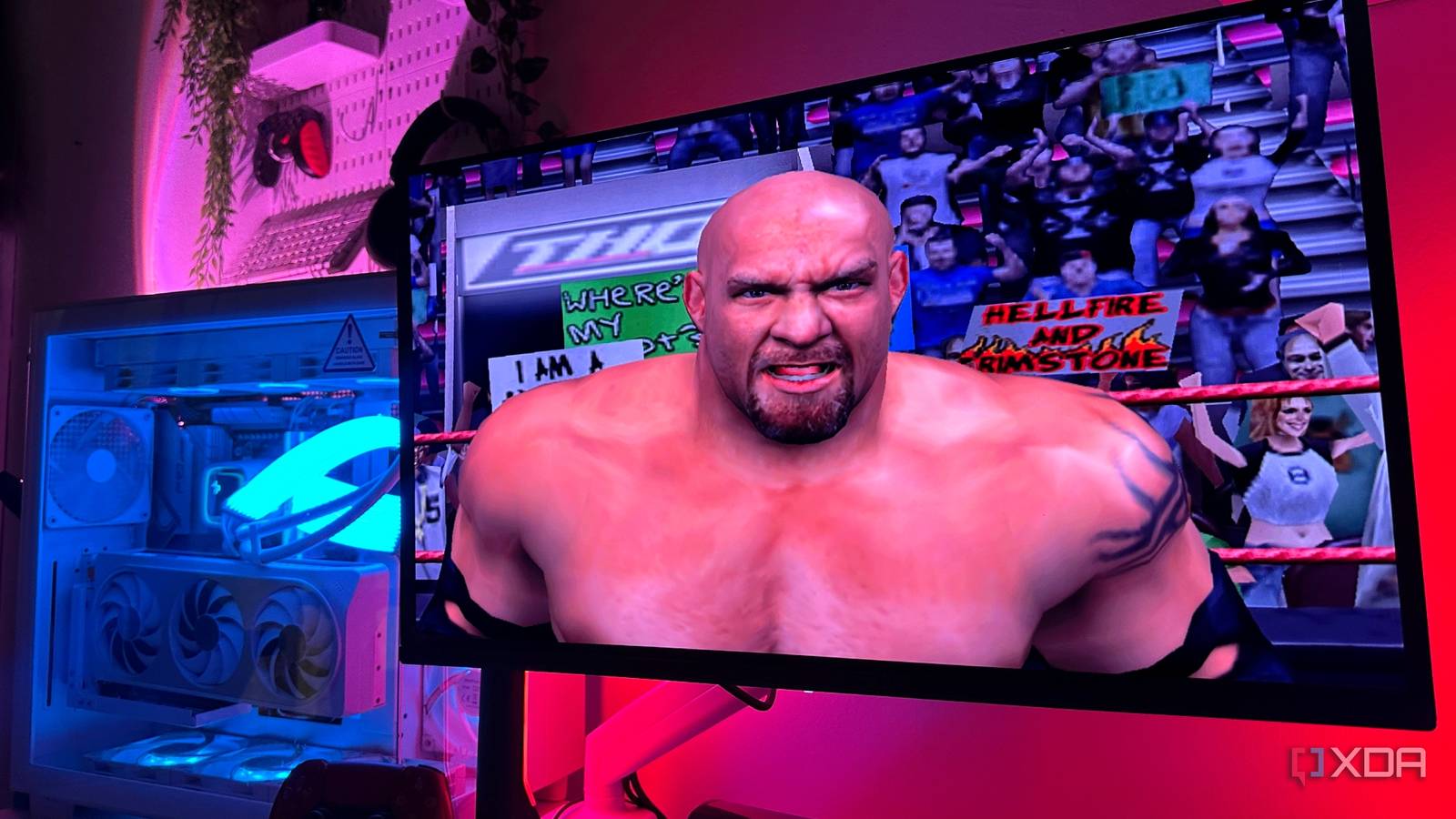
Published Sep 13, 2026, 12:01 PM EDT Gaming has been Samarveer’s greatest passion, and the Literature graduate in him takes immense joy in dissecting games for their themes, messages, and impact. Samarveer holds a deep appreciation of gaming, and considers the platform to be the most immersive and impactful across all media. He can be found engaging with gaming communities online, always ready to debate the finer points of ray tracing or itching to write an 8-page collegiate thesis on any game that impacts him emotionally. It's almost certainly a universal experience for us all to remember our childhood games as much prettier than the ones we actually played. In my own head, the PS2 games I played when I was five looked sharper, shinier, and so much more cinematic with realistic faces and environments. Now that I've grown accustomed to modern games and graphics, it's genuinely understandable to remember those old games as a lot closer to the titles I play today, despite the fact that they came out over two decades ago. Going back and playing my old PS2 games was definitely a reality check, and it sure was a lot less flattering than my nostalgia-tinted glasses led me to believe. Thankfully, after spending some time experimenting with DLSS 5 and PCSX2, I got surprisingly close to the version of these games that had been living in my head all along. DLSS isn't meant to work on PS2 games PCSX2 and ReShade helped me run it regardless There has been no shortage of discussion around DLSS 5 and its 3D-guided neural rendering, and I myself took a firm stance on it when it was first revealed. Officially, DLSS 5's neural rendering is designed around games that have DLSS support baked into their rendering pipelines. Obviously, PS2 games running on PCSX2 weren't built with any of that in mind, since they came out over two decades ago. The emulator has no business preparing motion vectors for a neural renderer. However, that hasn't stopped the modding community. DLSS 5's DLL files have given modders a plethora of ways (all unofficial, of course) to inject its neural rendering into older games, including DX9-and-newer titles and Vulkan applications, too. ReShade is particularly useful here, since it gives the renderer a place to intercept and process the image after PCSX2 does its job. Naturally, this interception method also works on PS3 games on RPCS3. DLSS 5's DLL files would otherwise work even more imporessively on DirectX 9.0 PC ports and above. The obvious problem here is that the PCSX2 emulator doesn't hand DLSS the information it needs. A neural renderer works only as good as its knowledge of how objects and pixels are moving between frames. That's where another ReShade mod comes in — iMMERSE by martymcmodding on GitHub — and helps expose motion-vector information that gives DLSS a better understanding of temporal movement in my quarter-century-old games. Effectively speaking, PCSX handles the actual PS2 game and renders it. Meanwhile, ReShade becomes a neural post-processing pipeline wrapped around it. Is this an absurdly roundabout way of getting DLSS onto a PS2 game? Yes. Does it also work remarkably well? Absolutely. DLSS 5 doesn't remake the PS2, but fixes how I see it My PS2 games transformed from "old games" to more like my memory of them After I got DLSS 5 running on my PS2 games through ReShade, the first thing I noticed was coherence rather than resolution. Instead of faces looking like a collection of pixels, hair and facial markings on characters became properly detailed. Kratos's armor in God of War II, for example, gained enough definition to look like something an armorer properly fashioned instead of a blurry texture just pasted over the character model. The early 2000s weren't particularly cutscene-heavy in games, but any facial close-ups showed me an entire world of difference in detail, making facial details look like a full generation ahead. A similar difference came about in the environments, too. Stonework, railings, window frames, fencing, advertisements, and distant trees all became noticeably easier to read. It's not like the DLSS 5 neural rendering pass made my titles acquire PS5-level quality, but the visual noise between the many details in the image dramatically dissipated. Trees and foliage look fuller and sharper, but the biggest difference-maker across all games were the roads, which, in typical "this is next gen" fashion, are slicker and remarkably more reflective. The neural rendering pass wasn't transformative for every game, though Certain art styles seem to be impervious to DLSS 5 However, not every game in my collection was affected equally. Budokai Tenkaichi 3, for example, with its cel-shaded art style, only became sharper and more saturated. The cartoon faces of all fighters remained the same, and the only difference DLSS 5 made was to the environments in the game. On the other hand, all my PS2 racing games — Gran Turismo 3: A-Spec, NFS Underground 2, and Most Wanted — benefited greatly from a neural rendering pass or two. The reflections on cars are unbelievable and leave me gawking at them with DLSS 5, and the neon lighting and distant scenery get some proper definition to chew on and sell the scene. This matters a lot more in motion, since it's the temporal information from iMMERSE that prevents fine details from turning into a shimmery mush. We don't remember our childhood games by their polygon counts — we just remember them looking gorgeous and impossibly realistic. This puts my nostalgia in perspective, too. I don't remember my games by their polygon counts or their texture resolutions, after all. What I do remember, though, is looking at them and thinking they were glossy, gorgeous, and impossibly realistic. Running a neural rendering pass over these games may not change what they were, but it does make them look closer to what my childhood self remembers them looking like. The DLSS 5 performance cost is very real Two neural passes were the sweet spot My RTX 4070 Ti had no trouble running these games natively. In fact, PCSX2 was throwing out quadruple-digit frame rates, so there was never a performance problem. When I began stacking neural rendering passes, though, my GPU ended up realizing that PS2 emulation, too, could be pretty hard work sometimes. Just two passes brought frame rates into the hundreds, but thankfully, they were still more than enough for a smooth experience. However, three rendering passes pushed every title below native performance, leaving very little reason for me to keep piling on neural processing. As such, the sweet spot was two neural passes, both set to a "Cinematic" preset instead of a "Natural" one. Nvidia RTX 4070 Ti + Ryzen 5 7600X + 32GB DDR5 RAM @ 6000MHz | 1440p DLSS 5 level GPU Power Draw Native 43W DLSS 5 Neural Rendering Pass x1 145W DLSS 5 Neural Rendering Pass x2 220W DLSS 5 Neural Rendering Pass x3 272W Even more worryingly, my VRAM usage climbed as I added neural rendering and color correction on PCSX2. It stayed below 12GB the entire time, of course, but seeing my RTX 4070 Ti pull almost 300 watts while rendering a PS2 game was objectively hilarious (and terrifying). In the end, I think I'd rather not chase every last neural-rendered pixel. Instead, I'll take two DLSS 5 passes, stay above 150 fps, and spend the headroom on a good CRT filter. If I'm recreating the memories of the PS2, that CRT filter is what will finish the job in taking me back to how my mind has retained those memories. ReShade Reshade is a free tool that allows you to mod the visuals of any game out there by adding and customizing various filters. My childhood was exaggerating, but I still got there Revisiting a game you loved as a kid is always a hit-or-miss situation. It'll either look terrible and tarnish your memories, or you'll enjoy it just as much but still realize how different it looks than in your museum of memories. Clearly, your childhood had access to a much more expensive graphics card. If a little modern rendering wizardry can close the gap between the image on the screen and the one that survived in my head for twenty years, I'm not particularly interested in arguing with the result. In fact, this ReShade method actually retains the original artists' intent, too, since it doesn't so much transform the game as much as it gives it a neural once-over for sharpness, detail, color correction, and, of course, graphical fidelity.
I ran DLSS 5 on my PS2 games, and they finally looked like I remembered them
Full Article
Original Source
Read the full article at Xda-developers →KhanList aggregates and links to publicly available news content. We do not host full articles from third-party sources. Always verify important information with original sources.