
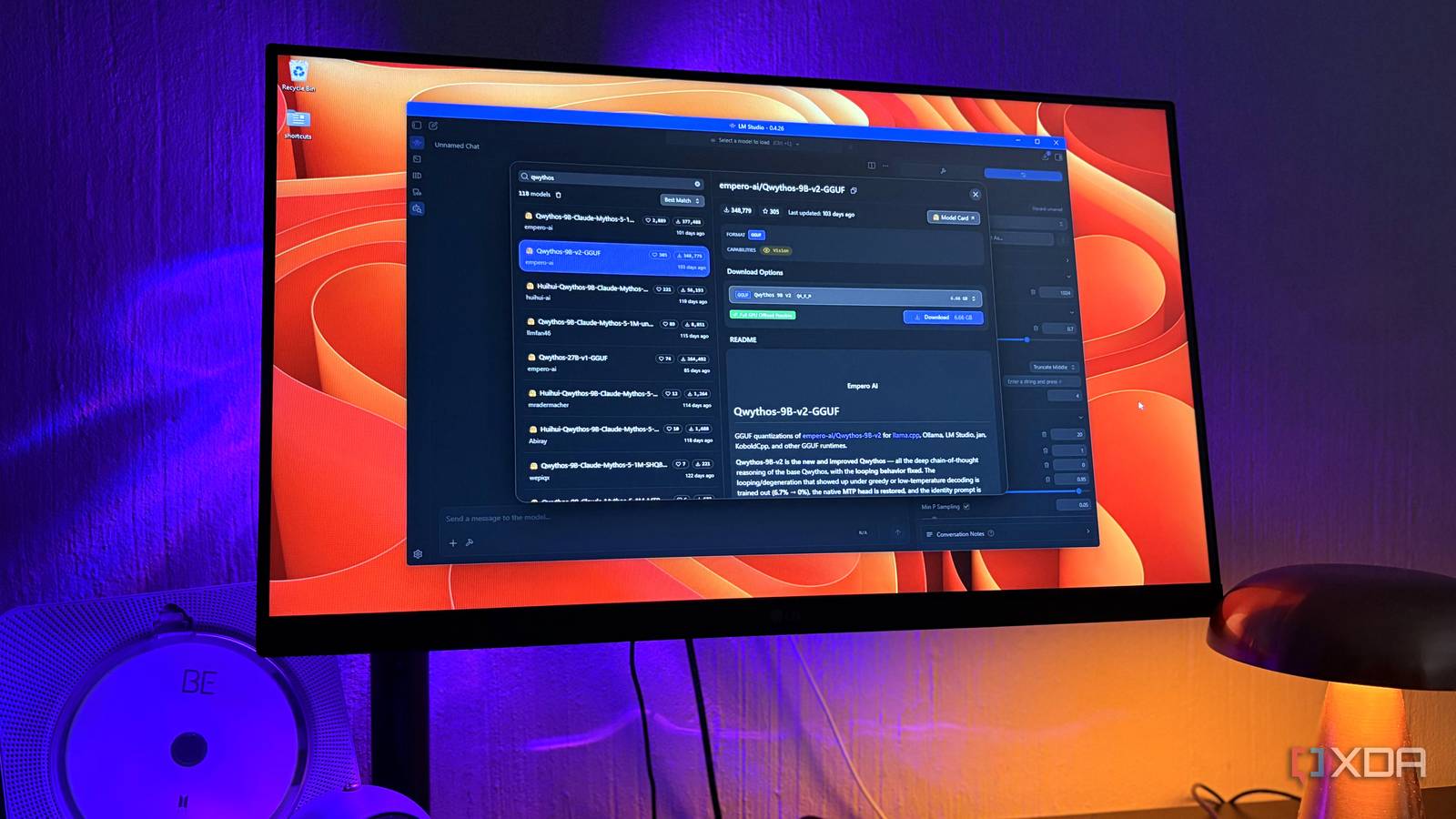
Published Oct 24, 2026, 5:30 PM EDT Nolen began their writing career in 2019, with three years dedicated to editing the Creative section at MakeUseOf. Their expertise lies at the crossroads of technology and creativity, covering areas like photography, video editing, and graphic design. Outside of work, you'll often find Nolen diving into a good book, writing their own stories, or playing video games. Claude Pro proves its worth most of the time. Anthropic's models are accessible pretty much anywhere through API, but the Claude workspace has become almost necessary in my workflow, especially Projects and Artifacts - and more recently, Claude Docs too. But when I scroll back through weeks of chats, I realize the sessions themselves are pretty basic, they mostly revolve around helping me understand things. So ultimately, I'm paying for the desktop app features, but these can be replaced by local tools like AnythingLLM or even PewDiePie's Odysseus. Recently, a 9B model showed up on Hugging Face with Claude's name in its title…sort of. It claims to have learned from Anthropic's most powerful models, and it runs on an 8GB graphics card. If you're in the small GPU camp like me, you probably get a little excited by these drops too. It all got me wondering how much of a Claude subscription a model like this could realistically cover. Say hello to Qwythos 9B A small model with a big claim Qwythos 9B is a free reasoning model from a lab called Empero AI, and the version I've been running is v2, which is the cleaned-up version following the original release. Reasoning model just means it thinks through a problem in a separate block before it responds. Your model runner will likely let you switch that thinking on or off, and v2 also fixes a habit of getting stuck repeating itself that the first version had. It's built on Qwen3.5 9B, one of the small models Alibaba's Qwen team released back in March, which could already handle images and long documents before Empero got involved. Empero then trained it on over 500 million tokens of Claude Mythos and Claude Fable conversations. For context, Fable 5 and Mythos 5 are the same Anthropic model, with Mythos only handed to a small group of vetted partners, so the idea here is a small model picking up how a much bigger one works through problems. The step-by-step reasoning it trained on was actually written by Empero's own tool, though, called rethink. So the Claude part is more about style than copied thinking, and Empero hasn't said how it got Mythos data in the first place. I'm not really sure what to make of that given how Anthropic has been so public about cracking down on labs that harvest Claude's answers to train their own models; I don't think there's a clean answer yet. Empero aims it at math, science, medical explanations, and cybersecurity, and it's deliberately uncensored. Coding is a bit worse than the base Qwen model, and Empero admits it can confidently get facts wrong without web search. What it takes to run Qwythos My six-year-old GPU handles it without a hitch I'm running an RTX 3070 with 8gb of VRAM. It was a pretty great card when I first got it, but these days it's firmly mid-range. I downloaded the Q4_K_M quant of Qwythos v2 through LM Studio, my favorite runner, and it was just under 7GB in size, which left me with room for anywhere from 10-30k context, depending on how many layers I offloaded. I'll definitely be pulling this into AnythingLLM at some point to gain back some of those workspace features I like in Claude Desktop. Once I got it running, it ran at around 20 to 22 tokens per second, and most answers started showing up in under a second. So all-in-all, this runs pretty much the same as my other go-to models, Gemma 4 E4B and Qwen 3.5 9B. How it fits so well comes down to how Qwen 3.5 is built. Most models keep a running memory of your conversation in every block of the model, and that memory eats more VRAM the longer a chat gets. Qwen 3.5 only does that in a quarter of its blocks, while the rest hold a fixed-size memory that stays put. So here I could easily run it with a 14k context length, and the 1 million tokens on the card is really meant for server hardware. Putting Qwythos up to my Claude habits Where it can stand in for Claude On the day-to-day, I mainly reach for Claude for explain-this-to-me or sort-this-out-for-me tasks, so that's where I started. The first test was a travel-time puzzle with a traffic catch. With thinking switched off, Qwythos worked through each step and got the right answer, which was "leaving at 9:12", in under a second. It did ignore that my question opened with a different departure time, though, and just rolled with it. Explanations were better when I turned Thinking on, which feels like stating the obvious, but some models drag out the responses unnecessarily long. I asked for a scientific explanation of why coffee makes you crash, and it thought for 28 seconds before giving an accurate rundown of the process. With thinking off, it got a little looser; a beginner explainer on local AI went over my word limit, and its analogy called the GPU a library, then later the thing reading the books. But still, not too far off. Current info is where small offline models usually trip up. Asking for the latest LM Studio version actually made it give me an honest answer about having no internet access rather than giving me something made up. This is where tool-calling matters, because you're going to have to give it web through MCP or something else to give it access to up-to-date facts, just as Empero says. The base Qwen3.5 9B scores 66.1% on BFCL-V4, a benchmark that tests how well models use tools, and Empero says Qwythos got all seven of its own test questions right when it could search the web. It got my question right the second I turned on my Brave Search MCP. Vision was the shakiest, which makes sense since Empero never trained or tested it. I gave it a screenshot of an app I designed, and asked for feedback on the design. The fixes weren't bad but they were pretty generic and some of them read like guesses more than anything. Rethinking what's worth sending to the cloud Overall, I think Qwythos can take over a decent chunk of the small stuff, like logic problems and explainers. This is definitely one I'm keeping on my PC, and I can already foresee myself neglecting my Gemma models a bit for this one because Gemma is usually what I reach for with explainers. And routing those basics to Qwythos instead of Claude will also help me save on rate limits. But, it can't handle coding and design very well, so those tasks will still go to Claude.
I ran a 9B model trained on Claude's reasoning on my 8GB GPU, and it made me rethink paying for Claude
Full Article
Original Source
Read the full article at Xda-developers →KhanList aggregates and links to publicly available news content. We do not host full articles from third-party sources. Always verify important information with original sources.