
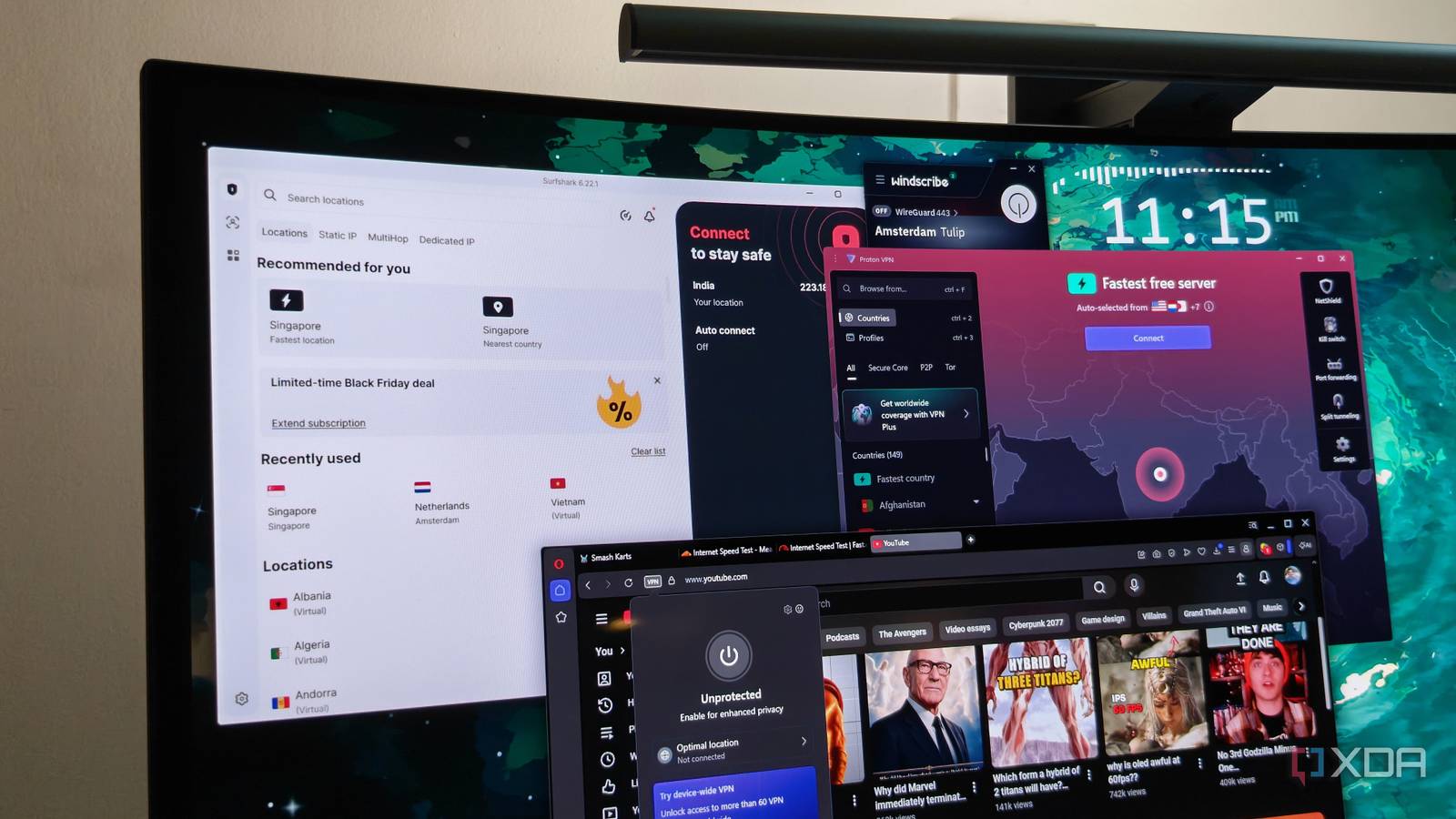
I have had a Surfshark subscription for nearly 5 years now, and it's been a good deal, all things considered. It costs me around $2.5 a month, and has helped ensure traffic privacy and avoid geo-blocking and ISP throttling (for the most part). During this time, there were periods where I dabbled in free VPN services like Proton VPN and Opera browser's built-in VPN. Free VPN has restrictions and, often, sketchy behavior, but I wanted to check if it can replace a paid service for the right user. So, I decided to test my Surfshark subscription against Proton VPN, Windscribe, and Opera's built-in VPN. I tested everything on Ethernet to eliminate Wi-Fi variables, and used Cloudflare Speed Test and Fast.com to test the percentage drop in speeds. Since speed is just one aspect of a VPN, I also compared the four services on data caps, device limits, the choice of servers, security features, and privacy policies. Speed and browsing experience Surfshark proved its worth, but free VPNs weren't far behind I have a 200 Mbps plan, and it mostly shows up as 190 Mbps in speed tests. I started my testing with Surfshark, followed by Opera, Proton VPN, and Windscribe. For each VPN, I tested the "best," "fastest," or "optimal" server shown by the app, followed by the closest server and also a long-haul connection. Since I'm testing in India, this helped me simulate a representative test for a wider audience. I also ran three runs of speed tests on both Cloudflare and Fast.com, measuring the median speed. Expectedly, Surfshark showed almost no drop in speeds on the fastest server (Singapore). YouTube performance at 1440p as well as 4K was nearly instantaneous. I changed the server to the Netherlands, as that's usually the one most VPN apps default to when choosing the best server, and it also served as a longer connection geographically. Speed and latency worsened slightly, but the browsing experience remained essentially the same. While Fast.com uses Netflix's CDNs to give an idea of your connection's streaming performance, Cloudflare's speed test is a more general indicator of how it would behave across the internet. The Fast.com numbers were almost always higher than those of Cloudflare, so I noted the percentage drop for both tests at the end. Moving to Opera's built-in VPN, I picked the "Optimal" server shown by the browser, which turned out to be the least optimal of all. It delivered a few hundred Kbps in speeds, so I abandoned it and manually selected the Asia region. Compared to Surfshark, Opera dropped the speed significantly, so I switched to the Europe server and tested again. It was only marginally faster. YouTube still ran well, even at 1440p, with only a second or two of buffering time when skipping ahead. However, on Opera's Asia server, YouTube simply refused to load (it worked fine on Europe). I guess YouTube's VPN blocking policy caught the Asia server but not Europe. That said, other video sites like Dailymotion and TikTok worked without problems on the Asia server. Switching gears from built-in browser VPN to the wildly popular Proton VPN, it took me a while to find the free sign-up option on its account creation page. Proton VPN doesn't allow you to manually choose a server; it auto-selects from a list of 10 free servers. However, you can use the "Change server" option to shuffle to a different server if you aren't satisfied with the performance. Proton's performance was way more impressive than that of Opera's built-in VPN. It retained over half of my connection's maximum speed, and the results stayed mostly similar across its best server (Romania), the Netherlands, and Canada. Lastly, I tested Windscribe, another free and popular VPN app. It allows sign-up without providing an email, so that's what I chose. Giving your email address has benefits, but I'd get to that in the next section. The best server on Windscribe was Hong Kong during my testing, but Fast.com showed an abnormal 240 Kbps result. I ran Cloudflare's test and got over 100 Mbps, so I searched about it. It turns out Netflix throttles known VPN servers, which shows up as a poor speed test on Fast.com. Cloudflare's test, on the other hand, shows the actual speed of the VPN tunnel. I changed the server to the Netherlands, and sure enough, Fast.com showed a proper result. Windscribe retained a significant amount of my network speed, just like Proton VPN. YouTube, Dailymotion, and other sites worked perfectly, too. To rank each VPN based on performance, I compared the best-case scenarios for each app. I calculated the percentage drop for Fast.com and Cloudflare separately. 200 Mbps Ethernet Fast.com speed test Cloudflare Speed Test Fast.com % speed retained Cloudflare % speed retained Surfshark 180 Mbps 128 Mbps 94.7 67.4 Opera browser 42 Mbps 12.5 Mbps 22 6.6 Proton VPN 130 Mbps 95 Mbps 68.4 50 Windscribe 140 Mbps 92 Mbps 73.7 48.4 Winner: Surfshark, with Proton VPN and Windscribe tied a close second Data caps and device limits This is where the cracks start to show Speed is one of the most important parameters of a VPN, but it's not the only one. Free VPNs need to restrict usage in one way or the other, and data caps and device limits are a few ways to do that. Surfshark allows unlimited simultaneous connections with no data caps, just like many paid services. Starting with the worst performer in the speed section, Opera's built-in VPN works only in the browser (desktop and mobile both), so the rest of the device stays out of coverage. That said, there's no data cap or device limit, so you can continue using it on every device without worrying about exhausting your usage. Considering the speeds aren't that great, the question is how much you'll be able to use it anyway. Proton VPN doesn't have any data cap, but you can only use it on one active connection. It uses your email address for the account sign-up, and you can have it installed on multiple devices, but only use it on one device at a time. Windscribe doesn't limit the number of simultaneous connections, but it's the only app on the list with a data cap, limiting you to 2GB of monthly usage (which I exhausted during the testing itself). You can increase that to 10GB if you provide your email address, but even that's too low for a whole month. I checked my browser's data usage on Windows, and saw just under 50GB of usage in the last 30 days. Firefox's built-in browser VPN provides users with 50GB of free monthly usage (currently unlimited till Jan 31, 2027), but I couldn't test it here in India. Winner: Surfshark, followed by Proton VPN Server choice and feature set Flexibility and security Many users look to a VPN to access geo-blocked content on streaming services, and a limited choice of servers hurts that proposition. This factor isn't as important as speed and data caps, but it's still important. Maintaining servers requires money, so free VPNs will obviously limit your choice, but different services do it to a different extent. While Surfshark provides servers across 100 countries, Proton VPN has a small list of 10 free countries, which you can shuffle around. The list includes popular locations, such as the United States, Canada, Japan, the Netherlands, Norway, and more, but it's still a small list. Windscribe has a similar list of 10 free countries, but you can manually choose the location. That said, the 10GB monthly limit makes streaming a non-starter. Opera browser is even more restrictive, as it only offers three regions: Americas, Europe, and Asia, so you can't choose a specific country. In terms of features, Proton VPN, Windscribe, and Opera offer a kill switch feature, which automatically blocks the internet connection to prevent IP address leaks, in case your VPN drops unexpectedly. Note that Opera's browser VPN is limited to the, well, browser. P2P traffic is not supported on either of them on the free tiers, but Opera and Windscribe offer basic blocking for ads and trackers. Surfshark obviously includes all routing, traffic, and browsing features you expect from a paid VPN. Winner: Surfshark, followed by Proton VPN Privacy and no-logs policy Some free VPNs are better than others Finally, we come to perhaps the most important parameter of all. The whole point of moving your traffic through a VPN tunnel is to protect it from prying eyes. If your VPN service itself is untrustworthy, you might as well not use one at all. While it's already known that using a VPN doesn't hide everything you do on the internet, it still helps to know the privacy policies of every service when choosing one. Surfshark has a strict no-logs policy with RAM-only servers that wipe all data on reboot. It is audited by Deloitte and Cure53, and it's based in the Netherlands, which is part of the Nine Eyes alliance. Surfshark's RAM-only servers and user data deletion within 15 minutes of disconnection mitigate jurisdiction risks. Surfshark is also bound by GDPR rules, giving users strict rights over personal data. Proton VPN and Windscribe are also audited by entities like Securitum, Packetlabs, and Leviathan Security Group. Proton is based in Switzerland, while Windscribe is under Norwegian jurisdiction. Windscribe is known to run RAM-only (diskless) servers, whereas Proton VPN uses full-disk encryption (LUKS) instead. Proton VPN requires an email address, but has a better no-logs policy, since Windscribe needs to store your last timestamp and 30-day data usage for free accounts. Also, Proton is protected by Swiss law, where VPNs aren't required to retain metadata, but Windscribe's proof of no-logs relies on real-world server seizures and court dismissals instead. Opera's browser VPN is bound by GDPR rules, since it's based in Norway. It doesn't store our browsing activity, DNS queries, or originating IP addresses, but the browser collects other device identifiers and usage data. Winner: Proton VPN, but it's not that simple — Proton VPN has open-source apps and the strongest legal protection. Surfshark wins on RAM-only servers and Big Four audits, but has jurisdiction trade-offs. Windscribe has RAM-only servers and real-world proof, but stores last-seen date and is headquartered in Canada. I can realistically move to Proton VPN Free VPN doesn't have to be unusable Surfshark has served me well, but I'm starting to feel that I'm not really making the most of my subscription. I don't use more than one device at a time, and I rarely try to access geo-blocked content. Besides, all the secondary features part of my subscription don't matter to me all that much. Surfshark is one of the most affordable VPNs on the market, but Proton VPN ticks a lot of boxes as a free service. For starters, the speed difference between Proton and Surfshark isn't huge. The real-world browsing experience is indistinguishable. Then, there's the limited server choice, but if I'm not looking for a specific location, that's not a big problem. Proton's privacy policy is also the strictest of the bunch, and its free tier enjoys the same security protections as the paid one. There's no data cap and the single connection limit is less harsh than it sounds in practice. Proton VPN uses revenue from paid subscriptions to maintain a decent level of service for free members. The next time my Surfshark subscription comes up for renewal, I'll gladly skip the 2-year $50 fee and move to Proton VPN permanently. Paid vs. free VPN can be a close call Although most free VPNs are guilty of selling user data or making other big compromises, not all of them operate this way. Proton VPN is one of the best options out there, and you can realistically use the free tier for years. I've enjoyed Surfshark for almost five years, but Proton VPN's free offering has made me reconsider my subscription.
I pitted my paid VPN against free options, and my subscription doesn't feel worth it anymore
Full Article
Original Source
Read the full article at Xda-developers →KhanList aggregates and links to publicly available news content. We do not host full articles from third-party sources. Always verify important information with original sources.