
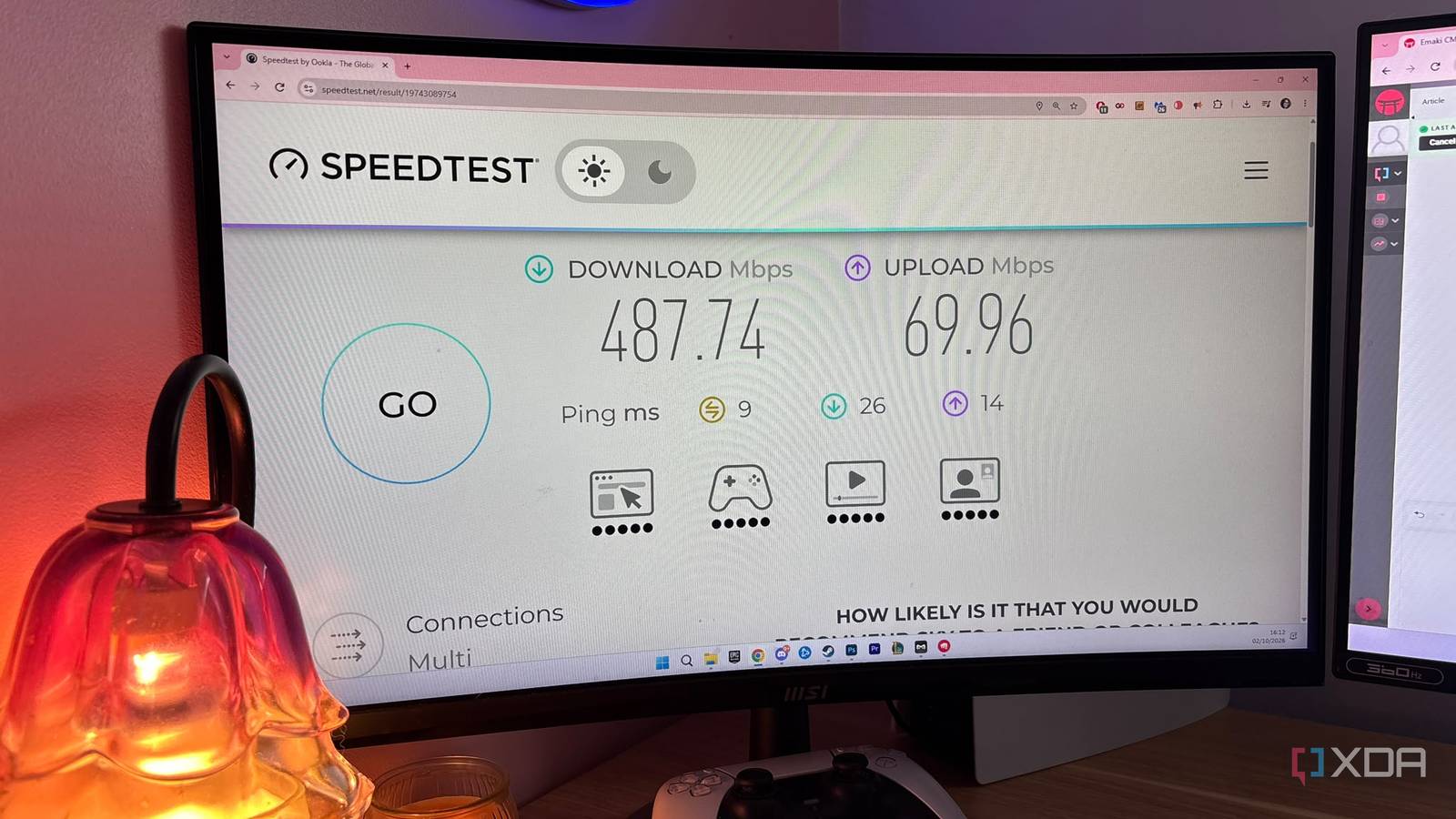
Published Oct 3, 2026, 5:00 PM EDT Jasmine is Software and PC Hardware Author at XDA with years of tech reporting experience ranging from AI chatbots right down to gaming hardware, she's covered just about everything. Whether it's breaking news about the latest AMD NPUs or creating video tutorials on social media platforms, Jasmine has contributed to the world of AI and tech in a variety of ways including interviewing the CEO of Razer, AMD's Director of Product Marketing and the VP of Lenovo. Passionate about gaming and PC technology, she has built countless computers, keyboards and other peripherals - knowing them inside and out. When you sign up for a new 1Gbps fiber or cable internet package, you might not stop to look at your household ecosystem: smart home bulbs, streaming boxes, tablets, IoT gadgets, and background servers. Realistically, none of them really need, utilize, or physically process a gigabit of bandwidth during normal operation. You might run a speed test on your phone or main PC, watch the gauge max out at 940 Mbps, and feel a brief wave oftechnological satisfaction. However, gigabit internet has become a security blanket between Wi-Fi physics constraints, server-side throttling, and everyday workload limits. Paying for gigabit speed is largely a marketing-driven exercise in number chasing for most modern households. Will your devices at home use a gigabit? The answer is probably no Cloudflare provides you with more information when compared to a standard speed test. Most everyday devices can't actually reach gigabit speeds because architectural constraints prevent them from saturating a 1G pipe. The first issue is the Wi-Fi physical layer. Even with modern Wi-Fi 6, 6E, and 7 clients, devices sitting in the same room as an access point, real-world wireless overhead, contention, and distance drop throughput down significantly. You might be getting closer to roughly 400 to 700 Mbps over the 1 Gbps that you're paying for. This doesn't even consider when you're moving away from it. Go over to the next room from your router, and the signal drops even further through the drywall or a floor, and your speeds dip even more. You might also deal with a lot of server-side bottlenecks. Your ISP might deliver a pristine gigabit stream to your ONT box, but downloading a file from a game server like Steam or Epic, an update repo, or a video stream like Netflix 4K will max out at 25 to 40Mbps. This means that you're essentially at the mercy of these providers' bandwidth limits and content delivery network throttling. Audit your household to decide whether gigabit internet is worth it Sometimes it might be Before investing in gigabit internet, do a household workload audit. Examine what your devices are actually doing versus what gigabit marketing promises. Many of your smart home and IoT devices won't use gigabit internet at all. If you've got dozens of smart bulbs, smart plugs, and temperature sensors running on 2.4 GHz Wi-Fi or Zigbee, they consume mere kilobytes per second and don't need blistering speeds. Move on to more general consumption and a look at media streaming. Streaming multiple simultaneous uncompressed 4K Blu-ray rips or high-bitrate Plex streams internally across your local NAS requires local network switching capacity rather than external internet bandwidth. And as addressed earlier, if you're using external streaming platforms, you'll face server-side bottlenecks anyway. And lastly, it's worth considering the single-user fallacy. A single human can realistically only actively consume or generate data for one high-bandwidth task at a time. More general internet use, like browsing Reddit, writing code, or attending a Zoom call, requires a fraction of a gigabit, so it won't be anywhere near as demanding as a gigabit plan. There are some instances where gigabit actually does matter. Some niche workloads aren't a marketing gimmick, and you might actually use it. For those who are into heavy, frequent torrenting and game drops, if you're a power user downloading 100 GB AAA game titles daily or syncing massive terabyte-scale media libraries off-site to Backblaze B2, a gigabit upload/download link can save a significant amount of waiting time. And if you've got a multi-user heavy household (like a large family or a shared home lab where multiple users are simultaneously downloading massive files, hosting remote game servers, or running intensive cloud workflows), a gigabit connection might be worthwhile. There are other ways to optimize your network From Ethernet down to access points Realistically, for the majority of users, even power users, gigabit internet is not fundamental because so many devices in your home can't take advantage of it. You're better off downshifting or optimizing your current network rather than paying extra to upgrade. The most important element of your network is hardwiring where it counts. Whether you pay for gigabit or not, you shouldn't ever expect Wi-Fi to prove its worth. You should run Cat6 Ethernet drops to your desktop, home server, and main TV streaming box to capture that wire-speed throughput. There are a range of other ways that you can optimize the actual Wi-Fi in your home too. It can be as simple as repositioning your router to make sure you're taking advantage of RF physics. Or it might be worth investing in another access point or mesh Wi-Fi system so Wi-Fi can reach dead zones in your home much more effectively. Review your ISP tiers and see whether dropping to a 300 or 500Mbps plan can save you money while making no noticeable difference in daily web browsing, remote work, or streaming performance. Gigabit internet provides very little value The majority of users won't see the benefit Gigabit internet is an incredible engineering feat, but for 90% of connected devices in a modern home, it provides very little value. It's essentially like driving a Ferrari in a school zone. There are many other ways to optimize your home network, whether that's running Ethernet to key devices or repositioning your router. Audit the devices in your home and decide whether you're paying for real utility or just buying peace of mind through a bigger number on your ISP bill.
I paid for gigabit internet and discovered almost nothing in my house can actually use it
Full Article
Original Source
Read the full article at Xda-developers →KhanList aggregates and links to publicly available news content. We do not host full articles from third-party sources. Always verify important information with original sources.