
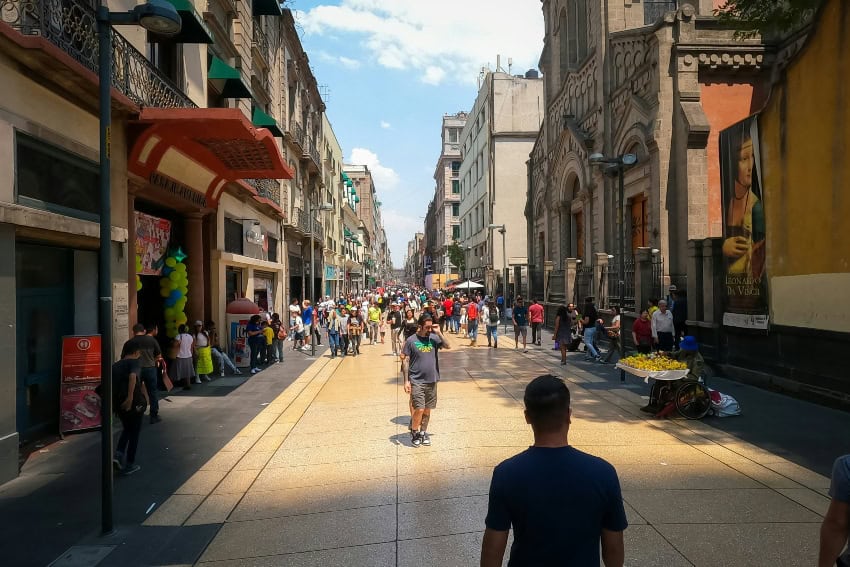
If you move to Mexico City in your 20s, I hope it becomes a home and not just a destination. I came to Mexico at 25 thinking I was moving abroad one more time. I had already lived outside Spain, so I knew what it meant to arrive somewhere new, figure out a city, make friends and eventually find my way around. I thought Mexico City would be another chapter in that story. Mexico City, like Paris or New York, is one of those places where you find things you didn’t even know you were looking for. (Andrea Leopardi/Unsplash) A year later, I realized something else happened. I didn’t just move to Mexico; I started building a life here. When you’re in your 20s, it’s easy to romanticize starting over somewhere else. How many of us, after a mental breakdown, have thought about leaving everything behind? Maybe moving to Paris like Blair, or finding the messy, exciting life Carrie Bradshaw had in New York City in her 30s. I’m not saying New York or Paris won’t give you what you need to find. They might. But I found something in Mexico City that I wasn’t necessarily looking for: a place where I could become a slightly different version of myself. MND goes all in on Mexico City: A perspective from our CEO Asking better questions in a new city For me, my 20s have become less about figuring everything out and more about asking better questions. Do I want to become a mother? Will I get married? What do I want my career to look like? What kind of woman do I want to become? What do I want my future family to look like? I don’t have the answers yet. But living abroad has made me more conscious of the questions. When I told my friends in Europe that I was moving to Mexico, some of them were worried. I wasn’t particularly afraid. My biggest concern was more mundane: I love walking, and I simply wondered whether I would be able to walk as much as I did back home. I quickly found out I could. I walk from our apartment in San Miguel de Chapultepec to Condesa to see friends, or go to a class. I walk through Chapultepec Park almost every day, and sometimes all the way to Polanco, which can take close to an hour. One of the first things Mexico City taught me was how easily we can misunderstand places we’ve never experienced ourselves. Not only does moving to Mexico introduce you to new places, but new people, too. (Evan Wise/Unsplash) Before coming to Mexico, I only knew two Mexicans. They had been exchange students in Finland when I was studying there in 2020 and 2021. We weren’t friends. I just remember them being very good at beer pong and drinking rum or gin with water. Then I arrived. And I started meeting people. Finding kindness in the unlikeliest moments Before Mexico, the country that completely changed my understanding of human connection was Cuba. I would need to write another article about everything that island gave me, but I truly thought nothing could surprise me in the same way again. Until Mexico did. On my third day living in Mexico City, I was waiting in line to pay for a haircut. The woman behind me noticed what I was doing and immediately told me there was a cheaper hairdresser in the shop across the street. This act of kindness was the first one that people have shown me here. They aren’t normally dramatic moments, but they happen very often. Sometimes it is smiling in the street, starting a conversation or simply making an effort when they have no reason to. At home, you move through your busy day surrounded by people and routines that are familiar. Abroad, you become more aware of your interactions, and they end up becoming part of what makes a place feel like yours. There was another adjustment I was not expecting. As a European — very active and not particularly patient — I was struck by how slowly life seemed to move here. I learned that “ahorita” doesn’t necessarily mean right now. It can mean soon. It can mean later. Most of the time it’s just a polite way of saying something will happen when it happens. And you’ll get your coffee when you’re meant to get it. If you’re in a hurry, I recommend you insist a couple of times. How different neighborhoods shape who you are Every street and neighborhood in Mexico City has its own rhythm. (Gina Rivera/Unsplash) One of the things that continues to amaze me about Mexico City is how different each neighborhood feels. Polanco and Santa Fe have their own rhythm: business, luxury, restaurants, offices, polished cars and people dressed for work. Then you go to Condesa or Roma, and suddenly you’re surrounded by leafy streets, cafes, parks and lots of dogs. I spend a lot of time in Parque México with a good friend of mine who has lived here since 2024, and we still find ourselves surprised by what we see: people dancing, doing karate, playing pickleball, learning to skate, practicing hula-hoop, someone selling poems, couples sitting on benches, foreigners taking photographs of a scene that locals barely notice because, to them, it’s simply Tuesday. That is Mexico City. The Historic Center still leaves me speechless: the old buildings, the ruins, the Zócalo, Alameda Central, Palacio de Bellas Artes, Museo Nacional de Arte (MUNAL), the markets and the streets where centuries of history exist on top of each other. And then there is Coyoacán, Frida Kahlo and Diego Rivera, colorful markets, museums, and streets that feel completely different from the rest of the city. The most interesting part is not just that these neighborhoods look different. They also make you feel different. You become a different version of yourself depending on where you are in the city. And in your 20s, that gives you something I have learned to appreciate: perspective. Experiencing Mexican art and architecture I’ve visited many museums since arriving — some of the famous ones and others that are less known. I don’t want to pretend I can explain Mexican art after a year here. But I can say that I have never experienced history through public art in quite the same way. The murals of Diego Rivera are not simply beautiful paintings. They tell stories about Mexico, its people and its history. Artists like Frida Kahlo transformed personal pain into art and became part of a cultural identity recognized around the world. I was also so impressed by Luis Barragán. Have you seen his house in San Miguel de Chapultepec? It was designed in the late 1940s, and I swear if you discover it today, you’ll want to move in there. Mexico City reminds me that contemporary doesn’t always mean new. Made in Mexico: Creating ‘Frida Kahlo’ The joys of Mexican food The same happened with food. Unpopular opinion: I’m not a foodie. I enjoy a latte and a cookie as much as avocado toast or a good meal at a cool restaurant every once in a while. Just give me some food when I’m hungry, and I’ll be happy. But even I have been fascinated by Mexican food. Mexican cuisine was recognized as an Intangible Cultural Heritage of Humanity by UNESCO in 2010, and one of the things I’ve learned is that there is no single thing called “Mexican food.” Ingredients, dishes and traditions change so much from state to state. Even as a vegetarian, I have found myself trying things I never expected to eat: nopal, huitlacoche and many other ingredients I did not know of before arriving. And Mexico City is not only Mexican food. You can eat Thai, Italian, Spanish, Chinese … you name it, you’ll find it. I even discovered one of my favorite Lebanese places here in the Historic Center. Lessons in community through Día de los Muertos Experiencing Día de los Muertos in Mexico can change the way you look at death … and at life. (Miguel González/Unsplash) I moved to Mexico City about a year ago, just as the rainy season was ending and Independence Day celebrations were beginning. I was warned before arriving that people knew how to celebrate. “But isn’t that true everywhere?” I thought. Especially coming from Spain, where we’re always down to party. But I understood quickly that celebration here can mean something bigger than drinking late into the night. There is a sense of community, belonging and gathering together. To this day, experiencing Día de los Muertos in Mexico has been one of the best experiences of my life. We went to the village of Malinalco, less than two hours from Mexico City, to visit family altars. We entered house after house, each one belonging to families that had lost someone that year. Every house was different. Some had large patios and modern buildings; others were old. In all of them, they replicated the profession of the person who had died through objects, decorations and food: a baker, a secretary, a police officer, a chef. The altars were filled with bright orange cempasúchil flowers and candles. In some of them, we lit our own candles as a sign of respect. Every family gave us something to eat and drink — from tamales and tacos to mezcal, tequila or warm spiced wine. In some of them, you could really feel the presence of the person being remembered. How generous of those families, after losing their loved ones, to celebrate their lives with us, strangers to them. It was so magical. I left with tears in my eyes from the lesson in humanity I had just experienced. Building a life together while making it your own I’m not single, and my boyfriend and I moved here together. Some people might think moving with your partner in your 20s means you miss out on the experience. That hasn’t been our case. If anything, moving here has made us more intentional about building a life, both individually and as a couple. Marta Delgado is a Spanish writer and marketing professional from Galicia, Spain, currently based in Mexico City. She writes about culture, lifestyle, and what it means to build a life abroad, drawing from her own time living in different countries.
I moved to Mexico City in my 20s. Here’s what I learned
Full Article
Original Source
Read the full article at Mexiconewsdaily →KhanList aggregates and links to publicly available news content. We do not host full articles from third-party sources. Always verify important information with original sources.