
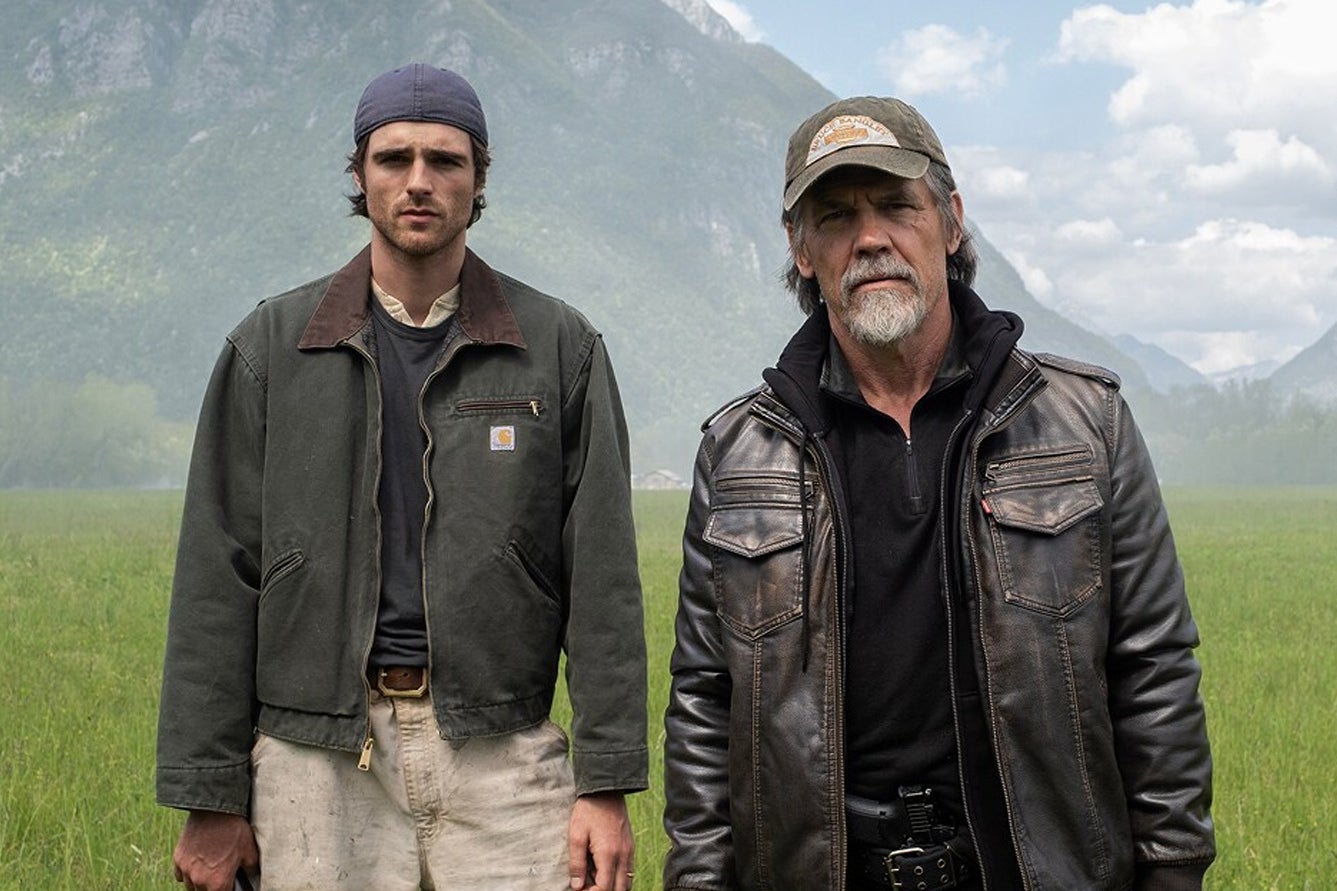
Movies The Dog Stars Has Plenty of Stars, but It’s Still a Dog By Enter your email to receive alerts for this author. Sign in or create an account to better manage your email preferences. Unsubscribe from email alerts Are you sure you want to unsubscribe from email alerts for Rebecca Onion? Aug 28, 20264:49 PM 20th Century Studios This article contains spoilers for The Dog Stars, both the bestselling novel and the new film adaptation. A third of the way into Peter Heller’s 2012 postapocalyptic novel The Dog Stars, the dog dies. I wondered, going into my screening of Ridley Scott’s new adaptation, whether he and screenwriter Mark L. Smith would save poor old Jasper, as a sop to the moviegoer’s sensibilities. The answer is no: The taciturn mechanic, pilot, and protagonist Hig, played in the film by Jacob Elordi, still must suffer the loss of Jasper. But instead of dying gently in his sleep and becoming a focal point for Hig’s all-consuming grief, Jasper (played in the movie by a Belgian Malinois named Raksha) expires from his wounds after cinematically defending Hig and his partner Bangley (Josh Brolin) from raiders in the night. People who check Doesthedogdie.com before committing to a movie may not care much about this difference. But the change says it all about what Scott and Smith have done to Heller’s sad story. The novel is meditative, slow, spare, like the depopulated world it describes. Hig speaks in first person, and Heller omits quotation marks, which has the effect of bringing you deeper into the mind of a survivor who lives mostly in the past, and whose present-day interlocutors are few and far between. (Or maybe the writer just really loves Cormac McCarthy.) The film, set in Colorado but filmed in Italy, wants to impress you, introducing tribes of raiders and cannibals and demented leaders right out of Mad Max, serving up action set pieces and last-minute escapes. Poor Elordi is left trying to do all the subtle grieving with his big brown eyes—a tall order, even for a very tall guy. The magic of Heller’s novel lies in the contrast between the majestic, empty landscape—the ultimate playground for the last pilot alive in the Rockies—and Hig’s endless sadness. This balancing act gave the book its particular savor, and it was helped a lot by an element the movie ditches completely: Heller’s book is kinda, sorta cli-fi. The story is set about a decade after a pandemic kills most people on Earth, and Heller imagines a Colorado where nature, even when relieved of the burden of humanity, is far past healing. “The old seasonal benchmarks were mostly nostalgia,” Hig explains near the beginning of the novel. “We had snow in the mountains this winter but there were two years running where the peaks were dry holding almost nothing. This scared me more than attacks or disease.” On Hig’s fishing trips, a habit he retains from his pre-pandemic days, he catches only “suckers and carp,” who have filled the niche left by the trout who’ve gone extinct. Memorably, Hig describes the “revulsion” he feels when he catches a sucker, “the sluggish resistance that couldn’t be called a fight, and the distended lips and the scales. I made myself get used to the taste and the bones.” Later, he realizes that even the carp are starving: “The trout are gone the elk the tigers the elephants the suckers. If I wake up crying in the middle of the night and I’m not saying I do it’s because even the carp are gone,” Hig says. The landscape makes Heller’s book a Western, but this sense of impending loss makes even the gorgeous landscape seem unstable—here today, gone tomorrow. This changing climate is also the reason that the characters of Cima (played in the movie by Margaret Qualley) and Pops (Guy Pearce) leave their well-hidden canyon ranch with Hig, rather than (as in Scott’s treatment) because of an exciting surprise invasion by raiders on horseback. (The movie never alludes to climate change at all.) “Last summer the creek almost dried up. We had to dig in the streambed to pool enough water just to drink. Half our cattle died. Pretty much been getting worse every year. Getting warmer. Just like they said it would,” Pops says, explaining to Hig why he wants to tag along on Hig’s quixotic mission to Grand Junction. In the film, instead, the trio hops into Hig’s Cessna on very short notice, pursued by tomahawk-wielding raiders in war paint on horseback. (As I said, the story is a Western, but the movie doesn’t seem to think very deeply about running back this kind of imagery.) As the plane struggles to lift off, Pops shoots one, then another raider off the plane; one even loses his head to the propeller, just like in the old adventure movies. Every human threat to Hig and Bangley is far smaller in scale in the book than in the film. The fighting force that attacks Bangley while he’s left alone at the Erie airfield is not the swarms of tattooed berserker War Boys who flood Brolin in the movie, but only 14 people, four of them armed (“dressed like goddamn Mongols … six of them female,” the book’s Bangley says). The danger Hig, Pops, and Cima discover at the Grand Junction airport isn’t a whole bunch of cannibal freaks reliving the 1950s in a perfectly maintained airport lounge, led by an insane ex–flight attendant (played by Allison Janney), but just two paranoid, round-the-bend old people who’ve laid a trap for incoming aircraft by stringing a taut line across the runway. Heller’s novel is always careful to understate this world’s violence, so that Hig and Bangley, who kill every person who approaches their redoubt (including, early in the book, a young girl traveling alone with only a kitchen knife for a weapon), look about as monstrous as anyone else who’s survived this long. (In the novel, Hig even feeds Jasper jerky made from the bodies of fallen intruders.) Not so in Scott’s movie, full of swarms of evil people who obviously deserve to die so our heroes can survive. These adaptive choices feel like they may have been made in service of an imagined audience weaned on the postapocalyptic worlds of The Walking Dead and The Last of Us. To Scott and Smith, Heller’s novel may have felt too minimalist, given what we’ve been accustomed to in the way of grizzled survivors, threatened fortresses, and paranoid gun nuts who were right all along. The happy ending in Heller’s novel is Cima and Hig getting together, Hig realizing that although trout and elk are gone, there are still “plenty of crows” and other species filling their niches, and Hig’s epiphany that life is inherently transient. The happy ending in Scott’s film is a party with Hig and Bangley’s neighbors, a band playing music, Bangley picking up a guitar, Hig and Cima dancing. In trying to give us what they think we want, Scott and Smith took away what this story needed. Books Dogs Movies Science Fiction Page to Screen
I Loved the Book. Ridley Scott’s New Movie Adaptation? Woof.
Full Article
Original Source
Read the full article at Slate →KhanList aggregates and links to publicly available news content. We do not host full articles from third-party sources. Always verify important information with original sources.