
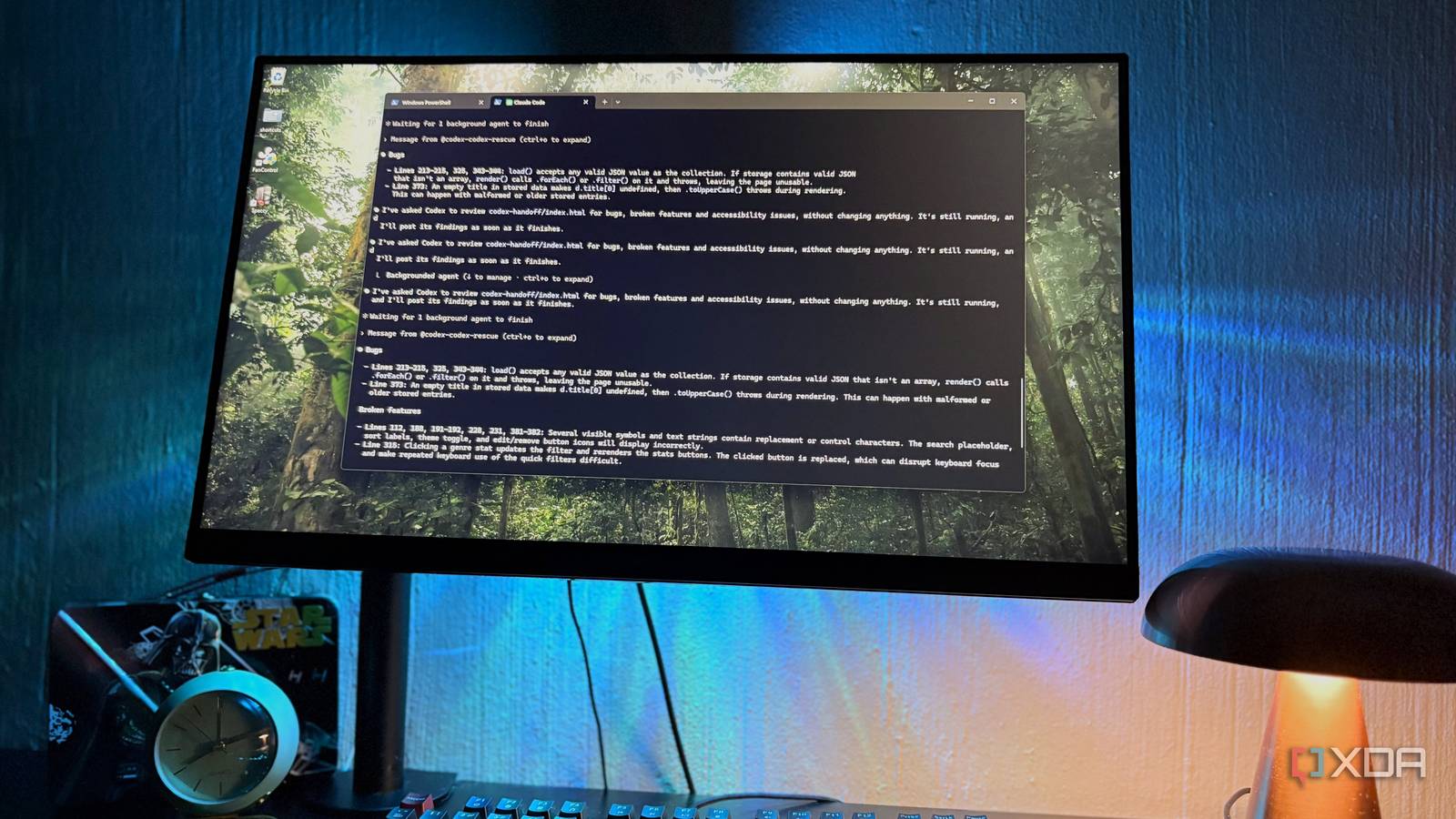
Published Oct 6, 2026, 7:00 PM EDT Nolen began their writing career in 2019, with three years dedicated to editing the Creative section at MakeUseOf. Their expertise lies at the crossroads of technology and creativity, covering areas like photography, video editing, and graphic design. Outside of work, you'll often find Nolen diving into a good book, writing their own stories, or playing video games. Whenever Claude Code finishes a build, it will let you know, and the file usually opens and will mostly work. What it doesn't tell you is what's off with the first look, and if you don't actually write code, like me, then there isn't much to check it against. Reading line by line isn't realistic for me so I have to rely on testing the build and asking the agent what's happening underneath. OpenAI publishes an official plugin that puts Codex inside Claude Code, which seemed like a cheap and easy way to get a second opinion without leaving the window. A second set of eyes that can actually read the code made more sense than a second set of mine, so I built a test project and gave Codex the file Claude had already called done. What "done" actually means in Claude Code The problems that never throw an error Claude Code is good at getting a file that runs, but where it tends to let me down is what happens after the fact when a job gets reported as done but something still feels off. In a landing page I built with Fable 5, for example, the background animation was supposed to be a scatter of shards. Claude Code confirmed they were spawning and called the page done, but on screen they were huge with borders that made them look like loose buttons, and it took two rounds of asking before they stopped looking like that. Edits are another thing. I can ask for one small change and Claude tends to adjust things I never mentioned, so fixing one problem tends to leave me with even more, or just a course of direction for the project. These quirks won't throw you an error, Claude will still report success. So the only way to notice the issue is when I look at the right part of the build and catch it myself - or get a second opinion, because I'm almost certainly bound to miss something on my own. Handing my projects from Claude to Codex Pulling a second pair of eyes into the same window OpenAI built a plugin that lets you hand off work from Claude directly to Codex. It works by calling the Codex command line tool you install on your PC and using that tool's login, so whatever Codex does comes out of my ChatGPT plan and not Claude's. A ChatGPT account is needed (the free one counts) or an API key, plus Node.js 18.18 or newer. You start by logging into Codex. Then inside Claude Code, type /plugin marketplace add openai/codex-plugin-cc followed by /plugin install codex@openai-codex, and it asks how widely the plugin should apply (I picked the narrowest option, so just the folder I was working in). Using it comes down to /codex:rescue plus a description of the job. A small Claude helper will pass that to Codex, which works in the background, and the answer shows up in the same window as a message from Codex. What a second model found in a file Claude had finished Reviewing a project Claude called done The project here was called DVD Shelf, which is a one-file tracker for a DVD collection with a dark mode that remembers your choice. I used Opus 5.5 on Medium, and it handed it to me as finished. Then I passed it to Codex through /codex:rescue with instructions to review everything and change nothing, and the list came back in seconds. Keep in mind, I didn't configure a model, meaning Codex would have defaulted to codex-mini-latest, which is optimized for speed and instruction following. For one, the page would have completely crashed if the stored collection was anything other than a clean list of DVDs, or even if any entry was missing a title. Then there were the garbled characters - some of the icons in the file were broken replacement characters that would have rendered as unreadable boxes in the browser. Claude wrote them in and moved on, but Codex noticed. What followed was more about accessibility functions. The decorative initial on each DVD cover was being read aloud by screen readers before every title, since there wasn't anything to tell it to stay quiet. Clicking a genre stat updated the filter but then also broke keyboard focus because the button would get replaced in the re-render. Search result counts would update on-screen, but not in a live region, so screen reader users wouldn't have been able to hear anything change. I wouldn't have caught all of these things by using the page myself. I think Claude built it more like a human would have, with a mouse on a clean file and none of my own data in it yet. Not every project needs to stay with the tool that started it I still default to Claude for building my projects, primarily because it's where my rules and skills already are. But sending my builds to Codex for a read-through seems like the smart thing to do now, because I wouldn't be able to catch all the bugs myself, and Claude will likely make changes I didn't ask for during the iteration process. This whole handoff came to about 5% of my Claude usage that day, which isn't too bad, but it was a pretty small project so the jury is still out on larger ones. Codex
I let Codex take over a project Claude Code couldn't finish, and it caught issues Claude missed
Full Article
Original Source
Read the full article at Xda-developers →KhanList aggregates and links to publicly available news content. We do not host full articles from third-party sources. Always verify important information with original sources.