
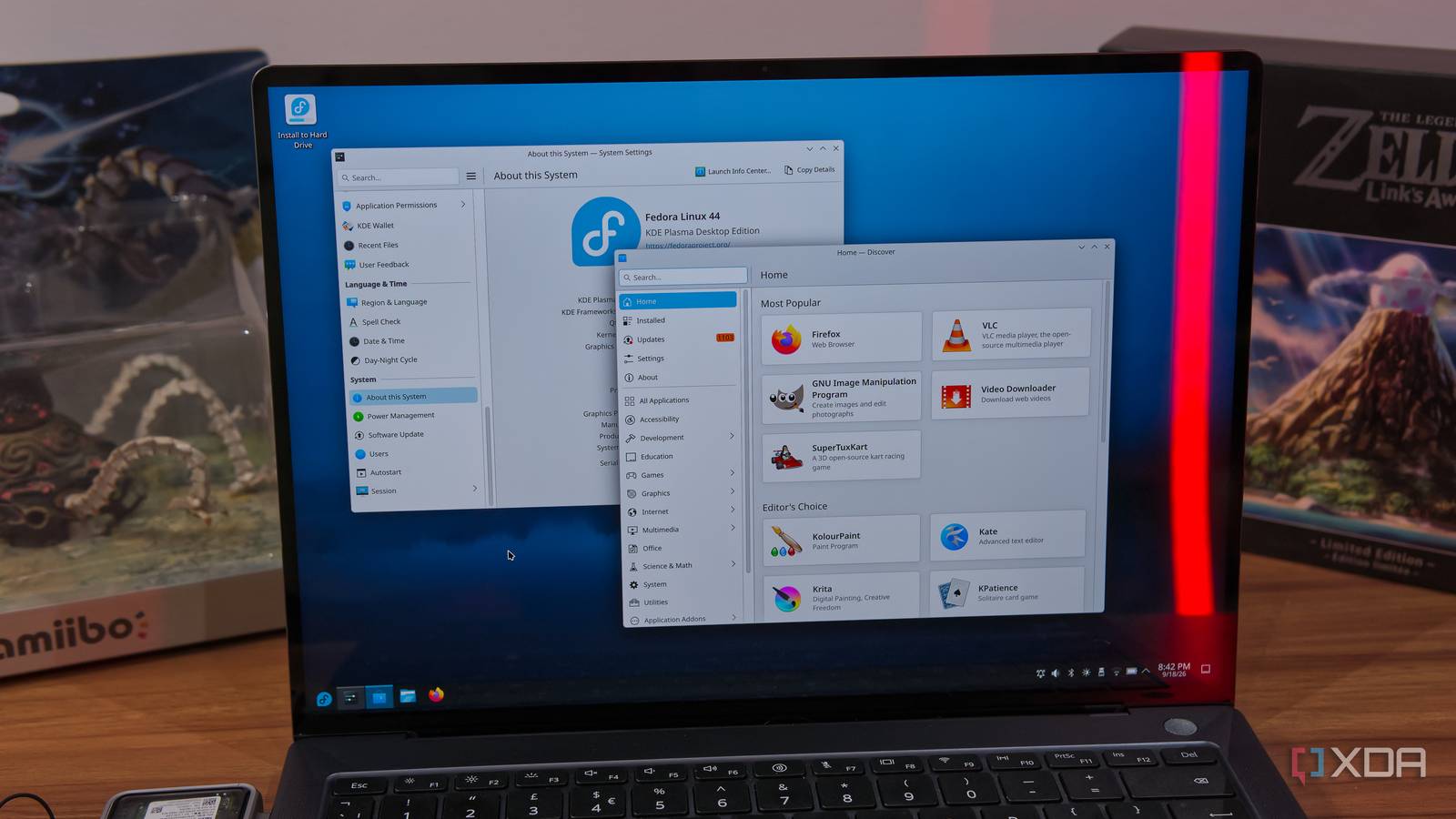
Published Oct 18, 2026, 8:00 PM EDT Simon is a Computer Science BSc graduate who has been writing about technology since 2014, and using Windows machines since 3.1. After working for an indie game studio and acting as the family's go-to technician for all computer issues, he found his passion for writing and decided to use his skill set to write about all things tech. Since beginning his writing career, he has written for many different publications such as WorldStart, Listverse, and MakeTechEasier. However, after finding his home at MakeUseOf in February 2019, he would eventually move on to its sister site, XDA, to bring the latest and greatest in Windows, Linux, and DIY electronics. So I'm trying to escape Fedora. It's not because I don't like Fedora (I do), and it's not because I hate Red Hat (I don't). It's because Fedora was only the second Linux distro I took seriously. The first was Linux Mint, which convinced me that Linux was worth the effort; once I had learned what I did and didn't want from my distro, I packed up and moved to Fedora KDE. There's absolutely nothing wrong with settling for the second distro you ever come across, but with so many options, all of which are doing something unique, and all of which are free, I had the feeling that simply staying with Fedora forever would be foolish; at least, not without me exploring other distros. There's just one problem: no matter how hard I try, I cannot escape Fedora. Fedora has the backing of big businesses It's not something everyone likes, but I do The cool thing about Fedora is that it's only one of three steps in the Red Hat chain. Users (like me) get the newest updates first in Fedora. Once Red Hat irons out the issues we spot, they move the stable bits down to CentOS Stream for enterprise use. And once they're totally sure that some of the parts are as stable as they'll get, the changes arrive in Red Hat Enterprise Linux (RHEL), for important enterprise systems that absolutely cannot afford to go down or crash. In a way, that means that I'm using all the cool new features that will eventually become the backbone of some of the biggest tech companies in the world. I think that's a good deal; after all, RHEL does not come cheap, yet here I am, using Fedora for nothing. In exchange, I can report bugs that I find and help Red Hat iron them out so they can eventually be merged into CentOS and RHEL. Of course, this also means that Red Hat has a ton of funding through all the businesses they service. It's good to know that Red Hat has a source of income it can use to keep the lights on while I'm here tinkering with its newest OS. Fedora is the most stable OS I've used yet I've not found one more stable If you've been following my Linux adventures, first of all, thank you. Second, you may be wondering where openSUSE Tumbleweed went. openSUSE is my second-fave distro, and came very close to dethroning Fedora. But, despite openSUSE Tumbleweed being a very good distro with a good level of stability, I found Fedora to be just that little bit more stable. With openSUSE, I noticed that my browsers would sometimes have their login details entirely wiped. Sometimes it would happen after an update, and sometimes it just happened while closing and immediately opening the browser again. I also had issues with openSUSE running on my older hardware, as it would keep visually locking up for about 20 seconds every day while thrashing my SSD. And sometimes, my PC would 'forget' where GRUB was after an update, and I'd have to hop into the BIOS and tell it where it was. Fedora isn't exactly perfect; it, too, has had its little problems. But the key is that, when Fedora messed up, it was usually a one-time thing. Something bad happened; I'd think, "That was strange," fix it, and then it'd never happen again. openSUSE's issues were recurring and ended up annoying me to the point where I returned to Fedora and never experienced them again. Fedora's flavors are great to explore I wouldn't have discovered atomic distros without them Finally, I really like the different flavors of Fedora you can get. When I said that my second-ever distro pick was Fedora KDE and I stuck with it for months, that wasn't technically true. I also fell in love with Fedora Kinoite, which is the atomic version of KDE. The atomic version has the same look and feel as Fedora KDE, but you cannot modify system files or install software via the terminal. It sounded like a nightmare to begin with, but it very quickly proved me wrong. Now I enjoy the stability and reliability of an atomic, immutable KDE version of Fedora, and if I tire of it for any reason, I can just reinstall Fedora KDE and get all the regular features back again. Second time was the charm My Linux adventure started in earnest with Fedora, and after exploring a ton of distros, I'm back to where I (almost) started. I suppose I'll coast with Fedora for now and see how things change in the coming years.
I keep trying to escape Fedora, but it's the perfect Linux distro for me
Full Article
Original Source
Read the full article at Xda-developers →KhanList aggregates and links to publicly available news content. We do not host full articles from third-party sources. Always verify important information with original sources.