
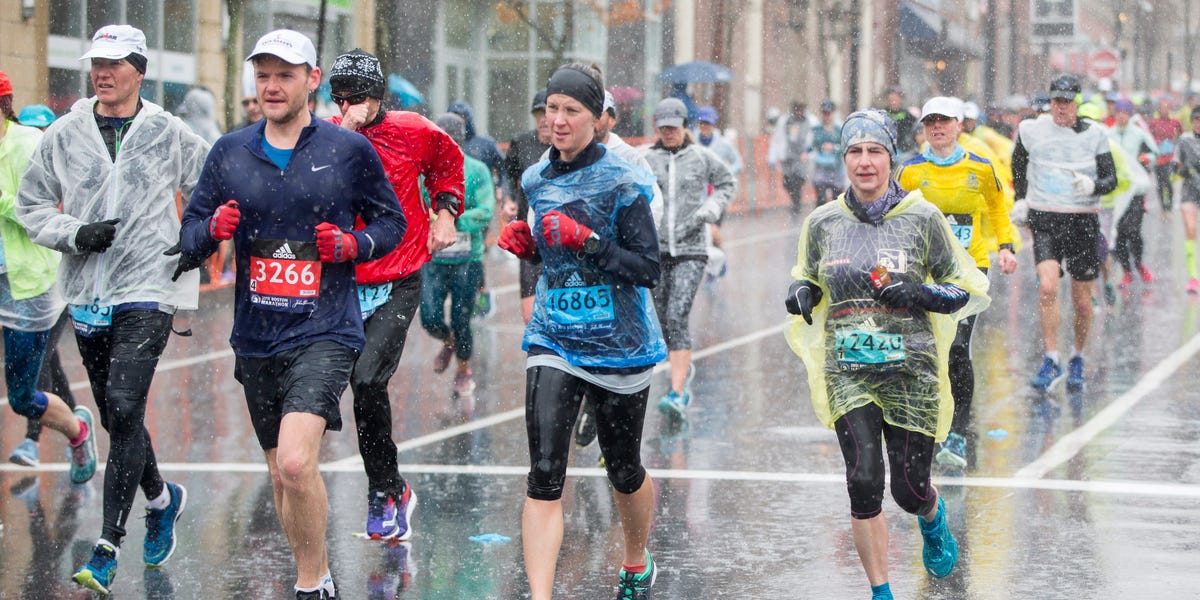
My first marathon, on an unseasonably cold fall morning nearly a decade ago, still feels like a fever dream. I remember sitting alone in my car in the dark with the heat blasting, rain pounding the windshield, and my knees up on the steering wheel as I sipped gas-station coffee and Glacier Cherry Gatorade with a hundred-yard stare.When I finally dragged myself out of the car to make my way toward the starting line, I considered the exceptional cruelty of the universe for denying me a prerace poop before I surely perished on the course.But my debut marathon didn’t need to be this bleak: I got myself into this position because I was a newly hired editor at Runner’s World who deeply wanted to meet the imagined expectations of her colleagues.At the time, I was consistently logging 80-plus-mile weeks simply because that’s what I’d done when I ran competitively in college, and I was scared to do anything else. So when a fellow editor heard that I had never run a marathon—and was putting in high mileage for what I called “just the love of the game”—he couldn’t believe it.“Are you kidding me?! You’re running that much but you don’t think you’re ready for a marathon?” he sputtered when he found out in early September. “You absolutely have the fitness, Morgan! No doubt about it!”As luck would have it, the defunct Via Marathon (now the D&L RaceFest held in Pennsylvania in November) was the next weekend—and the starting line wasn’t even a full five-minute drive from my house. Needless to say, my colleagues begged me to sign up; they knew I could do it. And I wanted to believe it, too. What would happen if, just once, I did something without overthinking it? I was reluctant, but, “Peer-pressure makes diamonds,” I told myself.The day before the race, I drove to the expo, signed up, and got my bib. I told no one. And not 24 hours later, I was running on the marathon course.Miraculously, it was not a complete train wreck. It was, however, quite possibly the absolute least enjoyable way a person could ever run a marathon: underfueled, cold, wet, and alone. While I couldn’t fix the weather, I absolutely could have shown up on race day with the support of a friend and at least one energy gel.What I Got Wrong at My First MarathonI Had No Clue How to FuelEven though I’d previously logged 20-plus-mile runs, I’d done little more than taste a college teammate’s spare GU out of curiosity. With zero fueling experience—and faithful to the “nothing new on race day” creed—I decided to rely solely on the aid stations along the course.About every three miles, the marathon provided Dixie cups of water and lemon-lime Gatorade Endurance (a super-concentrated formulation). For the first water stops, I grabbed a cup of Gatorade, took a sip or two, then chucked the rest. But even that strategy made me nervous my stomach would revolt in the final miles.So once I hit the half marathon mark, I decided I was far enough along that I could finish without it, and skipped the remaining aid stations entirely. Looking back on it now, I realize this was inherently risky, if not outright dangerous.I Tried to Do It Alone I was so paralyzed with fear on race day that I didn’t speak to a single runner on the course; I didn’t cheer anyone on, and I didn’t even let the people who loved me most know where I was that morning.I chose to race in isolation, which meant I missed out on fully engaging with the other fantastically weird people who love running the same way I do. And that meant I missed out on so much of the joy and community that makes the marathon unlike any other race distance.The One Thing I Got Right Surprisingly, I paced my first marathon pretty well. I was so worried I wouldn’t finish that I started the race super conservatively, more than a minute slower than most of my 9:00 pace easy runs. Since I hadn’t tapered at all, my legs felt like bricks—but that at least made it easy to keep my pace at a crawl. Of course, that’s no strategy for a PR race: It worked for me because I had no goal other than to cross the finish line alive.Only after I passed the half marathon mark did I allow myself to pick up the pace a bit each mile. For reasons I still don’t fully understand, my legs loosened up after the first 10K, and I actually felt invincible for the final eight miles. With 5K to go, I hit paces that I’d rarely touched in training. I negative-split the race, dipping below 8:00 pace for the final stretch, crossing the line in 4:14:14 … and I felt like I could have kept going.But the marathon is about so much more than pacing and race results.Because if you look at my finish photo, you’ll see a very cold and soggy, but smiling, runner crossing the line. And you might think that’s the face of a triumphant marathoner. But that’s not really happiness so much as it is relief: relief that I didn’t “fail” by dropping out or getting swept.On paper, I’m a marathoner, and I’m still so proud of that. It just feels a little hollow: I ran those 26.2 miles because I was afraid to fail—not because I believed I could succeed.Was My Next Marathon Any Better? After I recovered enough to unpack the insanity of it all, I decided my next marathon would be different. I wouldn’t sign up for another until I was confident that I could fuel it well, train for it properly, and bring along the people I care about for the ride. And all that has taken quite a lot of work—physically, mentally, and emotionally.I hope it doesn’t disappoint anyone reading this to know that I haven’t run another marathon yet. I hope to one day, but until then, I remind myself that I’m not on anyone’s timeline but my own. Life in itself is an endurance sport that demands patience and persistence: The goal is to just keep putting one foot in front of the other.Morgan is a gear editor who has been with Runner’s World since 2017. She started as an intern ghostwriting The Warmup, a bygone version of the daily RW newsletter. Now, she tests and reviews anything you might find on runners’ feet-from crew socks and compression boots to carbon-plated super shoes. A lifelong runner and shoe geek, Morgan has been chasing the perfect pair of kicks since she joined her grade school cross-country team. Since then, she ran as a Division I walk-on for the cross-country and track & field teams at the University of Delaware, where she studied English and Biology. She has one full marathon under her belt, and has raced more halfs and 5Ks than she can count.
I Got Almost Everything Wrong at My First Marathon. The One Thing I Did Right Saved Me From a 26.2-Mile Train Wreck
Full Article
Original Source
Read the full article at Runnersworld →KhanList aggregates and links to publicly available news content. We do not host full articles from third-party sources. Always verify important information with original sources.