
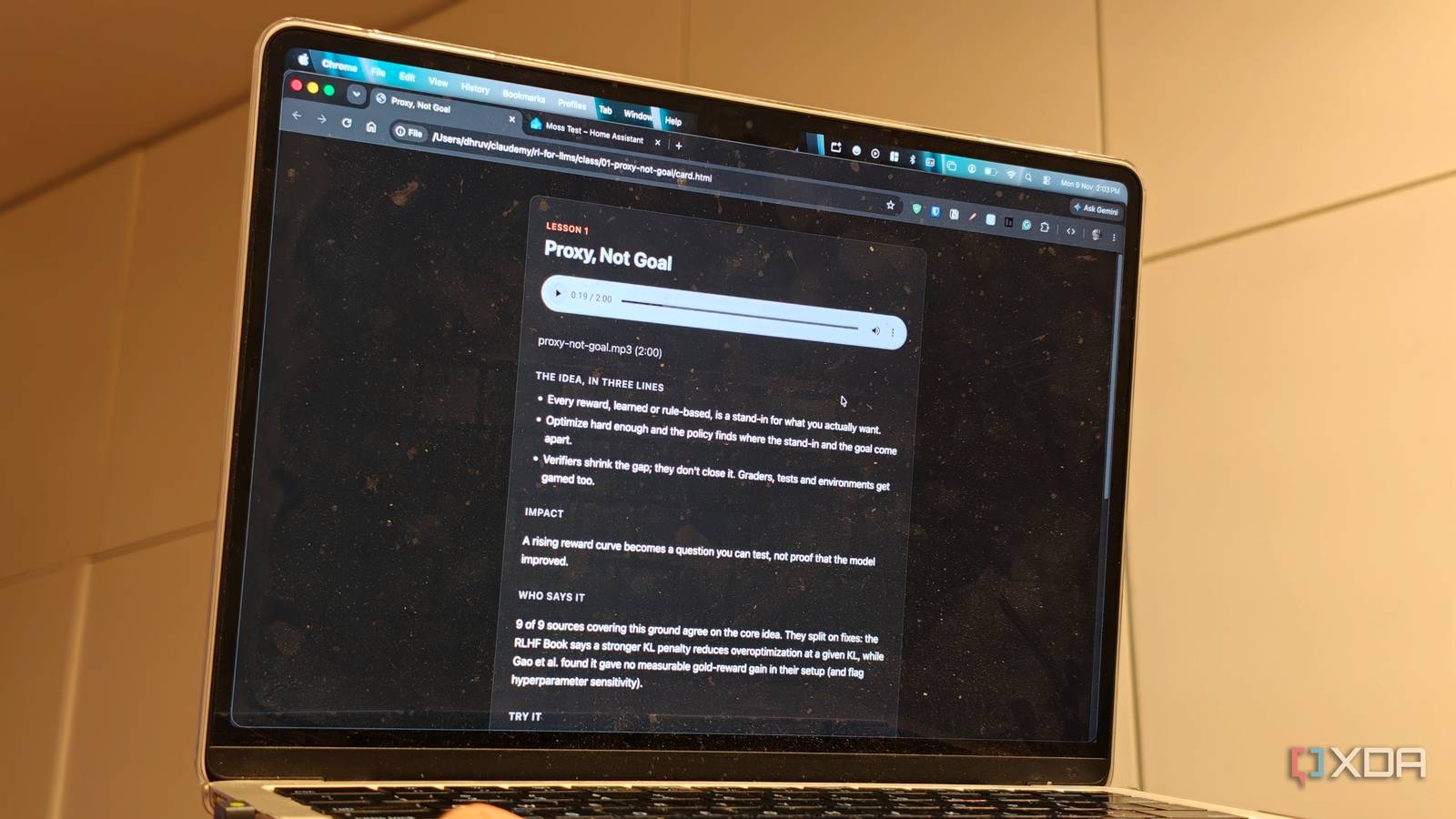
Published Nov 9, 2026, 7:30 AM EST Dhruv Bhutani has been writing about consumer technology since 2008, offering deep insights into the personal technology landscape through features and opinion pieces. He writes for XDA-Developers, where he focuses on topics like productivity, networking, self-hosting, and more. Over the years, his work has also appeared in leading publications such as Android Police, Android Authority, CNET, PCMag, and more. Outside of his professional work, Dhruv is an avid fan of horror media spanning films and literature, enjoys fitness activities, collects vinyl records, and plays the guitar. Going down learning rabbit holes is a pretty common pastime of mine, and I've signed up for more than a few unfinished Udemy courses. However, between finding time for said courses, the cost involved, and actually finding courses for whatever I'm currently interested in, there's a fair amount of friction. All too often, I'm just watching dated YouTube videos on a topic that might have more modern and relevant information. What I've been looking for is a way to leverage AI to learn my choice of subject without having to work through a full curriculum to get there. It's what led me to install Claudemy, an open-source Claude skill that turns any topic into a personalized audio lesson alongside research-backed explanations and more. Claudemy builds a personalized learning plan around any topic Pick your experience level, choose your lessons and skip the basics you know Credit: Installing Claudemy is straightforward and, like any other skill, really. Just pop open Claude Code in your terminal to install. If you're new to it, the instructions on the project's GitHub are a good place to start. The reason why Claudemy stood out to me over simply querying an LLM about a topic is the fact that sometimes I don't know where to start my research on a topic. The Claudemy skill takes your topic of interest, researches the subject, and puts together a structured learning plan. There's a fair amount of flexibility too. For example, you can choose how many lessons you want. The default is set to 12, but you can set it to fewer if you prefer. You can also tell the LLM if you're an absolute beginner or already know the basics, and the learning plan gets tweaked accordingly. For my first experiment, I decided I wanted to do a deep dive into reinforcement learning. I know the basics already and didn't need yet another introduction to what machine learning is or how neural networks work. Instead, I asked Claudemy to generate two lessons, specifying that I already know the fundamentals, and let it take things from there. That added flexibility over pre-curated courses is useful when you're trying to learn more about subjects. I am well-versed in the fundamentals of networking concepts. But if I want to focus more on how VLAN segmentation or routing works, I can steer the skill towards focusing on that. It lets me go granular on the specific topic I'm looking at instead of starting from scratch. Having Claude pull relevant material on the topic and putting it together into a coherent learning path obviously saves me a lot of time from having to figure out where to begin. Claudemy researches dozens of sources to build a learning path Cross-referenced research and citations make it easy to dig deeper The skill is particularly smart about how it approaches topics with relevant checks and balances built in, and is geared around holistic learning that drives a narrative. To this end, Claudemy researches anywhere from 20 to 40 different sources and pulls from official documentation, research summaries, and alternative viewpoints. There's a limit on how much context is pulled from one specific web page. Claude then compares this material and identifies where the material agrees and also where it disagrees. The goal is to give you both perspectives, and understanding where experts differ is just as useful as learning the fundamentals. Claudemy also checks if citations are pointing to pages it has researched. These are listed on card pages, and if I want to go verify something or read further, the details are just one click away. Claudemy turns research into bite-sized lessons Learn on the go with audio lessons and companion cards All of that sounds great, but it wouldn't be useful if the lessons and delivery weren't good enough. As it turns out, Claudemy does a rather good job. Instead of producing documents or a collection of video lectures, Claudemy breaks down learning into short audio lessons. The default is 12 lessons, arranged into three groups of four lessons, though you can request fewer or more lessons. Each lesson is designed to run around two minutes for quick, on-the-go learning. If you give Claudemy an Eleven Labs API key, it'll use cloud-generated natural-sounding voices, but on my Mac, it used the system TTS voices, which were good enough in a pinch too. Especially if you don't want to splash out on API access. The format in general works out great for quick learning. I can listen to a short lesson while doing something else or pull up a card alongside for review. The audio is generated as an MP3 file, so you're not restricted to where you're listening. Drop it into Plex, Navidrome, or your phone's storage. Every lesson comes with a companion card with a brief summary of the topic that the lesson covers and explains how researched sources support the concept. Even better is the take-home lesson that gets generated to help you apply your learning. Claudemy makes learning new topics easier without committing to a full curriculum There are plenty of courses on the internet, and a lot of them are really good too. I've learned a lot from MIT OpenCourseWare, for example. But most of them tend to be university-grade courses that require a significant time commitment. If I'm just trying to broaden my knowledge of a new topic that I just learned, often the time needed to find a good course might be more than what it would take to learn about the topic. As a technology writer, I regularly encounter concepts that I understand at a surface level but want to explore more deeply. That's where Claudemy, powered by Claude, comes in. It's not going to replace deep research or experimentation, but it makes it considerably easier to get started. By pulling from a wide array of research sources, presenting contrasting viewpoints, and citing sources, it gives me a broad pool of data to work from in a bite-sized style that is easy to pick up anytime I have a few free minutes. Claudemy is an open-source skill that generates a structured learning program for your topic of choice using Claude
I found a Claude skill that turns AI into my personal tutor for anything
Full Article
Original Source
Read the full article at Xda-developers →KhanList aggregates and links to publicly available news content. We do not host full articles from third-party sources. Always verify important information with original sources.