
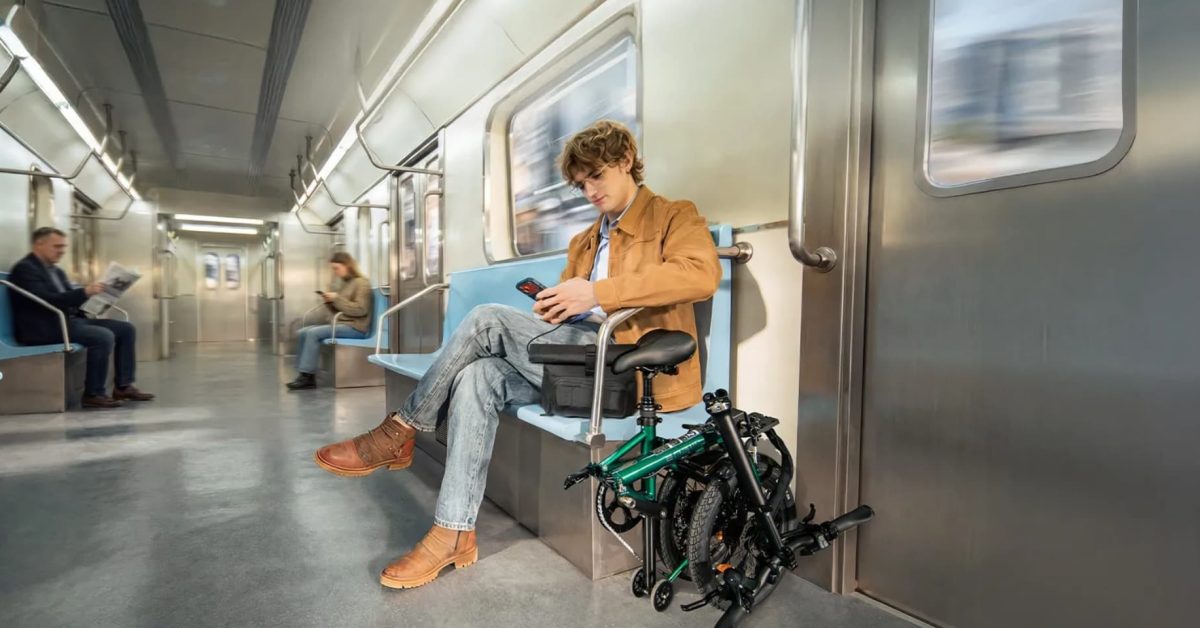
I’ve been waiting years for electric bikes to finally embrace USB-C charging. We’ve already standardized much of our lives around the convenient little connector, from phones and laptops to tablets and countless other gadgets. But for some reason, electric bikes have largely missed the memo. Now, though, I’m finally riding an e-bike that charges with USB-C, and the best part is that it doesn’t cost an arm and a leg. Meet the ENGWE Zip, a quirky little folding electric bike that costs just €999 and has quickly become one of my favorite examples of how a small feature can make a big difference. When it debuted earlier this year, it became only the third production e-bike I’ve seen that could charge via USB-C, allowing it to use the same charger that is likely already shared by your phone and laptop. USB-C charging on electric bikes isn’t entirely new, but it’s surprisingly rare. Ampler was one of the first companies to introduce it barely a year ago, though its bikes are sadly no longer in production after the company’s bankruptcy. More recently, Rivian’s ALSO electric bike arrived with USB-C charging, but that bike costs around $4,500 – at least if you want the model that’s slowly starting to ship. The ENGWE Zip, on the other hand, costs roughly a quarter as much as its only USB-charging competition. At €999, it’s priced at a relatively affordable US$1,100. That’s a quarter of the cost of the only other USB-C charging e-bike on the market. Of course, it’s not nearly as technologically advanced as Rivian’s ALSO e-bike. But hey, it’s at least shipping. And while the Zip is a fun little 16″ wheel folding electric bike in its own right, with a compact design that makes it easy to store and transport, it’s the charging setup that has me particularly excited. Instead of keeping track of yet another proprietary charging brick, I can simply grab the USB-C charger from my laptop and plug it into the bike. There’s one in my living room by the couch. There’s one by my bed. There’s one in all of my friends’ places. There’s a USB-C charger everywhere. If I’m traveling around, that means one less charger to pack. If I’m visiting someone, there’s a decent chance they already have a compatible charger sitting around. Heck, I can even use a basic USB-C phone charger in a pinch. Sure, charging a relatively large e-bike battery at 20W isn’t going to be particularly quick, but the fact that I can do it at all is incredibly convenient. Plus, the bike has one more trick. The battery also outputs USB-C, so I can charge my laptop or other devices from it as well. I can even charge two devices simultaneously, thanks to the dual USB-C ports. The battery is housed in a roll-top bag that is locked into the headset of the bike but can be quickly unlocked for charging off the bike. And since it’s a keyed lock, no one can steal the battery even when the bag is left on the bike. I typically charge the battery still mounted on the bike, though occasionally when I want to use a friend’s USB-C charger, I’ll just pop the bag off and bring it right up to wherever the closest USB-C charger is located. It may not be the fastest charge, but it’s pretty darn convenient. And with a 360Wh battery, a powerful 100W laptop charger will still get it pretty much full in 4 hours, or for a more typical 50% recharge, roughly two hours. And that’s really the beauty of USB-C charging. It’s not necessarily about charging faster. It’s about having options. It’s about not being stuck if the very specific charger that only works on your e-bike doesn’t happen to be around exactly where you are. Of course, there’s a technical reason we haven’t seen USB-C charging spread across the e-bike industry quite as quickly as it has with smaller electronics. Most e-bike batteries operate at 36V or 48V nominal, meaning their charging voltages are higher than the 20V typically supplied by common USB-C laptop chargers. That requires additional voltage conversion and charging circuitry inside the bike or battery. But clearly, it can be done. And if ENGWE can offer it on a €999 electric bike, there’s a pretty compelling argument that more manufacturers should be taking a serious look at the technology. In this case, it’s all housed inside the battery, meaning it could be directly incorporated into any e-bike whose manufacturer is brave enough to spec it. I’m not suggesting that every e-bike needs to abandon its dedicated charger tomorrow. For larger batteries, high-powered chargers still make plenty of sense, especially when you want to get back on the road quickly. But having USB-C as an additional charging option? That’s something I’d love to see become standard. For years, we’ve seen how electric bikes are becoming more convenient, more practical, and better integrated into our everyday lives. Yet when it comes to charging, we’re still carrying around a collection of more or less proprietary chargers. Now I’m riding a barely $1k electric bike that can charge from the same power brick as my laptop. And frankly, I think it’s about time the rest of the e-bike industry caught up! FTC: We use income earning auto affiliate links. More.
I finally got a USB-C charging e-bike, and it costs 75% less than Rivian’s bike
Full Article
Original Source
Read the full article at Electrek →KhanList aggregates and links to publicly available news content. We do not host full articles from third-party sources. Always verify important information with original sources.