
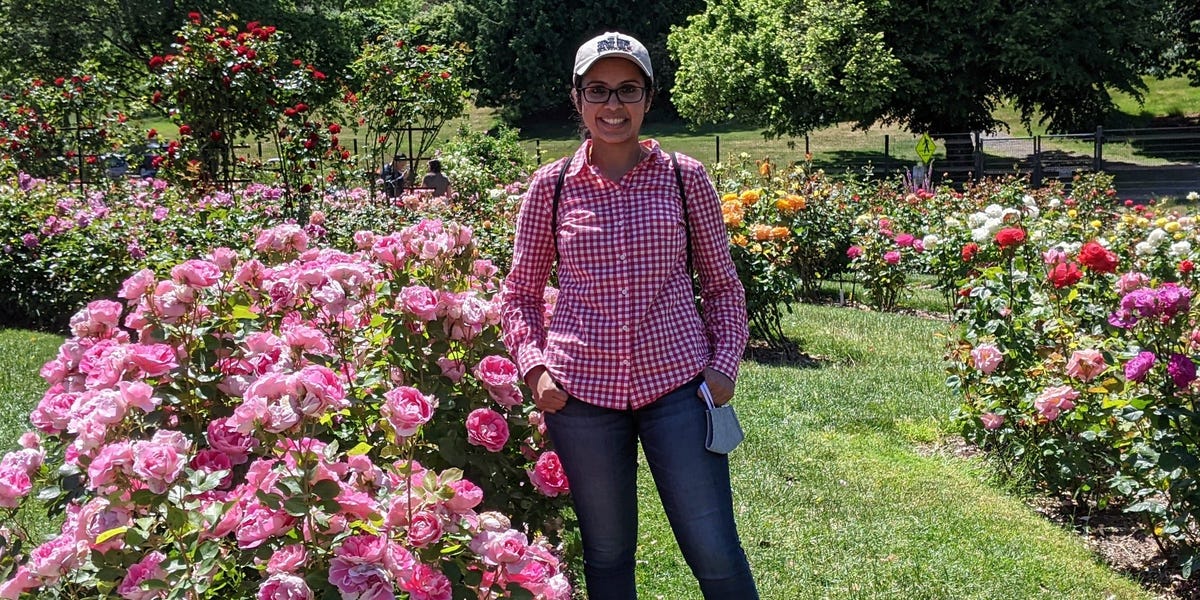
I earn over $400,000 a year in an overlooked tech job. AI is making my work even more exciting. Courtesy of Nikhila Pothukuchi Nikhila Pothukuchi says AI is transforming her job. This as-told-to essay is based on a conversation with Nikhila Pothukuchi, 38, an electrical engineer at Google who lives in California. The following has been edited for length and clarity.Time flies. I've been in electrical and electronics engineering for about 12 years, at Intel, Microsoft, and now Google, where my compensation is over $400,000.As AI demands become more complex, so too are the hardware systems I work on. It's an exciting time to have this job. My job can be hectic but variedI have a master's in electrical engineering, and I help design the electrical components of a product, like a Google Pixel phone, an Xbox, or a data center server, and that variation in scale brings different challenges. I might spend the afternoon in a lab testing a prototype circuit board under a microscope, and the evening on a video call with a contract manufacturer troubleshooting a defect.Before we hand the product over to software engineers, we often use a primitive type of software to check for hardware-related glitches. A new phone could be shipped out in less than two years of development, which can be hectic as an electrical engineer.Bugs in the hardware world can be devastating and hard to fix. While a software engineering brain thinks, "Move fast and break things," a hardware-oriented brain has to think, "Measure twice, cut once." Pothukuchi has been in electrical and electronics engineering for about 12 years. Courtesy of Nikhila Pothukuchi Electrical engineers deserve more credit in the AI eraIn today's world, it feels like everything I'm designing and building is for AI, from servers that host AI bots to smartphones that run AI applications. AI requires intense compute power, and with that comes the challenge of dissipating heat from hardware components that are doing computations at a mind-blowing rate. We also need to make sure AI is not over-utilizing the device's battery, because no user is going to buy a phone that needs to be charged every 10 minutes.Sometimes I think electrical engineers aren't getting enough credit. When people use AI applications on their devices, I don't think they're thinking about what's happening at the hardware level. If something goes wrong, most users will assume it's the software, but there are so many layers beneath that are easily overlooked.I've even struggled to get my family to understand what my role in delivering a product is, and I have different analogies to help them. For my brother, an avid Formula 1 fan, I compare software engineers to the drivers who get the spotlight on race day, while electrical engineers build the powertrain, cooling architecture, and fuel delivery. Even the best driver can't win if the car overheats or runs out of fuel after two laps. When I talk to job seekers in the engineering space, I notice most of them want to do things related to AI, and many see software-related jobs as the obvious path.However, AI is doing a lot of the coding in software engineering these days. For many software engineers I know, their job has become less hands-on and more about reviewing the code. Meanwhile, electrical engineering feels like it's becoming more hands-on.We have some really exciting problems to solve. Read next Business Insider tells the innovative stories you want to know Business Insider tells the innovative stories you want to know Business Insider tells the innovative stories you want to know Business Insider tells the innovative stories you want to know Charissa Cheong is a senior first-person reporter on Business Insider's Business Contributors and Freelance team, based in London. She covers: Relocation and immigration, how employment visas impact careers, what it’s like working at the world’s biggest companies or alongside its most prominent leaders, how the AI revolution is affecting professionals, and more. Charissa’s work spans a wide range of topics, but the unifying thread is first-person storytelling — sharing people’s unique career and life experiences in their own voice, with their own words. She writes in Business Insider’s signature “As-told-to” format, which is designed to highlight powerful perspectives in a conversational way. She also commissions and edits personal essays from freelance writers and contributors. Charissa joined Business Insider in 2022 on the digital culture desk, covering family vlogging, online harassment, and influencer culture. She moved to the contributors and freelance team in 2024.She graduated from the University of Cambridge with a BA in English and holds a gold standard NCTJ Level 5 journalism diploma. as told to
I earn over $400,000 a year in an overlooked tech job. AI is making my work even more exciting.
Full Article
Original Source
Read the full article at Businessinsider →KhanList aggregates and links to publicly available news content. We do not host full articles from third-party sources. Always verify important information with original sources.