
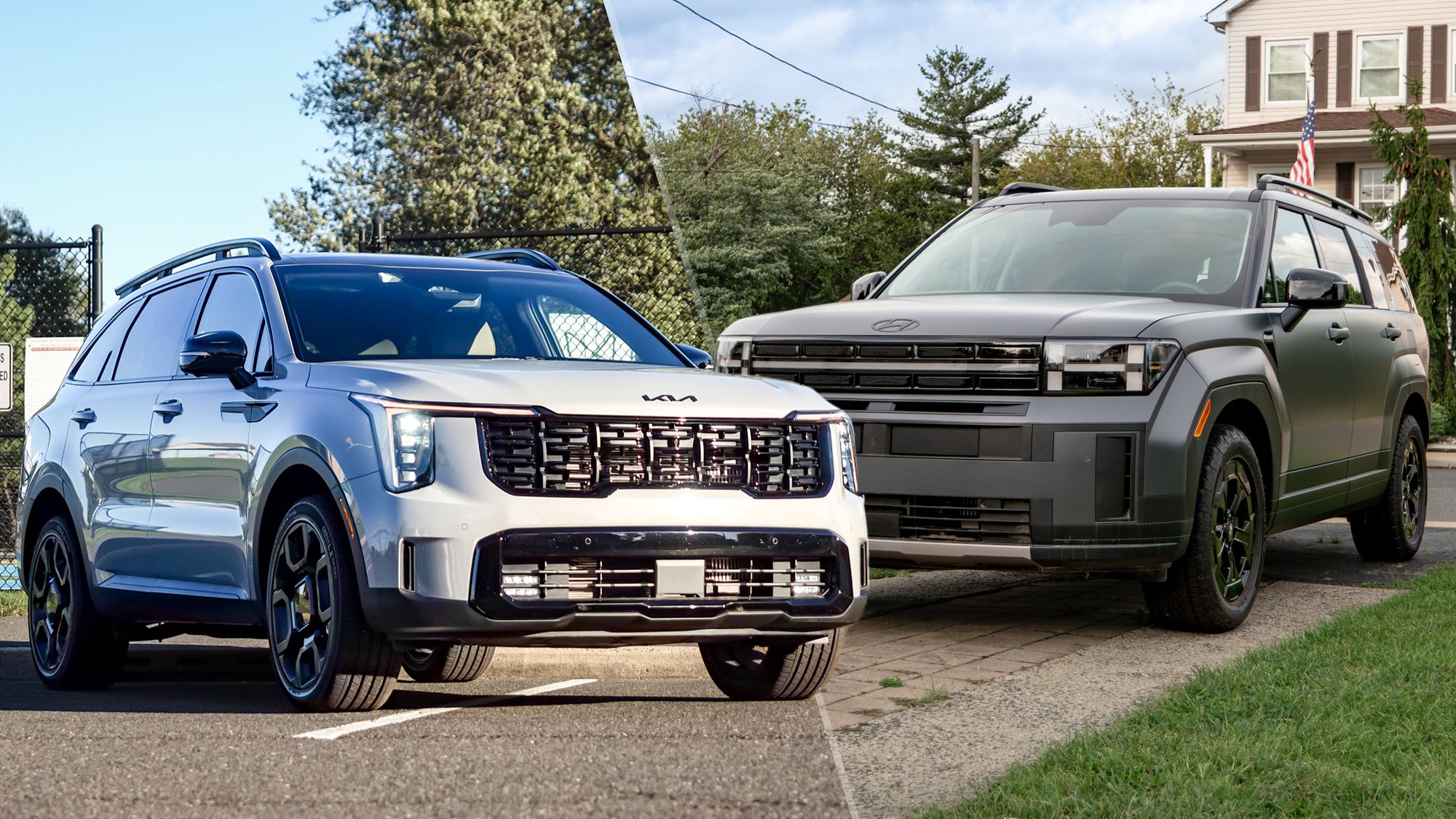
(Image credit: John Velasco / Tom's Guide) If there’s one type of vehicle I test more than anything else, it’s three-row SUVs. While three rows have long been tied to full-size options, there’s been a surge of automakers bringing third-row seating to mid-size crossovers — and this Kia Sorento vs. Hyundai Santa Fe matchup is something I’ve been waiting to cover.I’ve previously put their larger siblings, the Kia Telluride and Hyundai Palisade, to the test. While both are fantastic, some families might shy away due to their higher price tags. That’s where their mid-size counterparts step into the spotlight, offering the same family utility at a much more accessible price point.For this head-to-head test, I drove the 2026 Kia Sorento X-Line SX-Prestige 2.5T AWD and 2026 Hyundai Santa Fe XRT 2.5T AWD for a week each — with both coming in at under $50,000. After putting each through grocery runs, highway commutes, tight parking spaces, and everyday driving, only one mid-size three-row SUV earns my recommendation.Kia Sorento vs. Hyundai Santa Fe: Specifications Swipe to scroll horizontally Header Cell - Column 0 2026 Kia Sorento X-Line SX-Prestige 2.5T AWD 2026 Hyundai Fe XRT 2.5T AWD Price Tested $49,310 $44,525 Fuel Economy 20 mpg city / 27 mpg highway / 23 mpg combined 19 mpg city / 25 mpg highway / 21 mpg combined Engine 2.5L Turbocharged 4-Cylinder Engine (AWD) 2.5L Turbocharged 4-Cylinder Engine (AWD) Fuel Tank Capacity 17.7 gallons 17.7 gallons Horsepower 281 hp 277 hp Wheels 20-inches 18-inches MSRP $46,790 $41,790 Kia Sorento vs. Hyundai Santa Fe: Design Image 1 of 3 2026 Hyundai Santa Fe XRT. (Image credit: John Velasco / Tom's Guide) I’ll be the first to say that the Santa Fe commands attention on the road, blending a boxy silhouette with a retro-futuristic vibe that instantly evokes memories of the classic Scion xB.Up front, the bold "H" signature LED daytime running lights give it an unmistakable face, while the optional Ecotronic Gray Matte paint job adds an urban edge that’s tough to overlook. But despite those highlights, the design falls flat at the rear. The slab-sided tailgate looks awkward in person, and the low-mounted taillights sit so close to the rear bumper that they create an oddly disproportionate look. Image 1 of 3 2026 Kia Sorento X-Line SX-Prestige. (Image credit: John Velasco / Tom's Guide) In contrast, the Kia Sorento delivers a much more cohesive shape that’s simply easier on the eyes. Sure, it leans more conventional than the polarizing Santa Fe, but it borrows style cures from the Telluride and EV9 that make it stylish in its own right.The Sorento features a broad, upright grille flanked by vertical LED headlights, paired with sculpted body lines on its side that flow more naturally. Around back, high-mounted taillights pushed to the outer edges accentuate its planted stance. Throw in the rugged blacked-out exterior accents and 20-inch gloss-black wheels of the X-Line package, and the Sorento looks purposeful and premium from every angle.Get instant access to breaking news, the hottest reviews, great deals and helpful tips.Winner: Kia SorentoKia Sorento vs. Hyundai Santa Fe: Fuel economy Swipe to scroll horizontally Header Cell - Column 0 2026 Kia Sorento X-Line SX-Prestige 2.5T AWD 2026 Hyundai Fe XRT 2.5T AWD Total Miles Driven 181.1 miles 113 miles Average Fuel Economy 22.9 mpg 23.1 mpg Best short distance fuel economy 24.5 mpg 27.3 mpg Best long distance fuel economy 28.6 mpg 27.7 mpg Three-row haulers naturally demand more power and consume more fuel, but both of these mid-size options prove you can shave down your gas bill compared to full-size options. Better yet, both vehicles largely lived up to their EPA ratings during testing.Behind the wheel, I logged 113 miles of mixed driving in the 2026 Santa Fe XRT, recording a 23.1 mpg average. Meanwhile, the 2026 Kia Sorento X-Line averaged 22.9 mpg across 181.1 miles of mixed driving. That 0.2-mpg difference is negligible and effectively amounts to a dead heat — one that could easily tip either way depending on how heavy your right foot is.Where the separation occurs is across specific driving cycles. The Santa Fe XRT proved more efficient on short, local errand runs, recording a best short-distance run of 27.3 mpg versus the Sorento's 24.5 mpg. However, the Sorento clawed back an advantage on open highway stretches, posting a best long-distance score of 28.6 mpg compared to the Santa Fe XRT’s 27.7 mpg.Winner: Hyundai Santa FeKia Sorento vs. Hyundai Santa Fe: Driving performance Image 1 of 4 2026 Kia Sorento X-Line SX-Prestige. (Image credit: John Velasco / Tom's Guide) One of the most compelling reasons to choose either SUV is everyday drivability. Neither vehicle feels top-heavy or cumbersome when squeezing into tight parking garages or navigating crowded streets, making the Sorento and Santa Fe noticeably more agile than their larger siblings.Under the hood, both gas contenders pack punchy 2.5-liter turbocharged inline-four engines. The Kia Sorento X-Line holds a slight on-paper edge with 281 horsepower and 311 lb-ft of torque, compared to the Hyundai Santa Fe XRT’s nearly identical 277 horsepower and 311 lb-ft of torque. Image 1 of 4 2026 Hyundai Santa Fe XRT. (Image credit: John Velasco / Tom's Guide) What surprised me most was how energetic both felt off the line, even in their respective Eco modes. While Eco settings typically feel sluggish, both delivered zippy acceleration that made highway merging and overtaking maneuvers effortless. Whenever I wanted sharper dynamics, toggling into Sport mode delivered immediate throttle response.Overall, both gas SUVs are composed, responsive, and exceptionally easy to drive, with neither holding a definitive dynamic edge over the other.Winner: tieKia Sorento vs. Hyundai Santa Fe: Comfort Image 1 of 10 2026 Kia Sorento X-Line SX-Prestige. (Image credit: John Velasco / Tom's Guide) Without question, the Kia Sorento X-Line SX-Prestige takes this category because it comes equipped with heated, reclining second-row captain's chairs that easily offer the best seats in the house for road trips. It also helps that the Sorento offers a more upscale vibe inside, thanks to its genuine leather upholstery and suede headliner.Matching its exterior styling, the Santa Fe XRT adopts a more utilitarian approach with a standard second-row bench wrapped in synthetic H-Tex upholstery. While that allows the Santa Fe XRT to technically seat seven passengers instead of six, accessing the third row is far more inconvenient because it requires sliding the heavier bench sections forward. Image 1 of 10 2026 Hyundai Santa Fe XRT. (Image credit: John Velasco / Tom's Guide) When it comes to stretch-out space, you get a smidge more room across the board in the Santa Fe XRT, but the margins are slim enough that it's difficult to notice in person. Second-row passengers get 42.3 inches of legroom in the Hyundai compared to 41.7 inches in the Kia, while the third row affords 30 inches versus the Sorento’s 29.6 inches. As you can see in my photos above, my knees were brushing the seatbacks in both when seated in the third row.Due to its upright, boxy frame, Hyundai does maximize rear utility, providing 14.6 cubic feet of cargo room behind the upright third row versus the Sorento’s 12.6 cubic feet. While the Santa Fe wins on pure cargo packaging, the Sorento’s superior cabin refinement and second-row captain’s chairs make it the more comfortable vehicle to live with day-to-day.Winner: Kia SorentoKia Sorento vs. Hyundai Santa Fe: Value Image 1 of 8 2026 Hyundai Santa Fe XRT. (Image credit: John Velasco / Tom's Guide) When it comes to value, both mid-size SUVs offer premium tech well below the $50,000 mark. What I appreciate most is that both models come equipped with Highway Driving Assist and adaptive cruise control paired with lane centering — complete with dedicated steering wheel buttons so you can toggle lane centering at any time without diving into screen menus.However, the Sorento holds an advantage with blind-spot view camera monitors that project live video feeds directly into the driver’s instrument cluster, making highway lane changes significantly safer and more intuitive. Screen real estate is a strong suit across the board. Both vehicles feature generous 12.3-inch touchscreens with wireless Apple CarPlay and Android Auto. Image 1 of 10 2026 Kia Sorento X-Line SX-Prestige. (Image credit: John Velasco / Tom's Guide) The divergence ultimately comes down to the extra goodies included with the Kia. At $44,525 as tested, the Santa Fe XRT undercuts the Sorento by nearly $4,800. But the $49,310 Sorento X-Line SX-Prestige justifies its higher sticker by packing high-end extras like a digital rearview mirror, 12-speaker Bose premium audio, a panoramic sunroof, blind-spot view cameras, and a 360-degree Surround View Monitor.For buyers who want genuine near-luxury convenience without crossing $50K, those additions deliver unbeatable value.Winner: Kia SorentoKia Sorento vs. Hyundai Santa Fe: Verdict Image 1 of 10 2026 Kia Sorento X-Line SX-Prestige. (Image credit: John Velasco / Tom's Guide) While the Hyundai Santa Fe XRT puts up a strong fight with its aggressive sub-$45,000 price point, expansive rear cargo space, and slightly superior around-town fuel economy, the 2026 Kia Sorento X-Line SX-Prestige emerges as the more complete, well-rounded three-row SUV in this comparison. I still can’t get past the Santa Fe’s polarizing exterior styling and utilitarian interior, whereas the Sorento strikes an effortless balance between athletic proportions and genuine near-luxury refinement. Swipe to scroll horizontally Header Cell - Column 0 2026 Kia Sorento X-Line SX-Prestige 2.5T AWD 2026 Hyundai Fe XRT 2.5T AWD Design X Row 0 - Cell 2 Fuel Economy Row 1 - Cell 1 X Driving Performance X X Comfort X Row 3 - Cell 2 Value X Row 4 - Cell 2 Total 4 2 That elevated experience is cemented by the Sorento’s unbeatable feature packaging. Even though it commands a nearly $4,800 premium over the XRT, every dollar is accounted for with high-end equipment that makes driving both safer and significantly more comfortable — all while keeping the final price under $50,000. If you want maximum cargo volume on a strict budget, the Santa Fe XRT delivers. But if you want the best all-around family cruiser that nails design, everyday maneuverability, and cabin comfort, the Kia Sorento takes the crown.Kia Sorento vs. Hyundai Santa Fe: Pros and cons (Image credit: John Velasco / Tom's Guide)2026 Kia SorentoProsSpacious for a midsizeSmooth auto lane changeLots of power in ECO modeCup holders everywhere360 degree cameras and rear view camera monitorDesign is similar to EV9ConsTighter legroomSmaller trunk space (Image credit: John Velasco / Tom's Guide)2026 Hyundai VenueProsExtremely agile for its sizeSeats up to sevenMore rear legroom overallMatte paint job gives it a tactical stylePunchy accelerationConsBoxy design isn't for everyoneLight on extra features Follow Tom's Guide on Google News and add us as a preferred source to get our up-to-date news, analysis, and reviews in your feeds.More from Tom's GuideI'm not anxious that it's getting darker earlier with this thermal camera for my car — here's whyI just test drove the new Nissan Leaf — and it's irresistible at under $30,000CrabWalking with the GMC Sierra EV is the weirdest thing I’ve ever done with a car — and it’s actually pretty useful John’s a senior editor covering phones for Tom’s Guide. He’s no stranger in this area having covered mobile phones and gadgets since 2008 when he started his career. On top of his editor duties, he’s a seasoned videographer being in front and behind the camera producing YouTube videos. Previously, he held editor roles with PhoneArena, Android Authority, Digital Trends, and SPY. Outside of tech, he enjoys producing mini documentaries and fun social clips for small businesses, enjoying the beach life at the Jersey Shore, and recently becoming a first time homeowner.
I drove the Kia Sorento and Hyundai Santa Fe for a week — here's the 3-row family SUV I recommend
Full Article
Original Source
Read the full article at Tomsguide →KhanList aggregates and links to publicly available news content. We do not host full articles from third-party sources. Always verify important information with original sources.