
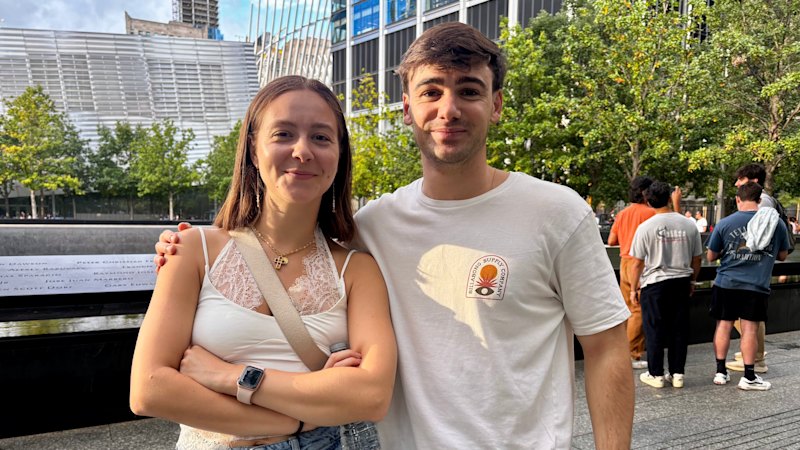
September 9, 2026 — 11:30amNew York: At the September 11 memorial in Lower Manhattan, two giant reflecting pools sit within the footprints of the twin towers that once commanded the city’s skyline.They are inscribed with the names of the 3000 victims who were killed that day, 25 years ago, when Islamic fundamentalist terrorists flew planes into the buildings and hijacked aircraft elsewhere in the US.Flowers at the 9/11 memorial left by King Charles III and Queen Camilla during their visit earlier this year.BloombergBut on a recent Sunday, it does not take long to find young people – who weren’t alive at the time – who did not believe that’s what happened, or weren’t sure.The very first people I met at the memorial were a Generation Z couple from Spain, Maria Nieto and Enrique Subiran, who wanted to pay their respects but weren’t confident about what exactly had transpired.“Even though I was born the same year that it happened, it resonates even nowadays, from something that was a terrible thing that they still don’t know why or what happened,” says Subiran, 25.The sentence catches me off guard. What does he mean by that? “There are still so many conspiracies about it; you can believe them or not. I don’t know. It’s a very controversial topic, I think.”Maria Nieto, 23 and Enrique Subiran, 25 – both from Spain – at the September 11 memorial.Michael KoziolSo, what does Subiran believe happened? “I don’t like to speak when I’m not informed about a topic,” he says. “I can’t really say what happened; I just believe what everyone says. But I don’t know what happened, to be honest. People say that no plane ever crashed.”But he has seen the footage, right? “Yeah. I don’t know about it, but I know there are so many conspiracies.” I suggest that he doesn’t seem confident enough in the official narrative to say for sure. “No, I don’t.”There is nothing new about conspiracy theories or mistrust of authority. However, the proliferation of social media, deepfakes, disinformation, AI and cyber warfare has made it much easier for these ideas to spread.In the US in particular, a decade of rabid politics and a president and acolytes who regularly lie or fudge the truth have combined to foster an environment where people frequently have cause to question what they’re being told.Smoke pours from the World Trade Centre after it was hit by two planes on September 11, 2001.Getty ImagesWhen a gunman charged towards the ballroom of the Washington Hilton hotel in April, allegedly trying to kill Donald Trump at the White House Correspondents’ Dinner, many Americans did not believe it was real.In Washington, a highly progressive city where more than 90 per cent of people vote Democrat, it was common to hear suspicions that the whole thing was staged to garner sympathy for Trump or bolster his case for his beloved White House ballroom – from people young and old.A Pew Research Centre survey conducted in August found that 93 per cent of people aged 18 and over at the time said they remembered exactly where they were on September 11, 2001.But for the 100 million or so Americans who were born after that, or were too young to remember it, there is no anchor in their own lived experience of the atrocity.At the memorial, I meet a young man who identifies himself as Frank Catalanello, 18, who says immediately that “the Illuminati” – a conspiracy tightly bound with antisemitism – was responsible for the attack that killed nearly 3000 Americans.He and his 19-year-old friend, who only gives his name as John, are keen to talk. But when we start recording, they clam up.“It was definitely a tragedy. My heart goes out to all the people and the families too,” John says. “The younger generation, I feel like collectively we all have some views that previous generations may not agree.”Such as? Frank points to what he says is an upside-down triangle on Freedom Tower, the building that replaced the World Trade Centre. But he is reluctant to explain what he means.Two men who gave their names as John, 19, and Frank Catalanello, 18, at the September 11 memorial in New York.Michael Koziol“It’s a touchy subject because … it’s what it is,” he says. “America is being sold out; it’s being bought out. I don’t know what to say. Just look around. As a white dude, I feel like this is not a place to be any more.”John agrees and goes on to say that the US is not the United States of America, but the United States of Israel.It is difficult to know how earnestly young men hold some of the views they espouse. Are they just trying to shock or rebel? Get a rise out of people? But in this case, it feels genuine.It would be wrong to say that conspiratorial thought was typical of the young people at the 9/11 memorial on Sunday evening. In my hour there, I also spoke to Harrison Tarbox, a 23-year-old living across the Hudson River in New Jersey, who came to the site with friends visiting from California.Harrison Tarbox, 23, says he doesn’t know anyone who subscribes to September 11 conspiracy theories.Michael Koziol“It’s very powerful when you’re here, and you actually see the monuments and the deep well in the middle of it. I find it very moving,” he said. “I still hear plenty of people older than me talk about it. Having moved here, I hear about it a lot more … It’s still prominent in my mind.”His friends all agreed that September 11 was covered substantially in their school curriculum. Tarbox said he was aware of the conspiracy theories, but no one he knows subscribes to them. “I haven’t met anyone that has forgotten [the event] or takes it for granted.”A group of five American teenagers felt similarly. “At school, every September 11, we talk about it,” said 15-year-old Michael Gaylor from Long Island. “It’s a big deal in and around that time.”Italian tourist Arianna Giacobbr, 23, was sure that 9/11 still impacts our lives today. “It’s one of the biggest tragic events of these times, maybe even the biggest,” she said. Asked if she considered terrorism to still be a threat, she said: “I think low-key yes.”People flee as the north tower of the World Trade Centre collapses.Getty Images One danger of increasing conspiratorial thought is that it easily combines with a resurgent antisemitism and, among young Americans especially, negative sentiment about Israel and creeping Holocaust denial.In a YouGov/Economist poll from late 2023, one in five Americans aged 18 to 29 agreed with the statement: “The Holocaust is a myth.” The same poll found 28 per cent of that age group agreed that “Jews have too much power in America”, compared to just 6 per cent among over 65s.Nancy Gibbs, a professor of media, politics and policy at Harvard’s Kennedy School, who wrote a famous cover story for TIME magazine in the days after September 11, laments that technological advances have enabled conspiratorial thought to blossom.“There have always been conspiracy theories, the same way there has always been propaganda, there has always been disinformation - none of that is new,” she says.“But the ability to distribute it and amplify it at scale, that’s what’s new. The ability for purveyors of conspiracy theory to reach enormous audiences is very different than the age of gatekeepers who could keep crank ideas or extreme views truly on the margins.“It wasn’t that they didn’t exist, or that they didn’t circulate on those margins, but they seldom penetrated the mainstream the way you’re talking about now.”Michael Koziol is the North America correspondent for The Age and Sydney Morning Herald. He is a former Sydney editor, Sun-Herald deputy editor and a federal political reporter in Canberra.Connect via X or email.From our partners
‘I don’t know what happened’: Those too young to remember September 11 are prone to conspiracy
Full Article
Original Source
Read the full article at Smh →KhanList aggregates and links to publicly available news content. We do not host full articles from third-party sources. Always verify important information with original sources.