
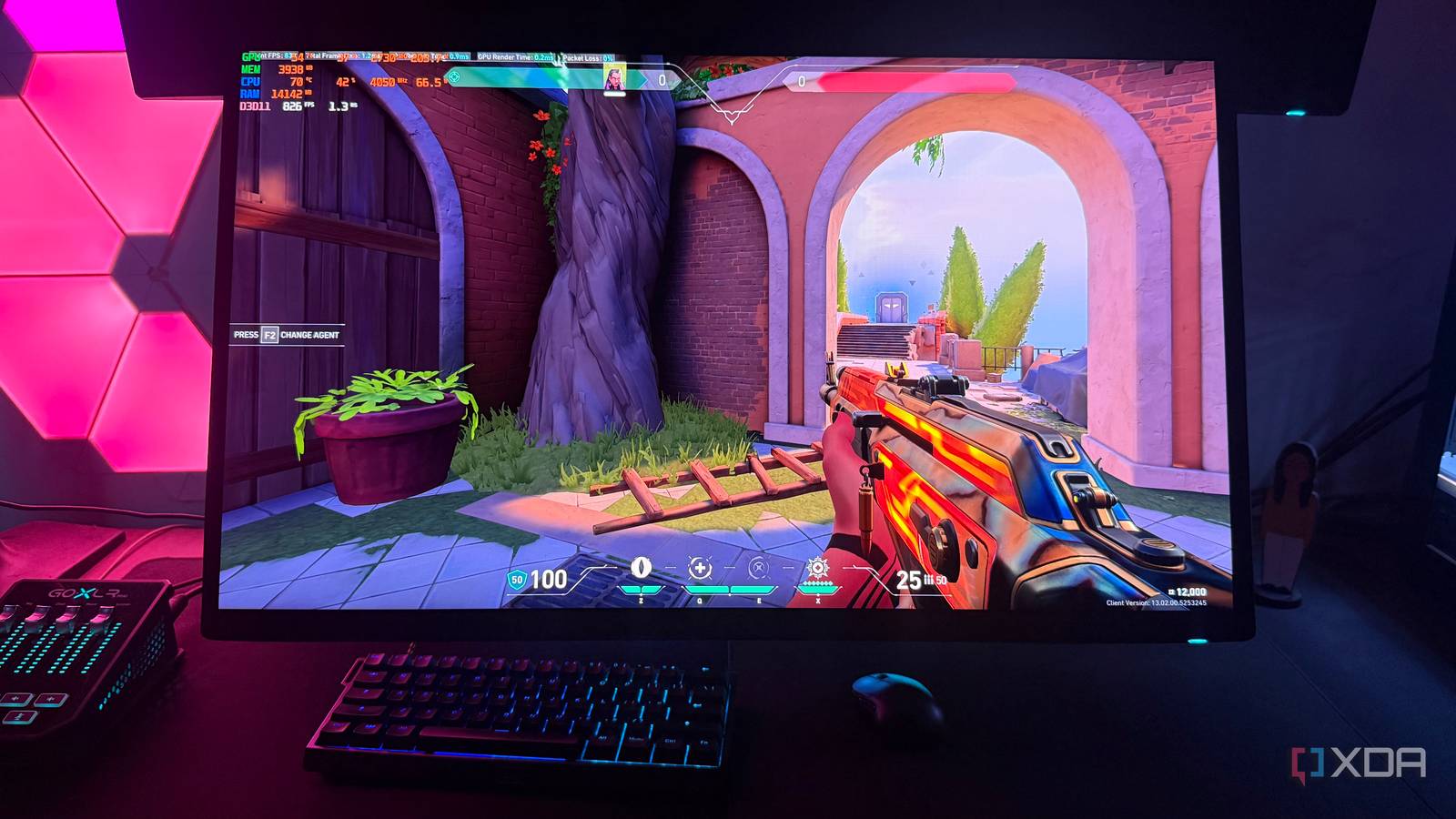
Published Oct 5, 2026, 7:00 AM EDT Hamlin has been in the tech field for over nine years. Since 2017, his work has appeared on MakeUseOf, Android Police, OSXDaily, Beebom, and more. He served as the Senior Editor at Valnet's MakeUseOf for over two years before joining XDA. He uses a high-end gaming rig for desktop use and a MacBook for traveling, but dislikes some of the quirks of macOS. You're more likely to catch him at the gym or on a flight than anywhere else. I've always looked at 4K as the pinnacle of PC gaming. Even back when I had the GTX 1070 a decade ago, I used Dynamic Super Resolution (DSR) just to get a taste of what 4K gaming would look like, even though my monitor was 1080p and the frame rates were horrible. Then, in 2020, when I built a high-end AM4 rig from scratch with an RTX 3090, I finally bought a 4K/160Hz monitor, and it truly felt like I'd reached the endgame. That is, until the performance started bothering me. Despite the RTX 3090 being marketed as an "8K gaming GPU" at the time, it couldn't consistently maintain 60FPS at native 4K in most newer AAA titles, even without ray tracing. So, when the RTX 4090 came out two years later with a massive performance uplift, I upgraded immediately for that uncompromised 4K experience I'd been chasing for years. And for the most part, this GPU delivered. But then I got into competitive shooters and ended up buying a 1440p/360Hz OLED. That's when I realized my priorities had changed, and now I actually use that 4K panel as my secondary monitor. 360Hz made me care more about how games feel And OLED helped me overlook the resolution downgrade It took me a while to realize that resolution doesn't matter nearly as much once you're actually focused on the game. Sure, if I'm just taking in the scenery in an open-world AAA title, a 4K monitor will obviously give me that endgame experience. But the moment I move my mouse around, I care more about how smooth and responsive the game feels. This is especially true in fast-paced competitive shooters, where I'd rather chase very high frame rates than a sharper image. Sure, you could argue the jump from 160Hz to 360Hz isn't all that transformative, but once you actually experience gaming at over 300FPS, it's really hard to go back. And of course, you could say the same for resolution, because 1440p does look softer after years of gaming at 4K, but my OLED panel has made this transition a lot easier. What I was sacrificing in pixel count, the OLED panel made up for with perfect blacks, infinite contrast, and near-instant pixel response times, so no matter what game I played, I didn't have to choose between looking great and feeling great. The 4K tax only gets worse as my GPU gets older At 1440p, I suddenly don't feel like I need an RTX 5090 When my RTX 4090 was new, I could load up virtually any game without worrying about whether it'd maintain 60FPS at native 4K, at least without ray tracing. After all, early benchmarks I watched on YouTube said it was up to 70% faster than the RTX 3090. Fast-forward to 2026, and I can't really say the same anymore. Newer AAA releases have gotten much more demanding, and I'm increasingly relying on DLSS to get the performance I want. If it wasn't for DLSS, games like Black Myth: Wukong would be averaging 40FPS. Even Assassin's Creed: Shadows couldn't maintain 60FPS at native 4K. Yes, I could use frame generation, but it only makes motion look smoother on the monitor; it doesn't make the game feel smoother when I move the mouse around. And considering I'm used to playing competitive shooters at 150+FPS, going back to the double digits for AAA titles was a tough pill to swallow. On my 1440p monitor, though, my RTX 4090 has way more headroom to push frame rates higher without DLSS. In fact, I sometimes use DLAA because I can afford to spend that headroom on image quality. So if a resolution downgrade can stop me from splurging thousands of dollars on an RTX 5090 that's barely 30% faster, I'll take that as a win. Of course, I'd love to game on a 4K/360Hz OLED But the hardware to do it justice still isn't there I'm not saying 1440p/360Hz OLED is the new endgame for me because if you put a 4K/360Hz OLED in front of me today, of course I'd want one. When you're getting the best of both worlds, there's really no reason to settle for the lower resolution. The thing is, we don't have a 4K/360Hz OLED on the market yet. MSI showed off one at Computex 2026, but it isn't expected to be available until early next year. But even if I could buy one today, I wouldn't be able to make the most of it. Pushing anywhere close to 360FPS at 4K is going to be extremely challenging outside of light competitive games like Valorant or Counter-Strike 2, and that's even if you have the fastest GPU on the market currently, the RTX 5090. Upscaling and frame generation can help to an extent, but when those generated frames do nothing for responsiveness, what's really the point? With the GPU I have, it's one or the other I still love how games look at 4K, and I'm sure if my 4K monitor was OLED, it'd look even better. But when I'm focusing on the gameplay, I just want the game to feel smooth and consistent, no matter what scene I'm looking at. At 4K, one demanding scene is all it takes to cause a noticeable FPS drop that breaks the immersion, whereas at 1440p, I have a lot more headroom before that happens. All in all, I like to game with the fewest compromises, and now that I know I don't need to chase resolution anymore, I'd rather stick with 1440p until 4K gaming no longer feels like a compromise.
I chased 4K gaming for a decade, then 1440p OLED made me stop caring about resolution
Full Article
Original Source
Read the full article at Xda-developers →KhanList aggregates and links to publicly available news content. We do not host full articles from third-party sources. Always verify important information with original sources.