
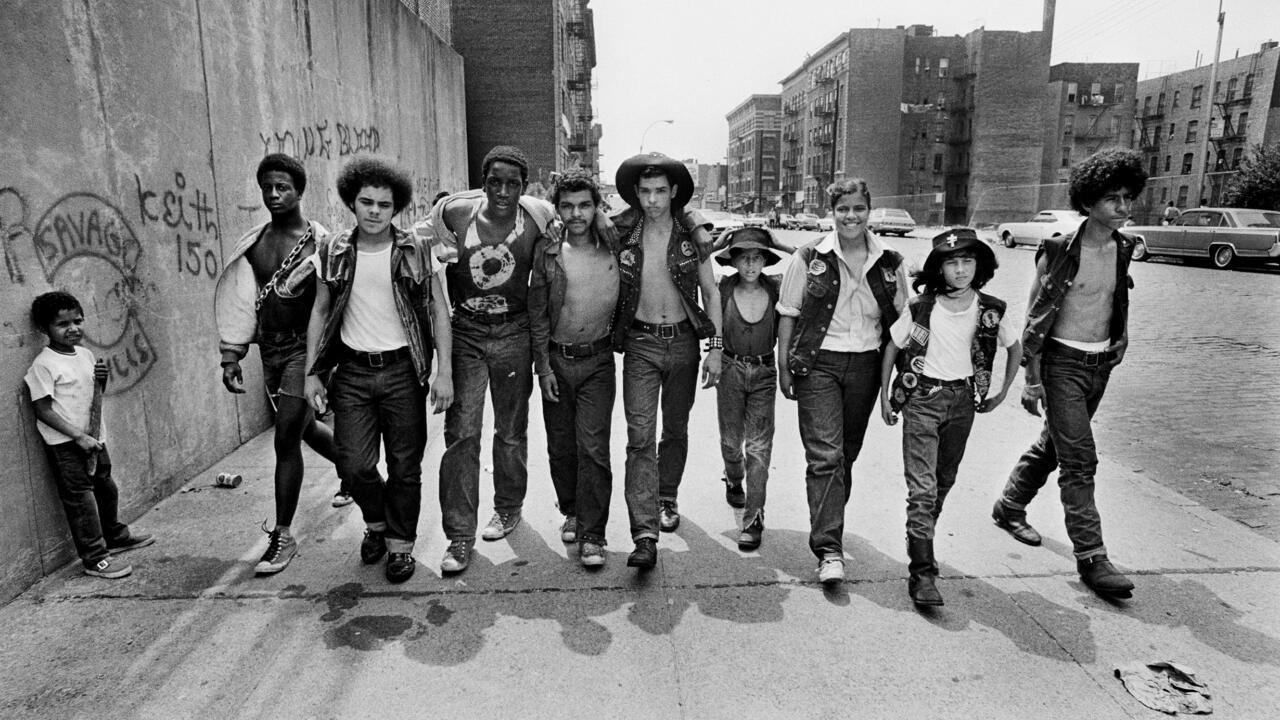
Paris, France – French photographer Jean-Pierre Laffont has been making his mark on the history of photojournalism for six decades. Based in the US since 1964, Laffont has documented a country in profound transformation, covering the civil rights movement, anti-Vietnam War protests, the rise of the women’s and gay rights movements and life at the White House. "I still have a frame in front of my eyes. I don’t take photos anymore, but I do make books," Jean-Pierre Laffont told RFI, speaking at the Paris Photo fair. The 91-year-old photographer has just released his eighth book, Rebels with a Cause, which documents American counterculture and social movements of the 1960s to 1980s. RFI: When did you move to the United States, and why? Jean-Pierre Laffont: I arrived in the United States in 1964. In April. I was labelled a pied-noir [literally a "black foot", meaning a person of European origin who lived in Algeria during French colonial rule] because I had just returned from Algeria [at the end of the War of Independence] and I couldn’t find work as a photojournalist in France. I approached magazines such as Paris-Match and Jour de France, but nobody gave me a chance. Whereas in the United States, they always give you the benefit of the doubt. Jean-Pierre Laffont at the NYC courthouse on 29 April, 1974, as former Attorney General John N. Mitchell and ex-Commerce Secretary Maurice H. Stans were acquitted of criminal charges involving financier Robert L. Vesco's secret $200,000 contribution to President Nixon's reelection campaign. © J P Laffont RFI: How did your career as a photographer begin in the US? JPL: I realised I arrived at the wrong time. It was a bad period because New York City was bankrupt. The rubbish wasn’t being collected, and you couldn’t go out at night. It was a dangerous and dirty city. And, like an idiot, I didn’t have a Green Card, no press accreditation or a journalist’s visa. So I had to fight my way back up on my own. I realised I had made a mistake. Then I did odd jobs – working off the books, of course – and found a lawyer. After a year, I had my Green Card and was able to start doing my first reports and to find an agency to represent me in France. RFI: Before moving to the US, what did you imagine the country would be like? JPL: I knew absolutely nothing about it. Besides, I spoke more Arabic and French than English. So I had to learn. It took me nearly a year to say ‘south’ – I couldn’t pronounce the ‘th’ sound, and so on. I worked as a photographer’s assistant, doing darkroom work for them, and then I found a magazine that took me on, and one job led to another. I did a feature in a prison in 1968. It was published in Paris-Match and Gamma [photo agency] asked me to be their first foreign correspondent. I joined them on 1 January, 1969. Jean-Pierre Laffont with his wife Eliane, who edited his book "Rebels with a Cause”, at the Paris Photo fair on 13 November. © RFI/I. Martinetti RFI: How would you describe Rebels with a Cause? JPL: Well, that was my wife Eliane’s idea – she’s a very good editor, as that’s her profession. She’s been doing this all her life, and she chose the photos from the contact sheets. She realised I had photographed the early days of the American rebels – that is, the people who didn’t want to go to war [in Vietnam], black people demanding their civil rights, particularly with Martin Luther King, [and] great boxing matches with Muhammad Ali. I also captured women campaigning for abortion rights and equal pay, gay people who wanted to kiss on the street and be treated normally and the first environmentalists, with Earth Day and so on. I captured all those defining moments when American youth were waking up, shouting to make themselves heard. A protester strapped to a crucifix, representing the martyrdom of American youth, at an anti-Vietnam War demonstration, Washington DC, 9 May, 1970. © JP Laffont/Sygma/CORBIS RFI: What would like to document today in the US? Are there particular social movements and political changes that you would be interested in capturing? JPL: These days, I would prefer to focus on more peaceful subjects. I’ve become very committed to social issues. I travelled round the world to document children at work – that is to say, young people under the age of 12, because at 12 years and one day you were considered an adult – and I photographed 15 countries over a year and a half. These were subjects that interested me far more than street photography, or scenes of demonstrations and protests. I looked into the problems faced by farmers who were losing their farms to the banks. That took me two years as well. I spent two years in India, I documented China’s awakening and I produced a book on Mao’s Long March. I covered the industrialisation of Japan and Korea, as well as Russia and Poland. I documented the independence movements in Africa, so I did work beyond just America. A member of a community of transvestites living around 66th Street and Broadway, who would work at night and during the day design clothes and organise fashion shows on the rooftops. New York City, 1966-1967. © JP Laffont RFI: Is there a photograph in your book that you feel particularly attached to, or one that you would especially like to share with a young photographer? JPL: Not at all. I don’t like my photos. I never look at them. I forget about them. On the other hand, I’m absolutely obsessed with the photos I’ve missed. I could give you a precise list of them. Hundreds of historic moments, places I was at, specific moments when I couldn’t take my photo... because the taxi wasn’t working, because the flash wasn’t working, or I didn’t have any film in the camera. Or I couldn’t get into that press pool because it wasn’t the right time for me to be in a booth at the United Nations, and so on. As for the photos I have taken, there are many that are, I think, quite successful. We have some iconic photos that are in extremely high demand for all sorts of books. I’m very pleased with them, but that’s all behind me now. I’ve taken them, that’s it, I’m moving on.
'I captured those defining moments when American youth were waking up'
Full Article
Original Source
Read the full article at Rfi →KhanList aggregates and links to publicly available news content. We do not host full articles from third-party sources. Always verify important information with original sources.