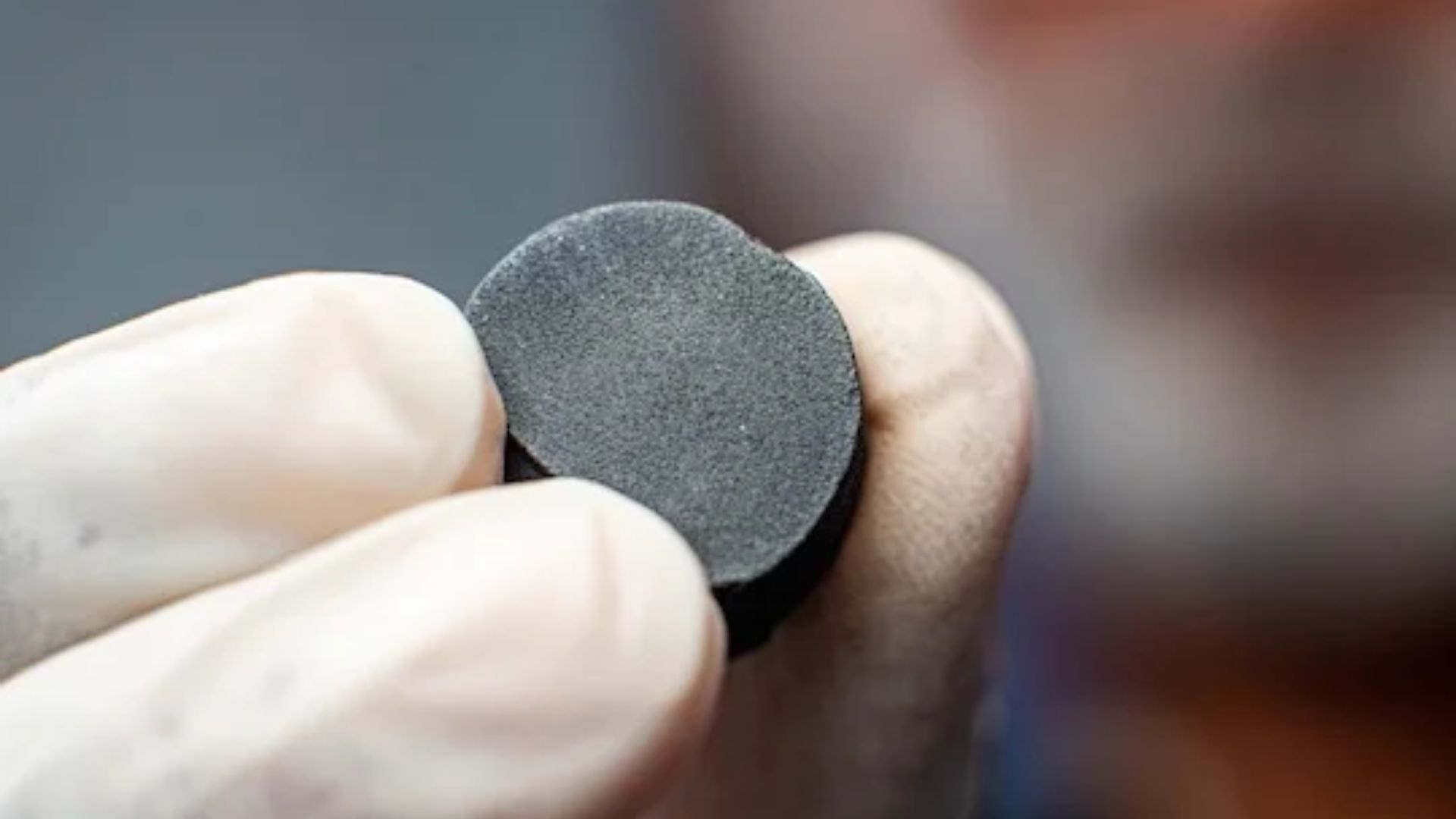
A new manufacturing technique developed at Rice University stabilizes diamond during thermal processing at low pressures, resulting in a dense, resilient composite material. The research, published in Materials Today, demonstrates how combining powder materials can overcome previous manufacturing barriers. The study also documents how hypersonic projectile strikes force diamond to turn into graphite in millionths of a second, a rapid phase change that absorbs kinetic energy. “The composite made by this process is almost nonmachinable and tough due to the presence of dispersed diamond particles and could help researchers design tougher materials for aerospace, defense and other technologies that face extreme conditions,” said Abhijit Biswas, first author of the study. Small diamond particles are cheap and simple to fabricate, yet binding them into large solid shapes is difficult. Sintering uses heat and pressure to fuse loose grains into a solid mass. At high temperatures, diamond naturally breaks down into soft graphite unless held under extreme pressure. Standard high-pressure, high-temperature methods can make polycrystalline diamond, but the required pressure limits the physical size of the manufactured objects. Engineered material synthesis To keep diamond intact without using massive pressures, the research team engineered a multi-material blend. They added cubic boron nitride to fine diamond particles because both substances share similar physical properties. They also added cobalt to act as a binder and stabilize the mixture during processing. The scientists then compacted this blended powder using spark plasma sintering, a rapid method that applies heat and pressure at the same time to fuse powders into a dense solid. This sintering method produced a tough bulk composite where diamond grains are held inside a continuous cubic boron nitride structure, with cobalt spread throughout the material. The embedded diamond particles make the composite nearly impossible to machine. Because this technique avoids extreme pressures, it offers a practical method for the large-scale production of diamond-based parts. Ballistic stress and dynamic testing The team evaluated the mechanical limits of the composite through high-velocity collision experiments. “Researchers fired tiny metal projectiles measuring 1-4 millimeters across at the composite at hypersonic speeds,” explained Rice University in a press release. When hit by a projectile traveling faster than seven times the speed of sound, the composite held together and resisted destruction. When struck by a larger projectile moving at an even higher speed, the material fractured. To study the breakages, the team analyzed the fracture surfaces and ran molecular dynamics computer simulations that trace atomic motion. “We found that extreme impact can drive diamond to graphite within microseconds, rather than through the slower heat-driven process we normally associate with this transformation,” Biswas added. “That gives us a new view of how diamonds behave under some of the most demanding mechanical conditions.” Rapid phase transformation Diamond and graphite both consist of pure carbon, but their different atomic arrangements make diamond hard and graphite soft. This transformation does not occur through the slow, heat-driven degradation typical of standard processing. Instead, the force and shock of the hypersonic impact drive an instant atomic rearrangement. As the diamond turns into graphite, the structural shift absorbs collision energy, improving the material’s capacity to withstand severe mechanical force. “Understanding how materials change their structure and phase under force, along with their strength and hardness, could help guide the design of future protective materials,” Biswas concluded. Get the latest in engineering, tech, space & science - delivered daily to your inbox.An active and versatile journalist and news editor. He has covered regular and breaking news for several leading publications and news media, including The Hindu, Economic Times, Tomorrow Makers, and many more. Aman holds expertise in politics, travel, and tech news, especially in AI, advanced algorithms, and blockchain, with a strong curiosity about all things that fall under science and tech.
Hypersonic impact turns diamond to graphite in microseconds, could aid defense and aviation
Full Article
Original Source
Read the full article at Interestingengineering →KhanList aggregates and links to publicly available news content. We do not host full articles from third-party sources. Always verify important information with original sources.