
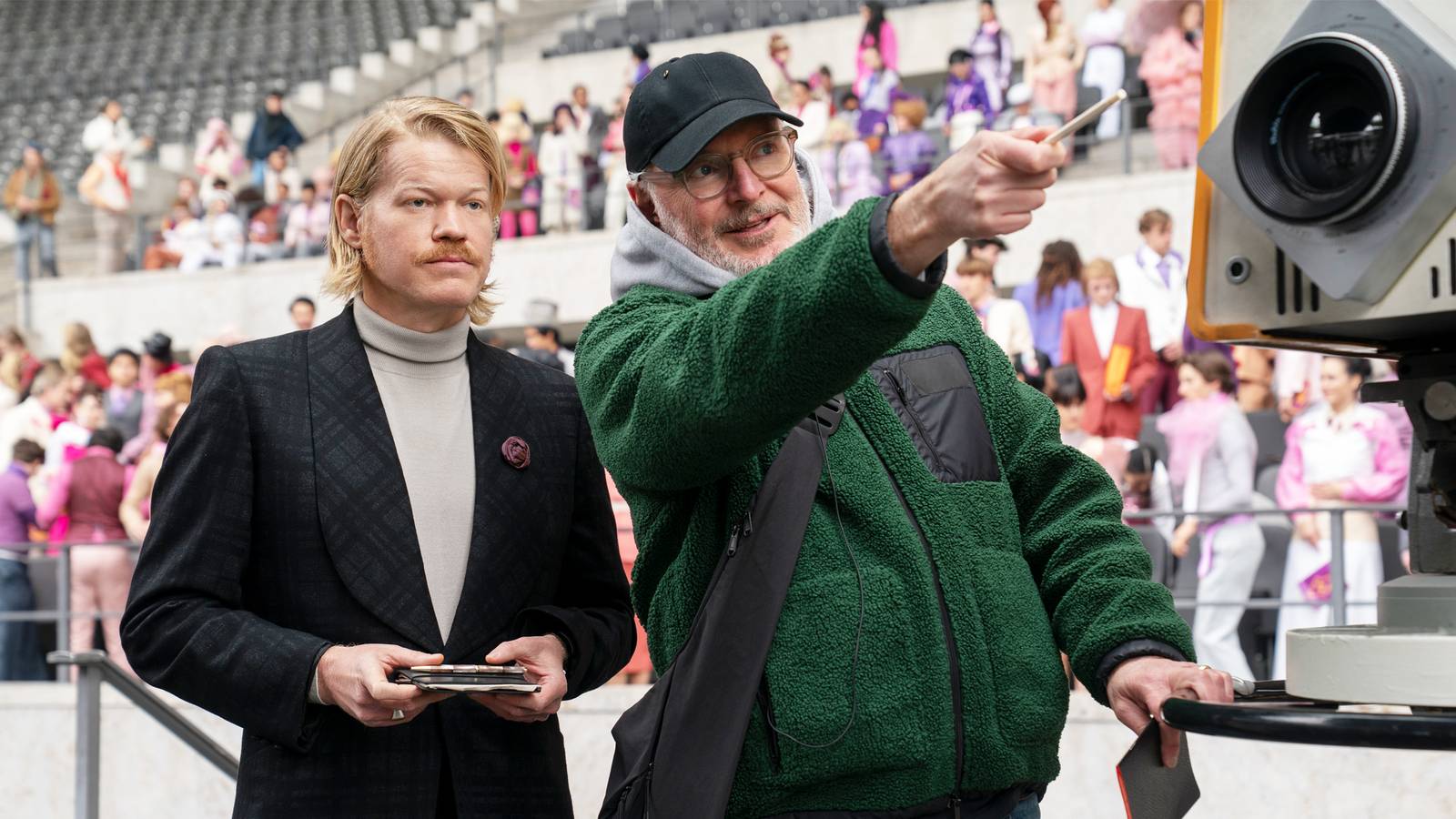
'The Hunger Games: Sunrise on the Reaping' Almost Had a Very Different Ending Image via Lionsgate Published Nov 22, 2026, 9:03 AM EST Sign in to your Collider account Editor's note: The following contains spoilers for The Hunger Games: Sunrise on the Reaping. Summary Collider's Steve Weintraub talks with Francis Lawrence for The Hunger Games: Sunrise on the Reaping. Lawrence discusses scenes cut from the movie, the epilogue, reuniting with the original trio, and casting the 50th Hunger Games. He also reflects on his career, from the Oscar contenders he passed on to the music industry, and an exciting update for Keanu Reeves' Constantine sequel. After the first movie, director Francis Lawrence took the reins of the Hunger Games franchise with 2013’s Catching Fire. He collaborated with author Suzanne Collins, established a family with the cast and crew, led by Jennifer Lawrence as Katniss Everdeen, and returned for each subsequent film as Collins continued to find inspiration through the years to pick up the pen again — once for The Ballad of Songbirds and Snakes, and again with the upcoming follow-up prequel, The Hunger Games: Sunrise on the Reaping. This most recent addition, Lawrence tells Collider’s Steve Weintraub, was a big surprise. The story of young Haymitch Abernathy, played by relative newcomer Joseph Zada, was at the top of book fans’ lists, but so soon after President Snow’s (Tom Blyth) prequel was an unexpected treat. “We're just as surprised as anybody else when the book's announced,” Lawrence admits, though he does get official early access. In Sunrise, Lawrence and the team were tasked with finding the perfect casting for the 50th Hunger Games, from the younger versions of known characters like President Snow (Ralph Fiennes), Effie Trinket (Elle Fanning), and Plutarch Heavensbee (Jesse Plemons), to brand-new faces like the fiery Maysilee Donner (McKenna Grace), Drusilla Sickle (Glenn Close), and District 12’s Wyatt Callow (Ben Wang). During a recent interview with Lawrence, the filmmaker discusses the making of the movie, including the major book scene that was cut from the film, the casting process, bringing back the OG trio — Lawrence, Woody Harrelson, and Josh Hutcherson — and whether we’ll be getting more Hunger Games in the future. Check out the full interview below for more on Sunrise on the Reaping, plus the Oscar-winning films Lawrence passed on, his most insane story from his time directing music videos with Britney Spears, Justin Timberlake, Lada Gaga, and more, and why the recent DC Studios shakeup may spell success for Constantine 2. 'Sunrise on the Reaping' Cuts a 10-Minute Arena Sequence From the Book Lawrence has his reasons — and Suzanne Collins’ blessing. Image via Lionsgate COLLIDER: If I were to watch the first assembly cut of the film, what would be the biggest difference between that version and the movie audiences are about to see? FRANCIS LAWRENCE: The bulk of the movie is very similar. I'd say a lot of it is the trimming of the fat. There are a few sequences that got cut. There’s a sequence right before the interviews where Drusilla’s character does some coaching of Haymitch and Lou Lou and Wyatt and Maysilee in the green room before they go out on stage, and we cut that sequence. So that was maybe 10 minutes, but that was an area that I felt needed to be compressed anyway. We were also trying to tie Effie's character in a little more specifically, so that was one big cut. And then there was another chunk in the arena that we shot that was in for a while that's probably another 10-minute piece. That’s after that sequence where the bugs all stick onto their skin, and then they wash off in the rain. So when they're sitting there in the rain, they hear some people start screaming, and they hear some cannons, and they go investigate to search some packs, and they get ambushed and get chased by a couple of other tributes and end up coming face to face with some Gamemakers that are actually in the arena trying to make some repairs. It's a sequence that I think a lot of fans are probably going to be surprised that got omitted, but it existed in the book as part of the theme of implicit submission. Once we sort of built the movie, and we watched it, really, Nina [Jacobson] and I, and then Suzanne [Collins] also finally agreed, we really felt like at this point in the movie, Haymitch was no longer submitting, so we did not need to have a sequence about him still submitting and getting into an argument with Maysilee about submitting. We felt like he was far, far beyond that, and having been down to Sub A and attempting that first explosion and doing everything he's doing, so we ended up lifting that sequence. With a sequence like that, even though it takes place further in the movie, was there ever a debate about moving the sequence forward? LAWRENCE: No, because it wouldn't work. He wouldn't have reunited with Maysilee by that time. If we moved it up ahead, then he would be with her, then not with her. The timeline wouldn't work. Image via Lionsgate The movie's two hours and 38 minutes. How much is going on behind the scenes from the studio perspective, being like, “Hey, the most you can release is 2.38?” How much is there to debate behind the scenes in terms of knowing we don't want to release a three-hour movie, or is there the option of, down the road, you could release an extended cut which has all these scenes in it? LAWRENCE: First of all, I've never wanted to release an extended cut. I've never found myself in this situation. I'm happy to release deleted scenes for fans that want to see scenes that were shot, and they can see them out of context. But I've never made a movie where I felt like somebody forced me to cut a chunk of the movie out for time, and I really believed that needed to be in there. So, I've never been in that situation before. The truth is, runtime for me is much more about feel than it is about actual length. The only thing that annoys me now about people watching movies is people tend to click up on a thumbnail, and you see a runtime, which may make them decide whether or not they want to watch it — and a Rotten Tomatoes score. So I wish they would just know what the movie's about and go and watch it. So, runtime for me is really just about the fact that it's like a little tag next to the name of the movie. Whether you're watching it at a theater, at home, on an airplane, or whatever, it's really about feel. Luckily, every studio that I've worked with so far has been about if the movie plays and people feel like it's moving and people aren't getting bored, and it's not feeling slow and sluggish, the time doesn't matter. I feel like there's a tipping point. Somebody told me this once, and I don't know if it's still true, because the way exhibitors work, things are always changing, but I think there is a tipping point around the three-hour mark where you actually truly start to lose shows in a day. So it can actually sort of affect box office over a certain point. But I believe if you're somewhere under three, and I don't have the exact science, you're not losing showings in a day, and all that kind of stuff. So, if a movie's working and moving and keeping people engaged, it doesn't bother me. The other thing that drives me a little crazy about time is the movie is actually under two and a half hours. The problem is, credits on a movie of this size are, with main-on-ends and end credits, 10 or 11 minutes long. So, the actual movie is under two and a half, but because of the credits, it gets stuck on, and then it looks like it's a two-hour, 40-minute movie to people. I wish more people understood that for some movies, an hour and 50 minutes is the perfect length, but when you are dealing with a movie like Hunger Games, where you are having all these new characters, and you want to meet these characters and feel for them, you need time to have scenes where you're talking that don't have action, that in a two-hour movie or an hour and 50-minute movie, you're not going to have those scenes. It's only because you're closer to 2.5 hours that you can put in 30 minutes’ worth of people talking. LAWRENCE: Yes. But again, it's about the dynamics of the movie, too. Things have to be happening. But if things are happening and you have dynamic peaks as you're going throughout, when those things happen, it buys you a little time. So there's something sort of instinctual, I believe, about the building of a movie, of finding those moments where you can create those dynamic pops that buy you a little time to sit with characters for a minute. Then you need another one of those dynamic hits — and that could be a story turn, it could be an action sequence, it could be somebody dies. I mean, who knows what those things are, but I think you need those things. But then once you have it, then you have a little room for quiet. "I hope not." Image via Lionsgate When you made the last Hunger Games movie, you thought that was probably it. You were probably thinking, “This is the end of my Hunger Games life,” or did you know when you were filming that she was writing this book? LAWRENCE: No. She never tells us if she's writing anything. She's sort of superstitious about it. Not sure if that's the right word, but she definitely does not tell us about it until she feels like she has a somewhat finished manuscript. This was probably the earliest that she ever showed us one of her books, but it was still a surprise. So when she called, and I saw she was calling my cell phone, I was shocked because I was not expecting that to happen, and especially that soon. Then also, when she tells me she has a book, she doesn't tell us what it is, so we basically have to go to her agent's house and go sit in the backyard, and there's a manuscript, and you open it up, and we're just as surprised as anybody else when the book's announced. So this could be the last time with Hunger Games. LAWRENCE: It could. I hope not. I like working with Suzanne and Nina and everybody. I love it, but it certainly could be the last one. You've spent such a chapter of your life making these films. Do you mentally let go? What is it like for you knowing that this could be the end of this part, or that it still could continue if she decides to write another book? LAWRENCE: I don't know if I mentally let go. I feel like I'm in a zone. When we finished The Mockingjays, that original batch, because it was like back to back to back to back, I was like, “Okay, I need a break from this.” I know Suzanne needed a break from this. And then everybody kind of went off and did different things. Nina did different things; I did; Suzanne tried some different things. Then we got surprised because she got inspired and she wrote the last one. Then it was like, okay, great. We sort of cleansed our palettes in a way, and we got to come back. Then, when we were making that one, we didn't know if that was just going to be a one-off and whether or not she was going to be inspired again. So, I think I've sort of just resigned myself to the idea of, like, I sit back and enjoy the suspense of whether or not she's going to write something again and whether or not I'm going to see her name pop up on my phone to tell me whether she's just calling to say hi or calling to tell me that there's a new manuscript to read. So, something to look forward to. But I've definitely stopped guessing or stopped trying to come up with ideas of what other movies could be and all of that, since it always has to come from her. Image via Lionsgate I know a lot of directors and some of them have told me that they really like to collect stuff from their movies. Guillermo [del Toro] likes to take home everything. With all these Hunger Games movies and other films you've worked on, how much do you like taking home things from the films, and how much are you like, “I don't care?” LAWRENCE: I don't really care too much. I mean, Keanu gave me the holy shotgun from Constantine that I can see right up there on my shelf. That was a very cool gift. So that's probably one of the cooler things I have. I have a couple of arrows from the original Hunger Games movies, the original series, because the arrows change throughout the series, based on where she is, if she's in an arena, if she's at home, or if she's in The Mockingjay — exploding tips and things like that. So, I have some arrows. But yeah, I don't have too many things. I have some ballet shoes that Jen [Lawrence]’s ballet double gave me from Red Sparrow. So I have a couple things. But Guillermo basically has, like, a museum. I would be taking costumes and other things, but that's just who I am. LAWRENCE: Some of the actors do that. There are different people that do those kinds of things, like steal costumes or little pieces or trinkets and props and things like that. I mean, I also have, sometimes, weird things, like I'm looking at a clock that I have that was in Ballad of Songbirds and Snakes. The art department on these last two movies is so good, and the props department is so good. I remember it was in Coryo Snow's apartment, where he lived. There was just this very, very cool clock, and I talked to one of the prop designers who was on set, who I'm friends with, and asked about the clock, and then she gifted it to me. So I've got that. But that, honestly, was just because I thought it was a cool clock. How the Original 'Hunger Games' Stars Reunited for 'Sunrise' “We were never sure we were going to be able to make it happen.” I definitely have to talk about bringing back Jen, Josh [Hutcherson], and Woody [Harrelson]. Talk a little bit about getting them to come back. Was it one of these things where they jumped at the chance to reprise their roles for a day? How did that come together? LAWRENCE: Basically the plan was we all hoped we would be able to figure out an epilogue that would include them because they're included in the book. Their presence is at the end of the book, so I think we knew fans would be speculating. There's an element to having them at the end of this story that is cathartic, which I thought was important, but we were never sure we were going to be able to make it happen — and this was before we asked them — just because you never know what people's schedules are going to be like and whether or not you can count on certain things. So, we kind of tasked ourselves with working on an adaptation that we felt could work without them. That was the thing. And then we would come up with something with them that, like, if we got them and they wanted to do it, we could make everything work, awesome, but if not, we felt confident that we could finish this movie in a way that would still feel fulfilling and satisfying and cathartic, especially after the kind of story we've just gone through. Basically, we started talking about when to approach them, and this was before the book was even announced. So we decided, because I will say, out of love, two of the three of those people are slightly unfiltered people, and so we couldn't let them know necessarily too soon because you don't want anything to accidentally slip before the book is even announced. So I basically texted the three of them that I wanted to chat with them about something to do with The Hunger Games the day before the book came out, and they all called me back instantly. I talked to Jen first, and I think she squealed and was super, super excited and wanted to jump in, for sure. Woody was down. Josh was down. Josh was funny, too, because I think he thought I was calling like something was wrong, like I was going to give him some sort of bad news about his character, or something. I’m like, “No, we actually want you guys to come back.” So they all wanted to do it. Then it really just became about, “Stay quiet for the next day until the book's announced, and then obviously don't say anything about being in the movie,” which they kept quiet for a while. [Laughs] Then it was really just about figuring out schedules because they all wanted to come back, and they all love each other, and it's the same crew. Luckily, this is a franchise that people aren't embarrassed by. So it's not like this is a group of people that made these movies and they're happy to have been done with them, and they're out of their lives forever. So they were, I think, very happy to come back for half a day of shooting. Where did you actually shoot their stuff and how long did it take? LAWRENCE: They came to Germany. Basically, we started this movie in Spain, where we did the Games. So we shot out there for about six weeks, I'd say. Yeah, five or six weeks. Something like that. And then we moved to the west of Germany, to the Cologne, Düsseldorf, Duisburg area, and Duisburg is where our District 12 is. That's where we do the Reaping and all the basic District 12 stuff at the beginning and the end of the movie. So we got them to come out and stay with us in Düsseldorf and do a half-day shoot at our Duisburg location at Landgraf Park, where the actual Reaping square is. But yeah, they were out in Germany with us. How 'Sunrise on the Reaping' Would Have Ended Without Jennifer Lawrence That epilogue hinged on the original trio’s return. Image via Lionsgate What was it like right before the first take with the three of them? What's that energy like figuring out how you wanted to shoot them, what it was going to look like? I would imagine that's a really cool, special energy having the three of them back on the set of a Hunger Games movie. LAWRENCE: It was cool. I have to say, the best thing, though, was actually two days before that. It was when they showed up in Germany. I remember I was coming back from a day — I don't remember where it was; it was like a forest or something — and I had rain gear on, and my shoes were muddy, and all this, and Jen texted me and said, “Me and Josh are in the bar. We're here. We're in the bar having a beer. Let us know when you're back.” And I said, “Oh, I'm almost back. I'm just going to take a shower.” Then I said, you know what? Fuck it. I don't need to take a shower, and I just walked into the bar in my rain gear and saw them. Then Nina came in, and then Woody and his wife came in, and then our cinematographer came in, and the camera operator came in, and the still photographer came in, and it was that group of people that ended up being, I don't know, 30 of us or something, that the bulk of had been making these movies since 2012. Some of them, Nina and even the still photographer, have been there since the first one. So, that was the special time, was to know that, like, oh, the whole gang is back together and we're here for this, to make one of these again. Then some of the new cast came in, like Joe [Zada] came in and I think Whitney [Peak] was around. I don't remember if McKenna [Grace] came in that evening or not, but a bunch of the new cast came in and met everybody, too, and that was really nice. But that was the night before they had their fittings and hair, makeup, wardrobe tests, and that kind of stuff. Then we shot the day after that, and shooting's fun, too, but I think it was the reunion for the purpose of making this and being in Germany and everything together. That was really fun. It's a great ending. It's so good, and it ties it all together. But I’m curious, have you revealed what the ending would have been had they not done it? LAWRENCE: Yeah, I think it would have been baby Katniss. I think it would have been knowing that Katniss was born. So, it would have been that idea where he sees his friends, who he's isolated himself from, and they now have a baby, and he overhears and sees and makes eye contact with the baby Katniss for the first time. Welcoming the 'Sunrise on the Reaping' Tributes Lawrence shares how this incredible cast came together. A lot of people don't realize the importance of the casting director. You're getting ready to make this — how much are you in your head thinking about what actors you want? Can you talk a little bit about collaborating with your casting director? You have a big, big cast to fill, and you put together this murderer's row of great actors, so talk a little bit about what that dynamic is like. LAWRENCE: Well, Deb [Zane], who's done all these movies, and her associate Dylan [Jury], they're great people. They're great at casting. They have great taste, great ideas. So, I think one of the things that happens is we start to talk about the characters and where they are in their lives and all of that. And then, you put lists together. These lists are for the people that you know are going to be established actors, right? It's going to be for the Caesars, the Snows, the Effies, all of that kind of stuff. So basically, just based on that, I made my first choices of, yeah, Ralph [Fiennes], I would love to work with Ralph, and Ralph could be Snow. He'd be perfect. And luckily he wanted to do it. Jesse [Plemons] was actually the first person we cast. I don't even think I looked at a list for him. I think I just knew I wanted Jesse, and so we got him. Luckily, he wanted to do it. He read the book. We didn't even have a script yet for him, but we got him. Elle [Fanning] I knew because I did a commercial with her when she was 19, and I just think she's great. I thought she'd be a perfect Effie, so we went after her. Kieran [Culkin] I also thought, and I think nobody, including me, thought he would ever say yes, and it took a minute to get him on a Zoom with me. But once we did, we kind of locked in, and he said yes. Glenn [Close] actually approached us and said she was interested in becoming a part of the franchise and wanted to take part in it. I was a huge fan from The World According to Garp and Dangerous Liaisons and Fatal Attraction, and so, of course, yes. Image via Lionsgate There are definitely discussions, but I will say with that group, it felt like those choices were easy, in a weird way, and then luckily they all said yes. So, they definitely do some chasing down and chatting to people to make the Zooms happen and figure out schedules and all that kind of stuff. I think where they really shine is the world of all the actors, like the people that we are unfamiliar with, because these movies are basically built on young, up-and-coming actors, and then established veteran actors. It's when they go and they find people like Joe Zada. Deb is the one who really just said, “You guys have to sit down with this kid.” And so we sat down with him, and he had made this improv tape because that was what we did before we had pages, because the book wasn't out yet. We basically had people create their own version of scenes of Young Haymitch, just to sort of see the lay of the land of, like, who's out there at that age? Who's interesting? Who's not? Who's possibly right, who's possibly wrong? So for her to put Joe in front of us and have us work with him, and for her to put Whitney in front of us and have us work with her. She sent pages to McKenna. I was familiar with McKenna’s stuff. I've had a friend do a movie with her before. But again, just to have Deb send her the stuff and for her to read for the role, and Maya [Hawke], too. Even to put Maya in front of us, and Iris [Apatow] in front of us, I think that's, for me, where they really shine because that's where their knowledge of the new up-and-coming, haven't-really-done-anything-yet people they think can pop, the people that have talent but also have charisma, that have that extra sort of effervescence to them that’s so kind of magical, I think that's where they really shine. Francis Lawrence Explains Why He Couldn't Crack These Oscar Contenders He reveals which blockbusters he stepped away from throughout the years. Image via Universal Pictures If people could see a list of all the movies you've been offered but didn't do, what's the one that people would be most shocked to see? LAWRENCE: I'm not sure offered is the right term, like I was offered and turned down. But some things that I was actually on and developed for a while, one of them is The Revenant. I was on The Revenant for a while and tried to develop that and couldn't quite crack it, and Alejandro [G. Iñárritu] did. After I was off of it, he figured that one out and did a fantastic job. I developed a version of The Odyssey years ago, which is also a tricky one. I'm trying to think of what else is out there. Those are two good ones. LAWRENCE: Yeah. Unbroken. That was another one that I don't think got cracked, actually, and we hadn’t figured it out yet. That's the story about Louis Zamperini in World War II. Oh, yeah. Angelina Jolie ended up doing it. LAWRENCE: Angelina Jolie ended up doing it, yes. But that was my project, and I met with Louis many, many times before he passed away. Then I got Catching Fire, actually. Originally, I was going to keep it and keep working on it because I didn't think we had figured it out yet, and then I got the Mockingjay sequel, so I knew I was going to be gone for a while, and I wanted somebody to make the movie before Louis died, so I let it go. But yeah, The Revenant I let go because I couldn't crack it, as much as I loved that story. The Odyssey, the same thing. I couldn't really crack the kind of episodic nature of it. And also, quite honestly, cracking the real Odysseus, the guy with pride and hubris. He's a tricky character. The DC Shakeup Just Put ‘Constantine 2’ Back on the Table "I have renewed hope." Image via Warner Bros. Listen, I ask you this every time or anytime I'm talking to Keanu [Reeves] or Akiva [Goldsman]: Do you think Constantine 2 will actually happen, and with the new owners, do you think it's more of a possibility now? LAWRENCE: Well, I'll tell you this. Not that I want anybody to lose their jobs, so this is not like a schadenfreude kind of thing, but I will say that we've been trying to make Constantine 2 for 20-something years, and we have an idea, and we have a script, and we've been wanting to make it, and the people that were at DC were an impediment to us making it. So, we are now more hopeful as of yesterday's news that maybe now there will be another opportunity. But again, we've been trying to make this for 20-something years, and there's always been obstacles in the road to making it, and it's not me, it's not Keanu, it's not Akiva. J.J. [Abrams] is on it, as well. We all want to do it. So, it's really going to be people at Paramount, Warner, whoever's running DC now, getting everybody on board to say, like, “Hey, we can do a sequel of our version of Constantine.” Personally, I don't even care if somebody has a plan for some sort of shared universe and they want to do another version of Constantine, if they just let us do the sequel to our version, they can coexist. So, I have renewed hope as of yesterday that there might be some possibility for forward movement there. The script that you guys have, or the story you guys are happy with, I'm assuming it's rated R? LAWRENCE: Yes. So, part of the idea from the very beginning was because we followed all the rules to make a PG-13 movie, and we got hit with an R. They told us, “You can't do anything about it. It's going to be an R no matter what.” We tried to fight them on it and they said, “Nope. It's an R.” But really, it's an R-rated PG-13 movie, which pisses me off. And so we all kind of came back and said, “Okay, when we do this next time, we're making the hard-R version of Constantine.” So when we do it, it's going to be the hard-R version of Constantine. I'm just going to be honest, I don't see a Constantine sequel as being a four-quadrant movie. This is being made for fans and a select part of the audience. So how much when you guys were figuring out the sequel were you thinking, “We're not going to get $150 million to make this?” LAWRENCE: We were thinking that a lot. That's always been the plan, and we keep talking about it now. We have to be responsible. We want to make it. This is not the kind of movie that I would charge full freight, and Keanu could charge full freight. It's something we have to do because we love and want to take a gamble on it, and do it responsibly. And so we've been thinking about that same idea for 20 years, that we're not going to do it for $100 million. We have to be scrappy about it. Early in your career, you directed a ton of music videos. You worked with Britney Spears, Lady Gaga, J.Lo, a ton of people. Now that it's been such a long period of time, what's the craziest thing you witnessed on a music video set that you were like, “I can't believe I'm looking at this?” LAWRENCE: I don't want to throw the artist under the bus, but there was an artist that was very problematic, just in terms of shooting. It's like the person was sort of, personally, very cool, and you could have nice conversations, but there were a lot of things going on in the shooting. It was a three-day shoot, and both the first and second day got sort of derailed by this person, and so the bulk of what we needed to do needed to get shot on the third day, which turned it into the longest shoot day I've ever had, which was 26 hours, which you would never be allowed to do anymore. This was 2001 or something — which is probably hinting too much about who this could possibly be. But yeah, we did a 26-hour day, and it was probably 9:00 in the morning, hour 26, and we were doing the last shot, and it was a person getting dropped into water on these wires, and, yeah, they demanded to eat something between takes. I just needed one more take, and we could wrap, and they sort of demanded to eat, and sat there hanging on the edge of the tank, eating banana chips for 20 minutes, with the whole crew staring daggers at this person. I think that was probably the craziest thing. I mean, I didn't see any wild drug use or any weird tantrums or anything like that. It was just how sort of thoughtless this person was about what this crew had just been through for three days, and then specifically this last 26-hour day. It was wild. The Hunger Games: Sunrise on the Reaping is in theaters now. Release Date November 20, 2026 Runtime 158 Minutes Director Francis Lawrence Writers Billy Ray, Michael Lesslie, Suzanne Collins Producers Brad Simpson, Nina Jacobson Cast Joseph Zada Haymitch Abernathy
Hunger Games Director Officially Teases the Franchise’s Future Beyond ‘Sunrise on the Reaping’
Full Article
Original Source
Read the full article at Collider →KhanList aggregates and links to publicly available news content. We do not host full articles from third-party sources. Always verify important information with original sources.