
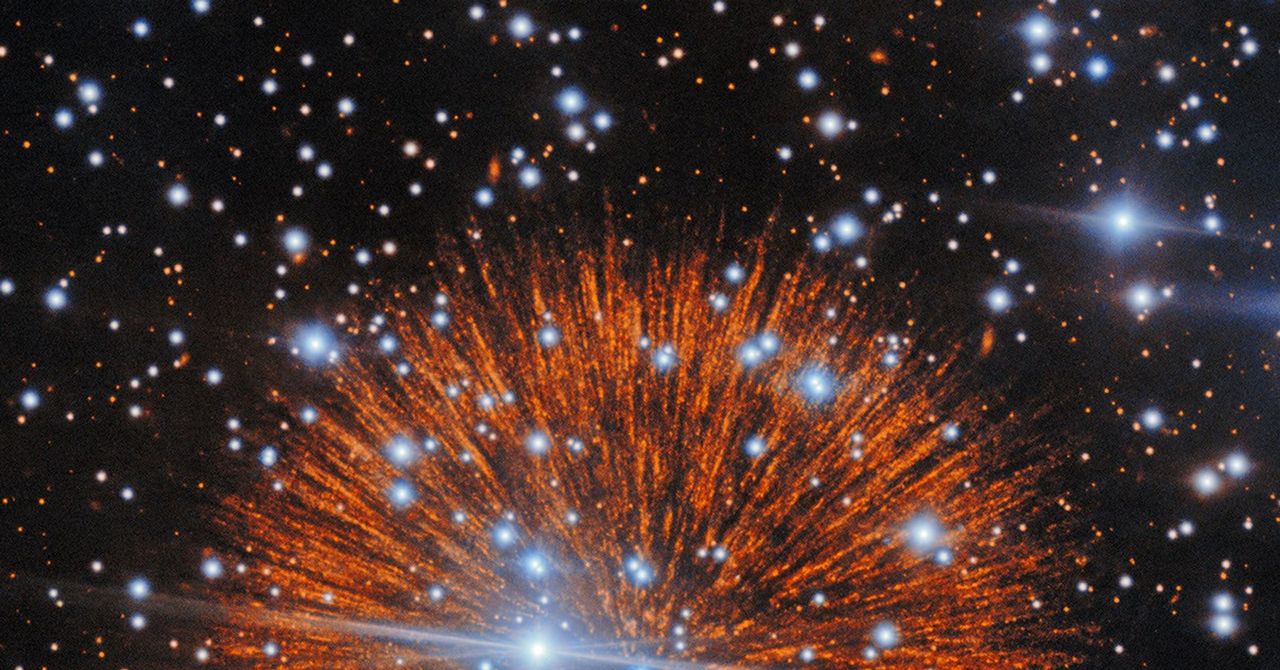
The new image isn’t just stunning—it may also provide clues about how this star survived its own explosion.Pa 30 is the remnant of a supernova that humans first witnessed in 1181.International Gemini Observatory/NOIRLab/NSF/AURAAstronomers have obtained the most detailed image to date of the Pa 30 nebula, the remnants of a supernova famous for having likely been observed and documented from Earth during the Middle Ages. Now, the new photograph reveals structures that had long gone unnoticed.Previous images of the explosion’s remnants had also captured a sphere of long, filament-like strands of matter that collectively resemble fireworks or a dandelion. The new observations, made with the Gemini North telescope in Hawaii, revealed about 10 times more structures than any previous glimpses of the supernova remnant. With this resolution, researchers can now see that these filaments are not continuous as they had previously appeared. Instead, they’re shaped more like beads on a string, made up of pearl-like knots of gas of relatively uniform size.These “cosmic pearls” are, in fact, enormous. According to the study published in The Astrophysical Journal, each bead measures about four light-days in diameter. “The planetary region of our solar system could fit in each knot about 10 times with room to spare,” Ilaria Caiazzo, a coauthor of the study, said in a press release. “The knots are quite strikingly uniform. We are excited to try to model them.”How exactly the pearls formed is not yet entirely clear, though it’s assumed they are concentrations of material ejected during the explosion. What’s strange, however, is their regularity. In the aftermath of a supernova, astronomers expected to find much more oddly shaped accumulations, but the knots are similar in size and appear aligned along the filaments. This peculiar order is a new feature that could help researchers gain a deeper understanding of stellar death.This image, obtained with the Gemini Multi-Object Spectrograph, shows that the ejecta from the remnant—with its unmistakable fireworks-like shape—form a cascading structure resembling a knot. International Gemini Observatory/NOIRLab/NSF/AURAThe Pa 30 nebula is also particularly unusual because the central star isn’t exactly dead. Instead, it’s considered a “zombie star.” Typically, a thermonuclear supernova is the violent death of a star, which is completely destroyed in the explosion. But in rare cases, part of the star may survive, and scientists do not yet fully understand how or why this happens. The unusual structures of Pa 30 could help astronomers reconstruct more precisely how these kinds of detonations occur and how zombie stars can live on afterward.All of this has been discovered because scientists seem to have a bit of a crush on Pa 30. Few astronomical structures connect modern observation so directly with human accounts from more than eight centuries ago. The nebula matches the records left by Chinese and Japanese astronomers in 1181, who described the appearance of a new star in the sky that remained visible for several months. At the time, it was impossible to know that they were witnessing the aftermath of a massive stellar explosion. Centuries later, scientists linked that event to the supernova that gave rise to Pa 30.This story originally appeared on WIRED en Español and has been translated from Spanish.The Big Interview: Patti Harrison had dreams of a tech utopiaIn your inbox: Go inside the world of digital security with Kernel PanicJorge Garay is a contributor to WIRED en Español. He specializes in technology, cybersecurity, and the legislative impact of social media. He has worked in digital media for 10 years. He is passionate about geek culture, astronomy, and the development of new communication technologies. ... Read More
Humans Watched This Supernova Explode Nearly a Millennium Ago. Now You Can See It in High Definition
Full Article
Original Source
Read the full article at Wired →KhanList aggregates and links to publicly available news content. We do not host full articles from third-party sources. Always verify important information with original sources.