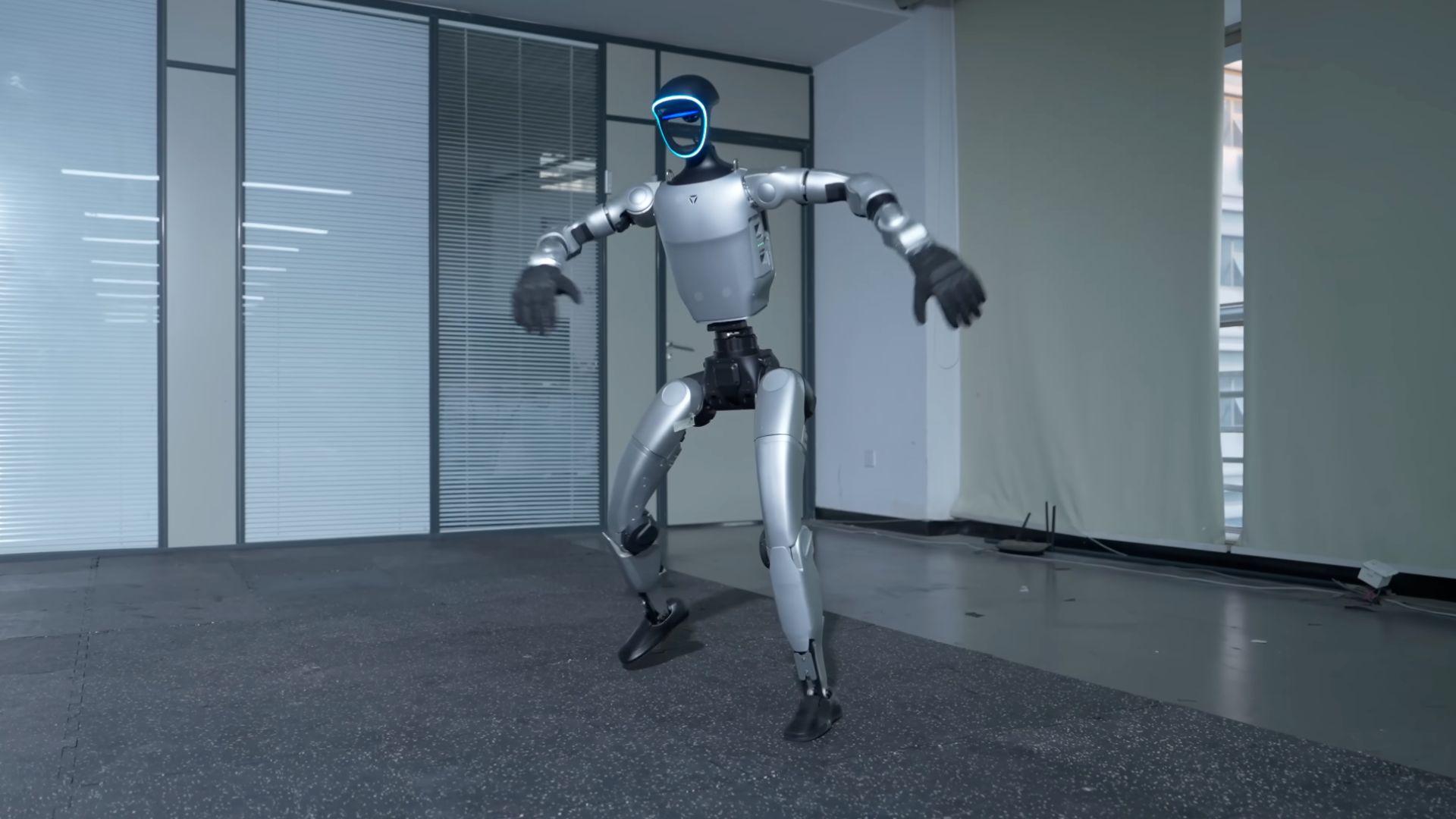
Researchers have developed a new control framework that enables humanoid robots to perform agile movements, including army crawls, breakdancing and backflips. Called zero-shot embodied skill transfer (ZEST), the system uses reinforcement learning to teach robots whole-body movements from human motion capture, video and animation data. Unlike approaches that require task-specific training, ZEST allows robots to learn a wide range of movements through a single training stage before deployment. Tests on Boston Dynamics’ Atlas, Unitree’s G1 and Boston Dynamics’ Spot showed the robots could perform crawling, cartwheels, handstands, soccer kicks and other complex movements across different robotic body types. Robots learn motion Researchers from the RAI Institute and Boston Dynamics have developed ZEST, a reinforcement-learning framework designed to give legged robots a more flexible way to learn complex, human-like movements from motion data. The system is designed to reduce the engineering and controller tuning normally required for each new robotic skill. ZEST, or Zero-shot Embodied Skill Transfer, can learn from three different sources: high-fidelity motion-capture data, ordinary video captured with a single camera, and keyframe animation. Human movements from motion capture and video are converted to a robot-compatible format through kinematic retargeting, while animation can provide movements that humans cannot perform or that are better suited to non-humanoid robots. Importantly, the framework does not require demonstrations to include explicit labels identifying when or where the robot should make contact with the ground. The core technology is a reinforcement-learning policy trained entirely in simulation and then transferred to physical hardware without additional fine-tuning. ZEST uses a relatively simple feedforward policy and relies only on onboard proprioceptive measurements during deployment. According to the study published by the team, it avoids several components commonly used in complex robot-control pipelines, including state estimators, long observation histories, future-reference windows, contact schedules, and extensive task-specific reward engineering. ZEST drives agility A key feature is adaptive sampling. Instead of training equally on every part of a motion sequence, ZEST divides trajectories into fixed-duration segments and tracks how often the robot fails on each segment. More difficult sections are then sampled more frequently, while a minimum sampling probability prevents easier skills from being forgotten. The system also uses an automatic curriculum based on a virtual model-based assistive wrench applied to the robot’s base. The assistance is strongest for difficult dynamic movements and gradually decreases as the policy improves. The researchers also developed simplified models for closed-chain parallel-linkage actuators used in joints such as the ankles, knees, and waist. These approximations reduce simulation complexity while retaining important actuator dynamics. ZEST additionally incorporates actuator effects such as power limitations, motor saturation, transmission losses and friction to improve the simulation-to-real-world transfer. The approach was tested on Boston Dynamics‘ Atlas, Unitree’s G1, and Boston Dynamics’ Spot quadruped. Individual policies required about 10 hours of training, or roughly 7,000 iterations, on a single NVIDIA L4 GPU. On Atlas, ZEST reproduced movements including crawling, forward rolls, cartwheels, army crawling and breakdancing. Video-derived skills included dancing, soccer kicking and box climbing, while animation enabled Spot to perform a continuous backflip and barrel roll.The researchers say ZEST can simplify the path from human movement data to robotic control, but it remains limited to flat, nonslippery environments and has not yet demonstrated generalization to completely unseen movements. Future work includes zero- and few-shot adaptation, continual learning, language- or keyframe-based control, and generative systems that convert high-level commands into executable robot motions.Get the latest in engineering, tech, space & science - delivered daily to your inbox.Jijo is an automotive and business journalist based in India. Armed with a BA in History (Honors) from St. Stephen's College, Delhi University, and a PG diploma in Journalism from the Indian Institute of Mass Communication, Delhi, he has worked for news agencies, national newspapers, and automotive magazines. In his spare time, he likes to go off-roading, engage in political discourse, travel, and teach languages.
Humanoid robots master crawling, cartwheel and backflips using motion data, animation
Full Article
Original Source
Read the full article at Interestingengineering →KhanList aggregates and links to publicly available news content. We do not host full articles from third-party sources. Always verify important information with original sources.