
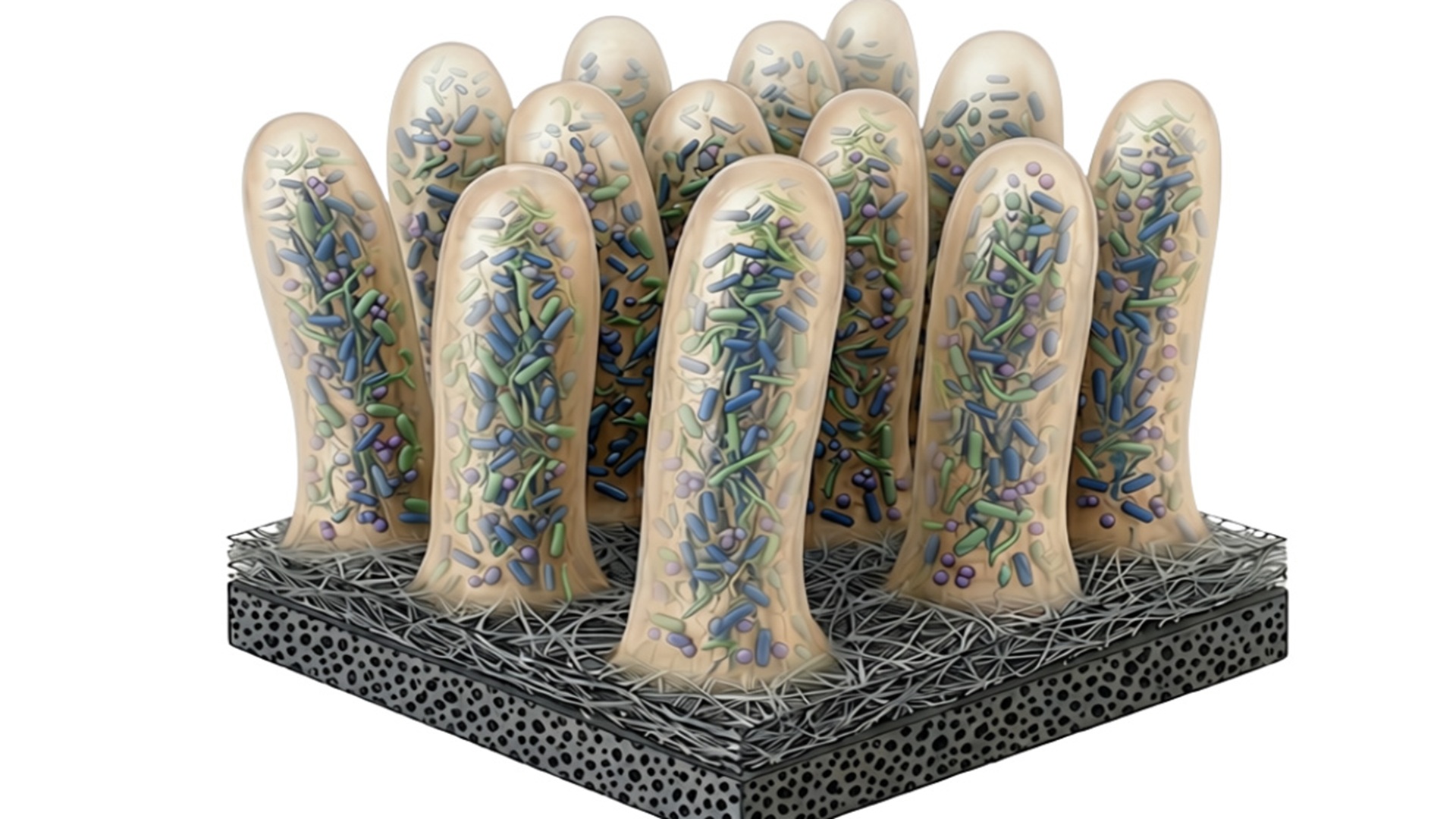
Researchers at Binghamton University have developed a bacteria-powered battery inspired by the human small intestine that maintained an output of about 0.75 volts for at least 14 hours during testing. The device uses flexible, finger-like structures inspired by intestinal villi to provide more space for bacteria to grow while improving nutrient delivery and waste removal. These tiny projections, which normally help the intestines absorb nutrients, offer a model for improving electricity generation using spore-forming bacteria. A team of researchers fabricated the structures using a flexible polymer hydrogel and embedded Bacillus subtilis bacteria within them. The structures serve as the battery’s anode, where bacterial activity helps generate electricity. The team says the technology could eventually be installed in wastewater pipelines, using organic waste as a nutrient source to generate electricity for low-power devices. Overcoming flat electrode limitations Bacteria-powered batteries generate electricity by harnessing the metabolic activity of microorganisms. However, their performance depends partly on how effectively bacteria receive nutrients and release waste. Conventional two-dimensional electrodes provide limited surface area for bacterial growth. Porous materials offer additional space but can become clogged as bacteria form biofilms, restricting the movement of nutrients and waste products. “Porous structures can be easily clogged by biofilm formation, so we had a lot of problems with nutrient delivery, waste buildup or uneven biofilm growth,” said Seokheun “Sean” Choi, a professor of electrical and computer engineering at Binghamton University. To address these problems, Choi and doctoral researchers Ruohan Zhang and Botian Wang turned to the structure of the small intestine. The intestinal villi provide a large surface area while allowing nutrients to move across relatively short distances. The researchers sought to reproduce these advantages in a flexible battery electrode. They created finger-like projections from a polymer hydrogel commonly used in biomedical applications. The material allowed them to build a three-dimensional structure capable of accommodating bacteria throughout the electrode. The bacteria-containing structures form the anode, while a modified carbon-cloth cathode sits on the opposite side of an ion-exchange membrane. Together, these components allow the device to produce electricity as the bacteria metabolize nutrients. Wastewater applications remain untested The researchers envision placing future versions of the biobattery inside wastewater pipes, where microorganisms could use organic matter in the water as fuel. “We can put this biobattery in a waste pipe, because it can easily be integrated with its surroundings,” Choi said. The flexible hydrogel could allow the battery to conform to different pipeline shapes and sizes. Such systems might eventually supply electricity to small sensors without requiring conventional batteries. However, the research remains at an early stage. The reported voltage was maintained with a continuous supply of nutrient medium, and the team has not demonstrated the system operating inside a wastewater pipeline. The researchers also want to simplify manufacturing through a single-step printing process that could make the structures easier to produce at scale. Another goal is to improve how bacteria are distributed within the device. In the human intestine, microorganisms are concentrated mainly in a mucus layer near the villi’s surface. The current design embeds bacteria throughout the hydrogel instead. Future work will examine whether reproducing more of the intestine’s physical and chemical conditions can help maintain bacterial activity and improve performance. The findings were published in the journal Small. Get the latest in engineering, tech, space & science - delivered daily to your inbox.With over a decade-long career in journalism, Neetika Walter has worked with The Economic Times, ANI, and Hindustan Times, covering politics, business, technology, and the clean energy sector. Passionate about contemporary culture, books, poetry, and storytelling, she brings depth and insight to her writing. When she isn’t chasing stories, she’s likely lost in a book or enjoying the company of her dogs.
Human gut-inspired biobattery delivers 0.75 volts for 14 hours in US lab tests
Full Article
Original Source
Read the full article at Interestingengineering →KhanList aggregates and links to publicly available news content. We do not host full articles from third-party sources. Always verify important information with original sources.