
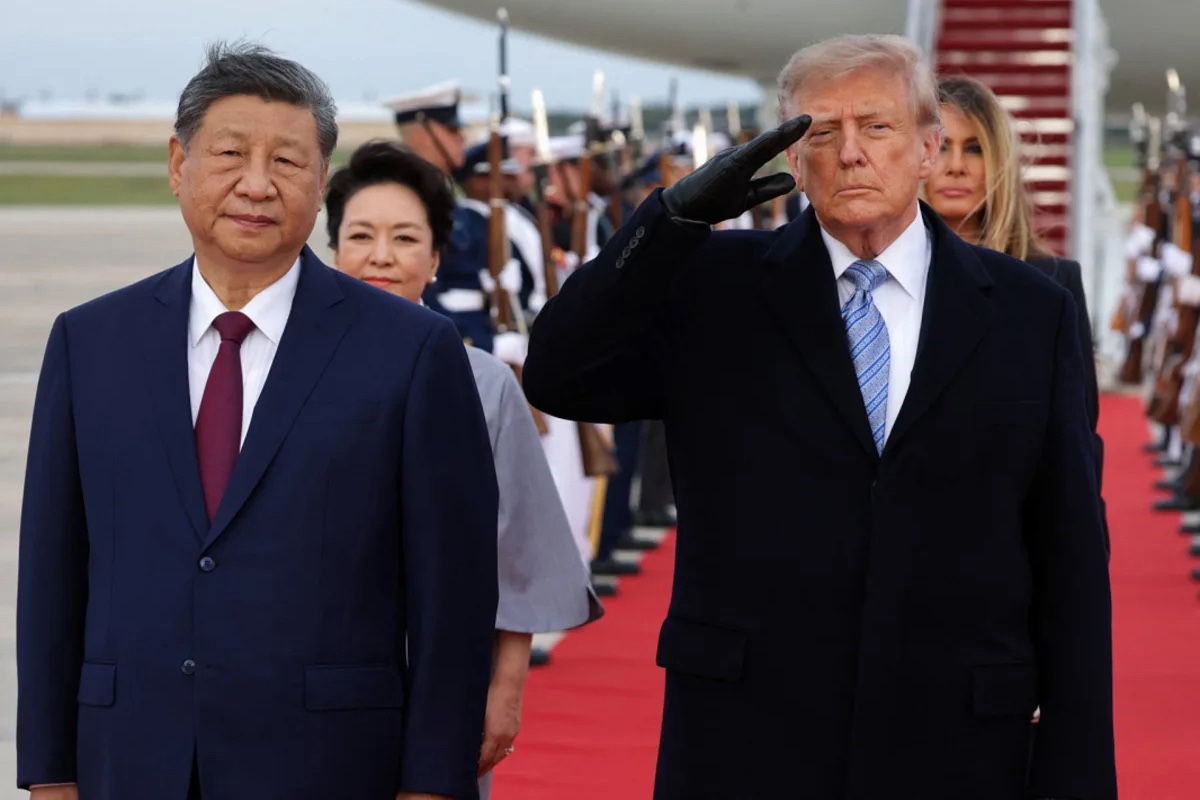
The most consequential sentence of Chinese President Xi Jinping’s visit to Washington may also be the simplest: “The Thucydides Trap can be overcome.” This line, delivered during Xi’s speech at the White House arrival ceremony, provides a better key to understanding the summit than the rich references to the history of US-China exchanges and the lavish language of mutual friendship. The United States and China remain deeply divided over trade, artificial intelligence and geopolitical influence. The summit did not produce breakthroughs directly in those issues. But what was proposed can set a constructive path for the two countries: two increasingly powerful and ambitious countries do not have to treat each other’s national successes as an existential threats. The central question in US-China relations is changing. It is no longer simply how to deal with China’s rise. Much of that transformation has already occurred. The harder question is whether Washington and Beijing can accommodate each other’s ambitions without allowing structural rivalry to spiral into confrontation. That explains Xi’s invocation of the “Thucydides Trap,” an idea he also raised during Trump’s visit to China in May. The Thucydides Trap describes the danger that can emerge when a rising power confronts an established one, generating fear and strategic competition that can ultimately produce conflict. Xi’s use of the phrase therefore addresses the structural problem underlying US-China competition. China does not intend to abandon its pursuit of technological, industrial or geopolitical strength. The United States, under Trump, is equally explicit about restoring American industrial power, technological leadership and national influence. “Achieving the great rejuvenation of the Chinese nation and making America great again can go hand in hand,” Xi stated. This proposition carries greater weight today because China’s position has changed. Chinese companies have become global leaders and exporters in electric vehicles, batteries, drones, telecommunications, renewable energy, electronics, robotics and increasingly artificial intelligence. China also possesses considerable leverage in supply chains crucial to advanced manufacturing. The sensitivity of US officials to Chinese restrictions on critical minerals was evident ahead of the summit, including concerns over yttrium, which is important to aerospace and semiconductor manufacturing. The United States retains enormous advantages of its own in advanced semiconductors, frontier AI, capital markets, research universities and military capabilities. The emerging reality is therefore one of sustained coexistence between two countries possessing different but formidable sources of power. There is good reason, however, to remain cautious about diplomatic visions. US-China history contains striking examples of warm rhetoric followed by rapid deterioration. During the 1868 Burlingame mission to Boston, which Trump referenced at the dinner reception, American leaders celebrated expanding relations with China and promoted greater trade and mobility between the two countries. Yet within little more than a decade, domestic economic and political pressures helped reverse that openness, eventually culminating in the Chinese Exclusion Act. The lesson is that goodwill is fragile unless institutions make it durable. That makes implementation the real test of the Washington summit. One potentially important test is already emerging in artificial intelligence. AI captures almost every contradiction in US-China relations. It is a source of intense technological competition, economic power and national-security concern. Yet the risks created by advanced AI do not remain neatly inside national borders. Xi specifically identified AI as an area of shared responsibility. In his arrival remarks, he said China and the United States should develop and manage AI “for good,” keep it under “human control,” and ensure that it promotes people’s well-being. That language has taken on added significance because China is also expanding its domestic AI-governance architecture. On September 14, 2026, China’s National Technical Committee 260 on Cybersecurity released AI Safety Governance Framework 3.0. The framework emphasizes risk awareness and the principle that AI should remain safe and controllable, and organizes governance around three elements: risk classification, technical responses, and broader governance measures. The over 130 pages in Framework 3.0 address risks arising not only from AI model development but also from deployment, applications, and derivatives. It considers unreliable outputs and hallucinations, malicious cyber activity, privacy and data risks, increasingly autonomous AI agents, embodied AI systems, social and emotional dependence, resource and environmental pressures, and the malicious use of AI in connection with dangerous weapons. The contrast with current US federal policy is notable, although it should not be overstated. Washington also addresses AI security and national security risks. But the administration’s overarching policy strongly emphasizes accelerating innovation, reducing regulatory burdens and maintaining American technological leadership. A June executive order, for example, explicitly argued against “overly burdensome regulation” while calling for faster AI innovation and adoption. However, the US technology sector is raising increasingly urgent warnings about the risks of the technology it is simultaneously racing to develop, with Anthropic’s CEO calling for AI development to “slow down.” Researchers have left leading AI laboratories while calling for stronger external oversight, and executives from major companies have publicly urged stronger safeguards even as commercial competition accelerates. China is articulating its priorities differently: technological development should continue, but alongside continuous risk classification, technical safeguards and government-led governance. Framework 3.0 is not binding regulation, and its publication does not by itself prove that Chinese AI systems will be safer. But its breadth matters because it shows Beijing trying to define AI safety as a problem that spans the entire technological lifecycle and society. That suggests another dimension of U.S.-China competition is emerging alongside the race for the most powerful AI: a competition over who helps define the global rules of AI. The United States benefits from the extraordinary global influence of its AI companies, semiconductor industry and research institutions. China, meanwhile, is trying to translate its regulatory rigor and government-corporate collaborations and increasingly detailed AI governance frameworks into a larger role in international standard-setting. This need not become another zero-sum contest. The United States and China can establish a layer of shared expectations around catastrophic misuse, cyber risks, increasingly autonomous systems and maintaining meaningful human control of AI. The most important signal after the Washington summit is not whether US-China relations are warming. It is whether two countries powerful enough to disrupt each other, and the rest of the world, can build a form of competition in which the two countries co-flourish. If they can, “strategic stability” could become more than a rhetorical phrase and serve as the operating principle for the world’s most consequential bilateral relationship, all the while deftly avoiding the Thucydides Trap. Gerui Wang is an assistant professor at Lingnan University, Hong Kong.
How US and China can nimbly escape the Thucydides Trap
Full Article
Original Source
Read the full article at Asiatimes →KhanList aggregates and links to publicly available news content. We do not host full articles from third-party sources. Always verify important information with original sources.