
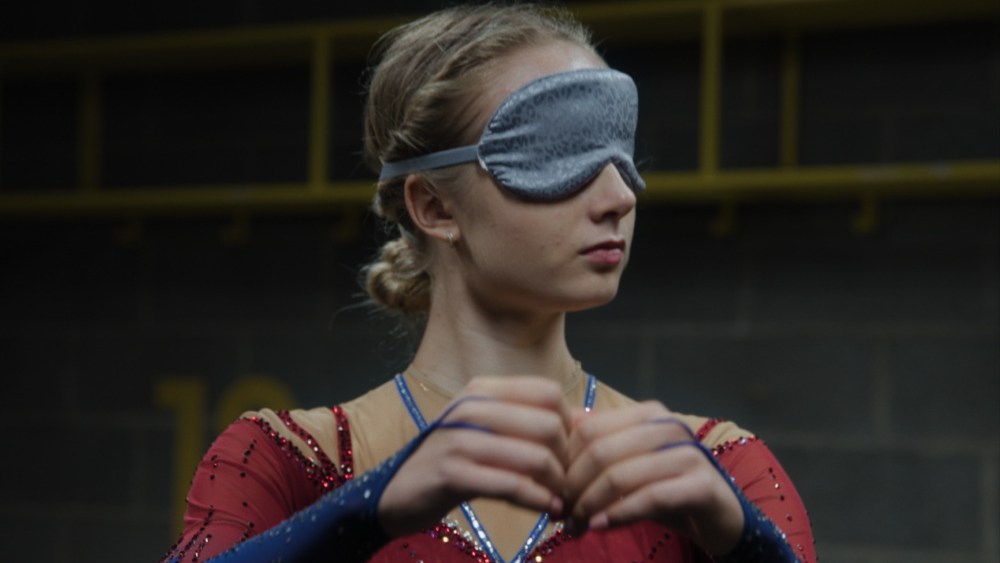
The immersive Czech film “Up Again,” screening in its world premiere at the Ji.hlava docu fest, starts in darkness as the unmistakable sound of ice skates scraping at high speed fills the cinema. Director Eliska Cilkova Andrsova says it’s a motif she returns to again and again throughout her three-year chronicle of the rise of teenage champion Czech figure skater Barbora Vrankova because, wherever she goes, “mentally, she is still on the ice.” A former competitive skater herself, the director, who also cut the film and composed the score, says she first came across Vrankova, naturally enough, on the ice. “Thanks to my own experience on the ice,” she says, “I understand the scoring system and the technical language of figure skating. This shared understanding made it easy for me to connect with Barbora, who was the reigning Czech national champion at the time. Over the following three years, we gradually became close to her family. I’m very grateful for the trust they placed in us and for allowing us to observe not only Barbora’s sporting career, but also the everyday moments behind it.” As the protagonist audiences first meet at age 15 takes on greater and greater challenges – eventually spending time away from home at a prestigious Italian skating school and then in the United States – pressure grows not just for Vrankova but for her family. As the director of the Czech Joy entry puts it, “A triple jump on ice skates lasts just a few seconds but requires years of physical training and mental isolation.” With no time to attend a regular school, her days are filled with online lessons, physiotherapy sessions and a strict training regimen. The action is captured through remarkable camera work that follows Vrankova’s every move on the ice, often at dizzying speeds and arcs. Throughout, the scraping of blades and the rumble of natural background sounds all play key roles. Cilkova Andrsova says sound is not for background in her work – instead, it’s “a path to the themes the film explores: performance, expectations and the search for one’s own place in a world that constantly judges people by their results.” Her previous docu “Pripyat Piano” was also built around sound, exploring the aural landscape remaining around pianos in homes that were abandoned in the Chernobyl Exclusion Zone – the area from where thousands were ordered to relocate after the nuclear plant disaster of 1986. For her new film, she says, a more personal balancing act was needed. “I think the biggest challenge was finding the right balance between being close enough to capture intimate moments and remaining as unobtrusive as possible. Barbora was growing up during our filming, from 15 to 18 years old. And the world of elite figure skating is surprisingly closed to outsiders. For example, at the international training center in Egna, Italy, where we started filming, sometimes even parents were not allowed to watch the training sessions.” As for approaching the demands of filming, she says, “the technical conditions were also extremely challenging. Imagine 20 figure skaters jumping simultaneously, loud pop music playing almost constantly, and coaches shouting across the ice rink. And of course, you cannot expect someone performing triple jumps to wear a microphone! But gradually, these difficulties became part of our creative approach.” Building on her aural approach to her previous film, the director says, “I built a subtle second layer of storytelling through sound, reflecting Barbora’s inner world. So while I approached the images in a purely observational way, filming her closely from her perspective,” she explains, “I occasionally allowed myself a little more creative freedom with the sound.” Some sequences were filmed “literally from the ice, skating alongside Barbora with our cameras.” The director’s experience as a skater helped her guide her cinematographers “and follow her movements more naturally. I didn’t want to create a conventional sports documentary with the visual language of television coverage. I wanted the audience to experience the physical reality of skating from very close.” Always conscious of respecting her subject’s well-being, Cilkova Andrsova at one point asked her team to stop filming after Vrankova struggled with several falls. “But later, Barbora herself told me that falling was simply part of figure skating, and that next time we should film everything. That was a very important moment for me. It showed how much trust had developed between us.” While the filming was planned in great detail, says Cilkova Andrsova, one event threw her production for a loop: “The biggest surprise came when Barbora withdrew from the European Championships. For a competitive figure skater, the European Championships represent an enormous dream. It’s the kind of competition athletes look forward to for their entire lives.” Some spend much of their childhood preparing for the opportunity, she adds. “And suddenly, Barbora was not going. I really hadn’t expected that. I think this was also the moment when I began to understand that our film was becoming something much more complex.” “It raised a question that eventually became central to the film: Who are we when we are no longer defined by our achievements?”
How ‘Up Again’ Director Captured the Rise of a Teenage Figure Skating Champion: ‘The Technical Conditions Were Extremely Challenging’
Full Article
Original Source
Read the full article at Variety →KhanList aggregates and links to publicly available news content. We do not host full articles from third-party sources. Always verify important information with original sources.