
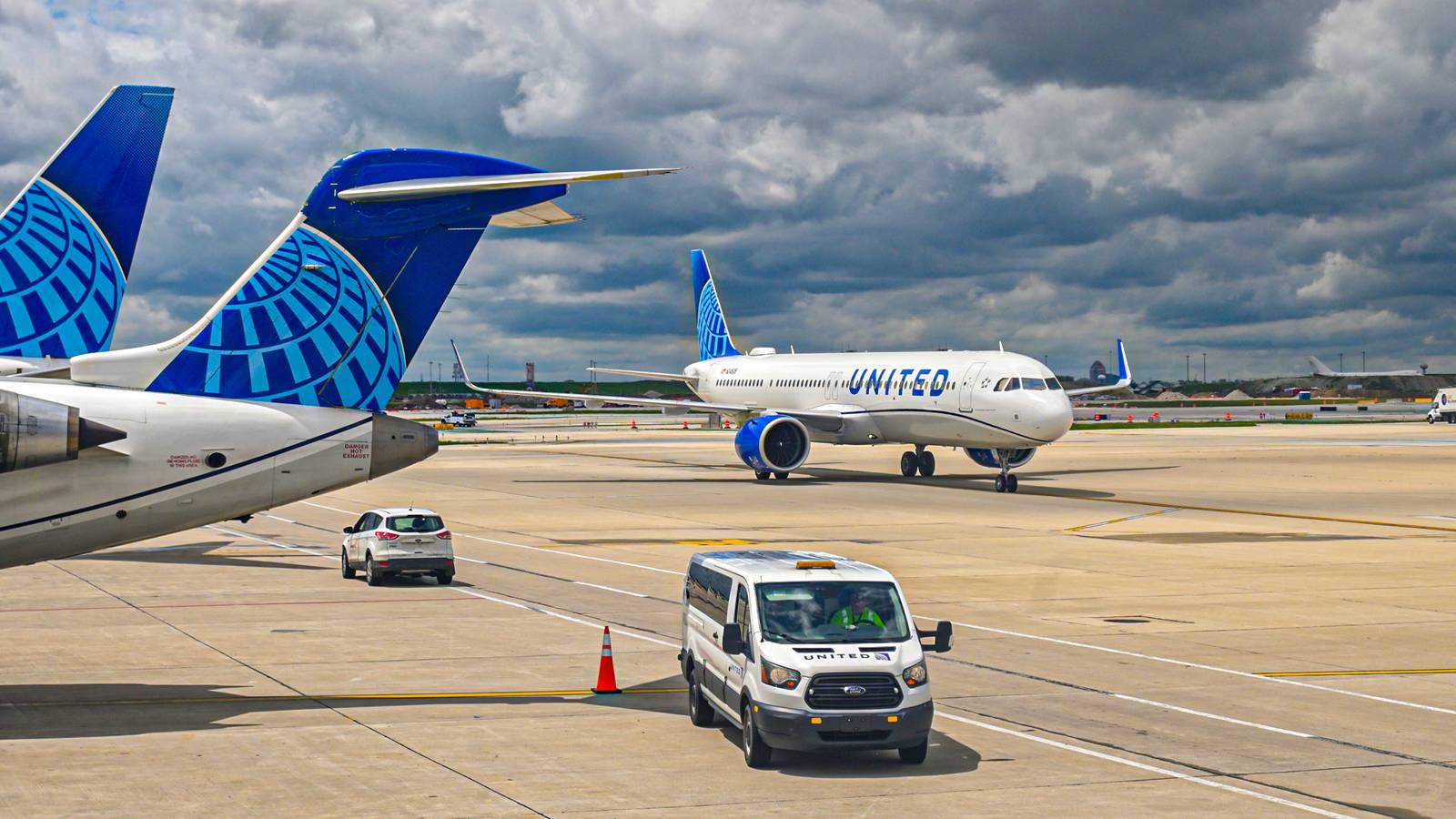
Published Sep 13, 2026, 3:00 PM EDT Luke Diaz is a freelance military writer with experience with active duty experience in the US Navy as well as defense and industrial engineering. He is a former Naval Flight Officer who performed tactical air control on the carrier-based E-2 Hawkeye. Against all odds, United Airlines is advertising the largest single-carrier schedule ever flown at Chicago O'Hare International Airport (ORD) this year. UA plans for up to 650 daily flights to 222 nonstop destinations, with 47 of them international, even as fuel prices are at record highs. This comes in the same season the Federal Aviation Administration slashed O'Hare's total daily operations ceiling by 12% to 2,708. That capacity cut comes off the 3,080 daily operations originally filed for summer 2026 by ORD carriers, as the Federal Register covered. The Federal Aviation Administration has even extended that ceiling through next October based on airfield limitations like air traffic control and other safety of flight factors. Even as the hub cannot grow its total movement capacity, it is nonetheless hosting a record-setting schedule this summer. United originally planned to run between 750 and 780 daily flights out of ORD, but as the FAA wheel forced the airline to cut back, it is making up for the seat capacity by simply flying bigger jets. The method that United will use is referred to as upgauging. While there are pros and cons to this alternative strategy, ultimately it allows UA to move the maximum number of flyers out of O'Hare during the busy summer travel rush. The Cap That Forced The Cut Credit: Shutterstock The FAA's order didn't emerge from routine airport planning. The agency responded directly to what United Airlines and American Airlines had already filed. Combined summer 2026 schedules submitted by the two carriers would have pushed O'Hare to a 15% peak-day increase over summer 2025. The FAA determined such an increase would push on-time performance below the roughly 60% mark O'Hare posted the previous summer. The FAA order dictated in an April order that it would cap airfield operations at ORD as a precaution against serious disruption to the National Airspace System. This instituted a capped scheduled operations at 2,708 per day between May 17 and October 24, which sat about 300 flights below what O'Hare had originally been expected to handle and roughly 10% below the 3,080 filed. In July, the agency extended that same ceiling through October 30, 2027. Once again citing continued construction under the multibillion-dollar ORDNext program as the chief cause. The scope of the project not only includes a new 19-gate Concourse D, a Terminal 3 renovation, but also foundations for a replacement Global Terminal. All of which bottlenecks aircraft and passenger movement through the mega-hub. The order applies to total arrivals and departures combined, counted by movement rather than by seats. That means a 50-seat regional jet consumes exactly the same slot as a 180-seat narrowbody. Thus, United is swapping those Bombardier and Embraer puddle jumpers for single-aisle airliners like the Boeing 737 or Airbus A320. That fleet management decision will allow the carrier to maintain the greatest capacity possible at its vital mega hub in the Great Lakes. A Gate War Measured In Departures, Not Seats Credit: Shutterstock O'Hare allocates gates under a 2018 lease provision that Chicago implemented for the first time in 2025: a 'use it or lose it' formula that redistributes gate space based on each carrier's flying volume over the prior twelve months, rather than on legacy holdings. United, which recovered from the pandemic downturn faster than American, invoked the provision and won five additional gates in the October 2025 reallocation while American lost four, pushing United's share of O'Hare gate space toward 42% against American's roughly 30%. American sued the city, arguing the reallocation process had started prematurely, and lost its bid for an injunction in county court. United's leadership was explicit that the January 2026 schedule announcement was an extension of that fight rather than a demand-driven build-out: on the carrier's fourth-quarter earnings call, CEO Scott Kirby said United would not "allow them to win a single gate" from American in 2026, according to Live and Let's Fly. Executives argued United's O'Hare hub earned roughly $500 million in 2025 while American's O'Hare operation lost a comparable amount. Because the lease formula rewards scheduled frequency rather than aircraft size or profitability, United's fastest path to more gates was simply to file more departures, including on routes that made only marginal commercial sense on their own. That approach ran directly into the FAA's movement cap, which counts every one of those frequency-driven departures the same as a demand-driven one, and forced United to decide which of its gate-defense flying it could actually keep. Upgauging: Fewer Movements, More Seats Credit: Shutterstock The FAA cap counts takeoffs and landings rather than passengers, so the fastest way to grow capacity within a fixed movement ceiling is to fly larger aircraft on the same number of slots. United has been executing exactly that shift for several years under its "United Next" fleet plan, which aimed to cut the share of North American departures flown on 50-seat regional jets from roughly a third to about 10% while raising average seats per departure from about 104 in 2019 to 134 now. At O'Hare specifically, that translated into swapping single-class regional jets for larger single-aisle narrowbodies on routes with enough demand to fill them, freeing up scarce movement slots for either additional frequency or larger gauge elsewhere in the network. The second part of United's two-stage strategy was to protect trunk routes and hub-to-hub services while sacrificing the newest, thinnest regional additions. Many of the routes that absorbed the cut were the ones United had just announced in January. Independent schedule-tracking data from OAG showed an even larger seasonal effect: United removed 9,088 departures from its June-through-August ORD schedule compared with its original filings, a 7.6% reduction that took the carrier from a planned 70,042 departures and 7.93 million departure seats down to 60,954 departures and 7.33 million seats for the quarter. No more four-times-daily regional jet service to Champaign and Bloomington in Illinois. Flights were scrapped to Kalamazoo, Lansing, and Marquette in Michigan. UA axed services to La Crosse and Wausau in Wisconsin, plus Tri-Cities in Tennessee as well as Erie in Pennsylvania, and Rochester in Minnesota. It also canceled planned seasonal Guadalajara service largely in support of the international soccer schedule. All in, ten to eleven small markets are losing O'Hare service outright, according to CBS News. As some consolation, United is expected to revive the routes once the FAA order lapses in 2027, according to Aero Crew News. Spreading The Schedule Around A Locked Midday Credit: Shutterstock O'Hare's peak hours were already saturated well before the FAA cap took effect, which meant United's growth had nowhere to go but the edges of the operating day. United said the carrier could not add flights between regular hours because that window was already tightly scheduled. So new frequency, including the five new Midwest routes later scrapped by the FAA cap, was built into earlier morning departures and a new late-evening bank. That challenge stems largely from O'Hare's transitioning runway configuration under the ORDNext program. The field will eventually transform from an intersecting X-layout to a parallel system. However, while it is under construction, aircraft must perform a prolonged taxi to reach some departure runways without crossing active runways. The procedure known as perimeter taxiing caps how many simultaneous pushbacks the airfield can handle regardless of what the FAA's headline movement number allows. Layering additional banks on top of the operating day lets United add scheduled volume without violating the cap's daily ceiling. Yet, it does nothing to relieve the crew, gate, and ramp staffing burden of running a larger operation across more hours. That resultant staffing gap inspired United's hiring push to add roughly 2,500 employees at O'Hare by the end of 2026. The new team members will support the expanded ops tempo, on top of new United Club and Polaris lounge capacity. The Bill Comes Due In Delays And Cancellations Credit: Shutterstock The pressure test of United's new ORD strategy came on August 9 when a ground-stop event set off what has been described as a global delay record centered on O'Hare. United canceled 52 flights that day compared to American's 10, even though the two carriers posted nearly identical total delay counts. United logged 1,055 delays versus 1,053 for American. Yet its cancellation rate was more than five times higher for United despite comparable disruption levels. OAG data cited by Aviation Week put United's share of O'Hare's scheduled seats at roughly 48% for the summer, against American's 34.3% and Delta's 3.6% market share by seat count. United's larger footprint meant that numerically more of the ground-stop's crew and aircraft disruption fell on its operation, yet the proportional difference still indicates poorer performance. The cascading cancellations in August reached out to spoke cities that saw no weather at all. Separate reporting found United was leading US carriers in cancellations more broadly, nationwide. Some routes into and out of Chicago showed delays stretching past an hour during peak periods even as national on-time performance across the industry declined amid a persistent FAA air traffic controller shortage. That shortage is a national problem United's Chicago strategy didn't create, but the carrier's decision to concentrate an outsized share of its network at a single congestion-constrained hub means any nationwide disruption event lands disproportionately on United's operation first. As the FAA's cap is now locked in through October 2027, the underlying contest over O'Hare's fixed slot inventory is unresolved.
How United Airlines Is Squeezing A Record 650 Daily Flights Out Of O'Hare's FAA-Capped Schedule
Full Article
Original Source
Read the full article at Simpleflying →KhanList aggregates and links to publicly available news content. We do not host full articles from third-party sources. Always verify important information with original sources.