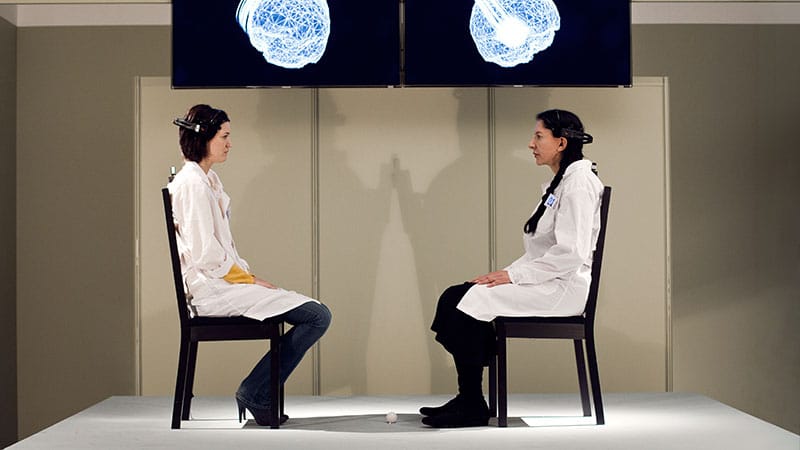
In 2010, the Serbian artist Marina Abramović invited the public to sit across from her, one at a time, at the Museum of Modern Art in New York City. All they had to do was gaze at each other. Many participants were brought to tears.Abramović was fascinated with the experience and wanted to know why people might have such an intense reaction to a stranger. She contacted the Weill Cornell Institute for Developmental Psychobiology in New York City. Suzanne Dikker, PhD, was a postdoc there at the time.Suzanne Dikker, PhD“We were invited to collaborate with her on this question of, ‘Why does this resonate so much with people, to sit in silence and engage in mutual gaze?’” Dikker said. “It gave me the opportunity to try to figure out how we might be able to collect brain data from people during naturalistic face-to-face communication in real-world settings.”Dikker had long been fascinated by how people in conversation can quickly “get on the same wavelength” and understand each other. She identified neural signatures linking rapid language processing to our ability to anticipate upcoming words. But she felt like lab research was only scratching the surface of how connection with others works in real life. “To study that, you really need to engage people in face-to-face communication,” said Dikker, now a research associate professor of psychology and neural science at New York University and professor of psychology at Ghent University in Ghent, Belgium. “I wanted to go into the field.”That’s how she ended up inside a Moscow museum in 2011 with Abramović tracking people’s brain waves. For the first time outside the lab, Dikker could see what it looked like when neural activity between two people synchronized — when they found a shared flow.Artist Marina Abramovic (right) and the “Measuring the Magic of Mutual Gaze” project.It all begs a serious question: How can we better understand genuine in-person human connection — and establish it quickly — when we’ve become siloed by technology and its social bifurcations?Since Moscow, more research by Dikker and others has demonstrated the possibility of measuring the phenomenon. Research suggests certain experiences, from pregame rituals to live music, can encourage biological synchrony and give us that elusive feeling of mutual alignment.Scientists have been using functional MRI and EEG technologies to track neural synchrony in the lab since the early 2000s. Dikker has taken those experiments outside: to classrooms, festivals, and music studios. Some studies have drawn a distinction between synchronizing to external stimuli vs one another, but Dikker views it more expansively.“I think it’s more an ‘everything everywhere all at once’ kind of thing,” she said. “By which I mean a complex interplay between the stuff we see and hear and how we interact, or how individual differences in our brains may impact how we process the environment, and that might in turn impact how we feel socially connected.” Shared Variation in Neural ActivityAfter the experiment in Moscow, Dikker helped create the Mutual Wave Machine, which generated real-time visual representations of neural synchrony. Two at a time, participants outfitted with EEG headsets sat facing each other for about 10 minutes while researchers tracked their brain activity. Many participants engaged in conversation, made eye contact or similar motions with their hands, or tried to think about the same thing. The more synchronized their brainwaves were, the more light was projected onto the surface of each of their chairs.Dikker and her collaborators brought the Mutual Wave Machine to other public settings, gathering data for 5 years. They tracked real-time variations in brain areas that control higher-order functions, such as language and memory, to avoid measuring purely sensory fluctuations caused by unrelated stimuli. Participants also answered questions about their relationship to each other, personality traits, and mental states.The researchers recalculated synchrony later, after removing unwanted signals, leaving them with a subgroup of 726 participants at a museum and a music festival. The results showed that people who knew each other longer or felt closer to each other showed stronger neural synchrony.Dimitris Xygalatas, PhDWhat the researchers actually measured is “a statistical relationship between two brains’ oscillations, using conservative metrics designed to filter out noise and mere shared exposure to the same stimulus,” said Dimitris Xygalatas, PhD, associate professor of anthropology and director of the Cognitive Science Program at the University of Connecticut in Storrs, who was not involved in the study.“What stands out here is that subjective feelings of social closeness turn out to have measurable correlates at the brain level. That’s an important contribution: It shows that neural coupling can serve as a signature of shared engagement,” Xygalatas said. “When two people report feeling connected, their brain activity actually rises and falls together, and that coupling is predicted by exactly the things we’d expect to matter: empathy, closeness, engagement, joint action, and eye contact.” The Big Question About Neural SynchronyResearchers still don’t know why neural synchrony exists. Does it bring us together or simply demonstrate a connection?“The main open question is what neural synchrony does,” Xygalatas said. Research from the Mutual Wave Machine, for example, doesn’t show whether neural synchrony is functional or not. “I’d want to know whether it predicts downstream outcomes, for instance, cooperation, trust, or interpersonal proximity. That’s what would tell us whether synchrony is doing work or simply reflecting it,” Xygalatas said. The relationship between eye contact and neural synchrony is also mysterious. Several studies have shown that eye contact synchronizes neural activity, but the causal mechanism remains unknown. Other research finds that, rather than creating synchrony between two people, eye contact begins when synchrony peaks between people who are already in sync. Elizabeth B. daSilva, PhDThe possible drawbacks of neural synchrony are also under investigation, said Elizabeth B. daSilva, PhD, associate professor of psychology at Indiana University Columbus, who was not involved with Dikker’s research. DaSilva’s 2024 Personality and Social Psychology Review study aimed to “provide a shared language of what we mean when we talk about synchrony” across different domains.“The field is still trying to figure out to what extent is synchrony beneficial,” daSilva said. “It’s often framed as something positive, but there could be some situations where too much synchrony might be seen as unnatural or intrusive — you can be so in sync that you can’t then be flexible and respond to other information.”Synchrony in the WildWhile researchers continue teasing out the purpose of synchrony, numerous social situations seem to encourage it.During ritual gatherings before soccer games in Brazil, for instance, Xygalatas tracked higher levels of heart rate synchrony among fans than during the game, when “each peak neatly corresponded to a specific game event, such as a goal or a missed chance,” he said. Live music may have a similar effect on fans. The artists “can act as emotional conductors,” Xygalatas said, citing his 2024 research finding that the Imam’s heart rate predicted worshippers’ heart rates in an Islamic congregation. The scale of the crowd also creates “ collective effervescence, an almost transcendent feeling of being one with a group of people acting in unison,” he said, which his 2010 research on religious fire-walking has demonstrated.Dikker’s research suggests playing music with others also encourages neural synchrony. She got a glimpse of this between Residente and Bad Bunny, two rappers who’d never worked together before, as they sat opposite each other with EEGs measuring their brain activity as they interacted. Their synchrony signals were translated into sounds Residente later incorporated into the song “Bellacoso” in 2019.Two years ago, Dikker listened to Grateful Dead guitarist Bob Weir and Phish bassist Mike Gordon perform the song “He’s Gone” in Weir’s San Rafael, California studio. Gordon, long-interested in how artists reach “flow state,” invited Weir to participate and helped recruit Dikker and other researchers. Sensors tracked the artists’ brain activity, heart rate, and skin conductance. Gordon and Weir each pressed a foot pedal when they felt “in flow” — a device called XenboX developed by Gordon with help from Dikker and other neuroscientists. Weir died about a year later.“I didn’t realize how special that was until I was in the room,” Dikker said.Mike Gordon, left, and Bob Weir participating in a 2023 project that measured and visualized how the musicians became “in sync” with each other while playing live music.Designing Ways to Use SynchronyResearchers are trying to harness neural synchrony in different settings and for different purposes, such as improving social cohesion among students or enhancing therapist-client dynamics. Dikker co-authored a recent Trends in Cognitive Sciences article that considers a possible framework for interventions based on neurofeedback. Real-time visual representations of brainwave dynamics may encourage different behaviors. For instance, pairs told that visual displays represented their neural synchrony became more synchronized than those who were not told. Knowing they were in sync motivated people to stay focused or engaged with their partner, Dikker suggested.Some places are building synchronization opportunities into everyday life. The Netherlands, where Dikker is spending time this summer, has an ongoing campaign to inspire small talk — a potential route to getting on the same wavelength with someone you’ve never met before. “That is a way of synchronizing with others,” Dikker said. “Or discovering that strangers are okay 99.9% of the time and that it’s actually rewarding to do this kind of social interaction.”Xygalatas and daSilva reported having no relevant disclosures. Other relevant disclosures are noted in the piece. Disclosure information for study authors is available in the original study publications.
How Two Brains Can Quickly Be ‘On the Same Wavelength’
Full Article
Original Source
Read the full article at Medscape →KhanList aggregates and links to publicly available news content. We do not host full articles from third-party sources. Always verify important information with original sources.