
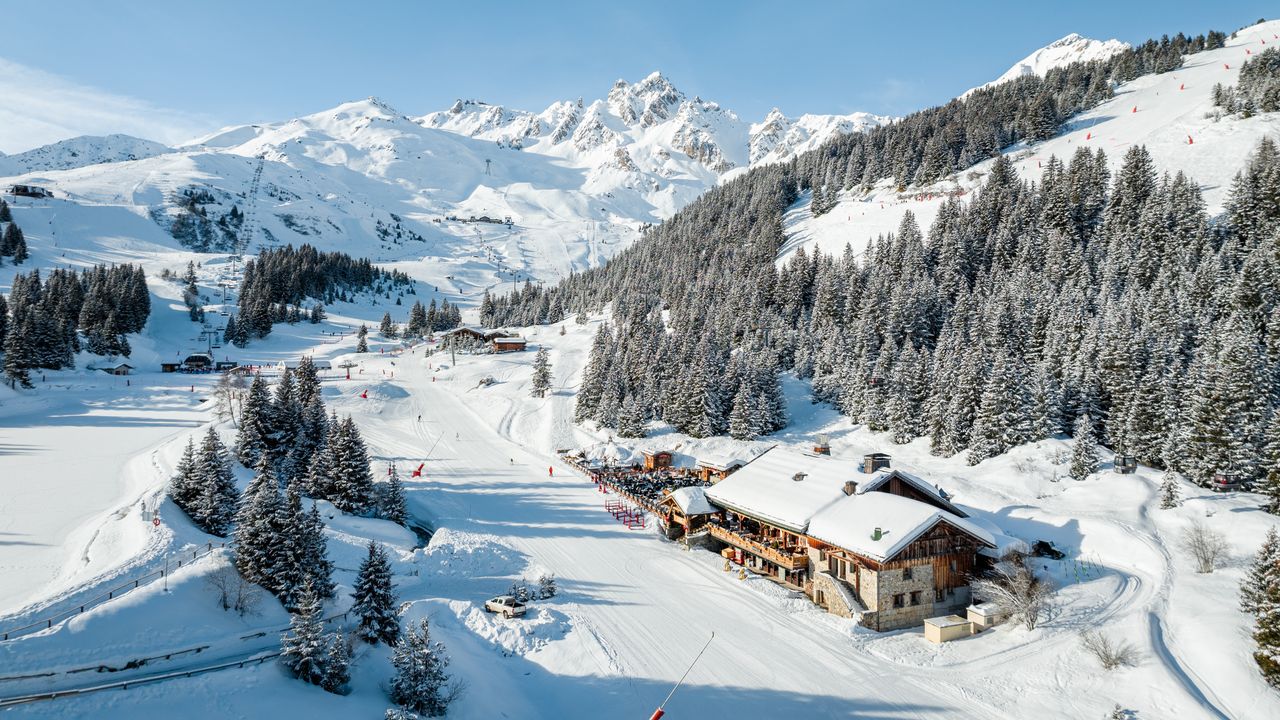
Standing at the top of a steep gully, I looked down at the line ahead. A handful of tracks cut through 10 inches of powder to my left, telling the story of the skiers who arrived before me. But I couldn’t help but notice untouched snow under an overhanging cliff face to my right.Before I dropped in, I looked out at the view ahead. I could make out tiny chairlift towers on the snow-capped peaks and ridgelines on the horizon. It felt as if the entire mountain range belonged to the Les Trois Vallées Ski Resort, one of the best—and the biggest—ski destinations in Europe.Les Trois Vallées (also known as Les 3 Vallées, or the 3 Valleys) began with the construction of a 19-passenger open-air “chairlift” in 1938 in the small town of Méribel. But it wasn’t until 1971, with the creation of the joint ski pass that offers access to the seven resorts that make up Les Trois Vallées, that the ski area took its current form.Today, the resort spans three main valleys and has 169 chairlifts accessing nearly 26,000 acres of skiable terrain (for comparison, Park City has 7,300 acres of skiable terrain). That makes it the world’s largest interconnected ski area—and it’s all accessible via a single ski ticket. Lift tickets for each of the seven resorts are available, but the cost savings don’t make it worthwhile—for a couple of extra euros, you can buy a pass that gives you access to the entire resort. Les Trois Vallées is also a convenient destination for Epic Pass holders, who get seven days of skiing at Les Trois Vallées.Given the destination is so vast, here are some tips for navigating the expansive terrain and various villages that make up Les Trois Vallées, based on my most recent trip in 2026.Insider tips and tricksWhere to stay in Les Trois ValléesWhere to eat in Les Trois ValléesHow to get to Les Trois ValléesAn aerial view of the skiing area of Les Trois Vallees, also known as The 3 Valleys. GettyInsider tips and tricksIf it's your first time, hire a guide“We need to ski over there today,” our guide and former ski racer, Timothée “Timy” Theaux, says as he pointed toward a distant ridgeline. “The wind is coming from Italy, so that side of the ridge is where we’ll find the best snow.”We skied seamlessly from lift to lift until we reached an open bowl with untouched powder. Theaux knew exactly where to go given the current conditions, and how to get there.Les Trois Vallées isn’t like a typical US resort. The terrain is so vast and complex that skiing it without a guide can be more of a chore than skiing with one. Guides—which you can hire through each resort’s ski school, like ESF Val Thorens—not only know how to navigate the resort and keep you safe off-piste, but also know exactly where to go to score skiers the best possible conditions and overall experience.I pictured myself without a guide at the resort, spending day after day staring at trail maps, hopping on lifts that dropped me a mile from where I thought they would. Thankfully, our guide’s expertise spared us from what could’ve been a logistical nightmare.On our third day at the resort, low visibility made it hard to see more than 15 feet ahead. As we impatiently waited for the fog to lift, lapping groomed runs outside of our hotel, Theaux decided to head toward Courchevel.“Courchevel and Méribel are good to ski when visibility is low,” he told us, explaining that they’re both at a lower elevation and have more tree skiing.Even if it’s just for a day or two, hiring a guide at the beginning of the trip will help skiers and riders get a feel for Les Trois Vallées and each individual resort. While all seven resorts offer a good mix of terrain for every ability level, some, like Val Thorens, sit at a higher elevation and have more alpine terrain than resorts like Courchevel, which are lower and have more tree skiing.The terrain is also so vast that it’s not hard to avoid crowds—which typically stick to the pistes at each resort (Courchevel, Val Thorens, and Méribel are some of the more popular ones). Focusing on one resort per day, rather than spending an entire day riding lifts from one side of the resort to the other, is a stellar way to maximize time on snow.Backcountry skiers can enjoy the vast off-piste areas beyond the resort's groomed runs. GettyEscape the crowds and get off-pisteUnlike many US ski areas, there aren’t dedicated off-piste areas marked on a map—everything within (and really, outside of) the resort’s boundaries is fair game. But leaving the pistes requires a guide, or at the very least, knowledge of how to navigate backcountry terrain. A low-angle, mellow backcountry slope can quickly steepen enough to raise avalanche concerns, and skiers who leave the pistes should be able to recognize and manage backcountry hazards. And while not all off-piste terrain at Les Trois Vallées requires the chops of an expert skier, it doesn’t take much to get yourself in trouble. When it came to navigating the resort, keeping us out of trouble, and scoring the best conditions away from the crowds, Theaux took out all of the guesswork.After several lift rides and traverses, we finally found ourselves in Courchevel, on the opposite side of the resort from where we were staying in Val Thorens. We immediately left the groomed runs and headed for the trees, leaving the crowded pistes behind.As a New Englander, I feel at home in tight, scrappy tree runs. But leaving the pistes to explore the vast terrain and big lines encompassed by Les Trois Vallées was special. Unlike the runs I’ve grown accustomed to at my local ski areas, pistes at Les Trois Vallées don’t have a hard line defined by thick trees and icy trail edges; almost everything is skiable.“Dropping into an off-piste line alone, with just your guide, is one of the most special feelings in the world,” says Dan Egan, a pro skier who has been spending winters in France for nearly three decades. He was skiing with us for the week. “You really get to connect with the place in a way you never would on a groomed run filled with people.”At the top of nearly every chairlift, I spotted about a dozen distant backcountry lines I wanted to explore. Saw-toothed peaks gave way to steep chutes and couloirs, many of which funneled into open powder fields. “I need to come back and ski that,” I found myself thinking about a dozen times per day.Courchevel is perhaps the spiffiest resort at The Three Valleys—but there are budget-friendly villages nearby. GettyWhere to stay in Les Trois ValléesEach resort town has its own feel, so it’s important to know your priorities before booking. Courchevel, for example, is the most luxurious destination, while Col de la Chambre is perfect for skiers who want to spend their evenings partying. Budget-conscious skiers should consider Brides-les-Bains or Orelle; whereas Les Menuires might be better for families. Saint-Martin and Méribel both have a cozy European village vibe, but Méribel might have the slight advantage for off-piste skiers.Val Thorens is known for its vibrant aprés-ski scene. GettyWhen we first arrived at the Fahrenheit Seven hotel in Val Thorens, I felt like I was in an early 2000s ski movie. The back deck was packed shoulder to shoulder, and the DJ knew just what to play to keep the crowd going. It was the middle of the afternoon on a random Sunday.While there is plenty of partying to be done all over Les Trois Vallées (the parties at La Folie Douce Val Thorens and La Folie Douce Méribel are not to be missed), there are also more laid-back places to stay. Of the seven resorts and villages, each has its own unique feel and caters to different types of skiers. And all of them offer lift access to the pistes.“Courchevel is my favorite place to ski because it has a lot of luxury restaurants and accommodations, so hardcore skiers think it’s not for them,” Theaux told us during our low-visibility day. “The off-piste terrain is always empty.”But if you’re heading to Courchevel for the accommodations over the skiing, Les Airelles Courchevel is about as luxurious as it gets.Saint-Martin-de-Belleville, slightly below Val Thorens in the Belleville Valley, has the quiet feel of a quaint European hamlet. Like Val Thorens (and most villages around the resort), it’s very walkable, but it's better for skiers who value history and culture over parties. Orelle, made up of 10 hamlets and less popular than other villages, and Brides-les-Bains, known for its thermal waters and spa culture, are also quiet options; the latter is great for budget-conscious travelers.Méribel, next to Courchevel's high-end restaurants and parties, is known as a family-friendly resort village with plenty of restaurants, bars, shops, and easy lift access. Similarly, Les Menuires is also known as a family destination, but is ideal for skiers looking to explore some of Les Trois Vallées’ bigger off-piste terrain.Traveler-approved properties in Les Trois Vallées:Food across the resort is locally sourced, even at on-hill dining options, like Caron 3200. Caron 3200Where to eat in Les Trois ValléesNo matter which village you stay in, good food is never more than a couple of steps or a chairlift ride away.“I really love the jamon because it requires patience,” says Vincent Suchet, the cheesemaker and grandson of Pépé Nicolas at family-owned, Michelin-starred Chez Pépé Nicolas—located just below Val Thorens in the Belleville Valley. He told us as we sipped wine and tasted local cheeses in a cool, stone-walled cellar: “And I favor the cheeses because you have to wait two years; the flavor is the best when you have to wait.”The culinary experience stood in stark contrast to what I was used to at US ski areas—fast service, overpriced, yet mediocre cheeseburgers and pizza, and ingredients sourced hundreds, if not thousands, of miles away. At Les Trois Vallées, home to ten Michelin-starred restaurants like Hotel La Bouitte, the food is just as important as the skiing.During my week at the resort, I couldn’t find a single fast-food or chain restaurant in any of the seven villages. Restaurants are all family-owned, and thought goes into where ingredients are sourced. It’s not uncommon for cheeses to be made by a local farmer whose family has been doing it for generations.Caron 3200, perched above Val Thorens, is the highest wine bar in Europe. Caron 3200Even on-hill dining options, like Caron 3200, perched above Val Thorens at 10,500 feet (making it the highest wine bar in Europe), emphasize the culinary experience.“We have 150 different wines, and most are French,” Eric Bonnel, managing director of Val Thorens Tours, told us as we sipped wine and admired the views of Mont Blanc and the surrounding Alps through the oversized windows. “And we store them at three different altitudes. The reds are aged at a higher altitude because there’s less oxygen.”On our last evening at Les Trois Vallées, it finally started snowing. I momentarily felt a slight sense of disappointment about leaving ahead of a huge storm. But as I sipped my post-meal Génépi with new and old friends, I realized it didn’t matter. The skiing was only a small part of the Les Trois Vallées experience.Les Trois Vallées is accessible via train, plane, or car. Sylvain AymozHow to get to Les Trois ValléesFor international travelers, the most convenient airport to fly into is Geneva, which is located just a couple of hours from the resort (depending on where you’re staying). While the Swiss airport has the most international flight options, it’s also possible to fly into Lyon, Chambéry, and Grenoble.Companies like Alpine Fleet offer shuttle transfers from the airports to the resorts in Les Trois Vallées. You can also rent a car, but with the lifts and shuttles available in each resort town, you don’t really need one once you arrive.Those traveling within Europe or from one of the area’s international airports can access Les Trois Vallées by train, with the Moûtiers train station serving major cities like London, Paris, Geneva, and Lyon. From the train station, travelers can get to each resort by taxi or bus.
How to Plan a Trip to the World’s Largest Ski Resort, Les Trois Vallées
Full Article
Original Source
Read the full article at Cntraveler →KhanList aggregates and links to publicly available news content. We do not host full articles from third-party sources. Always verify important information with original sources.