
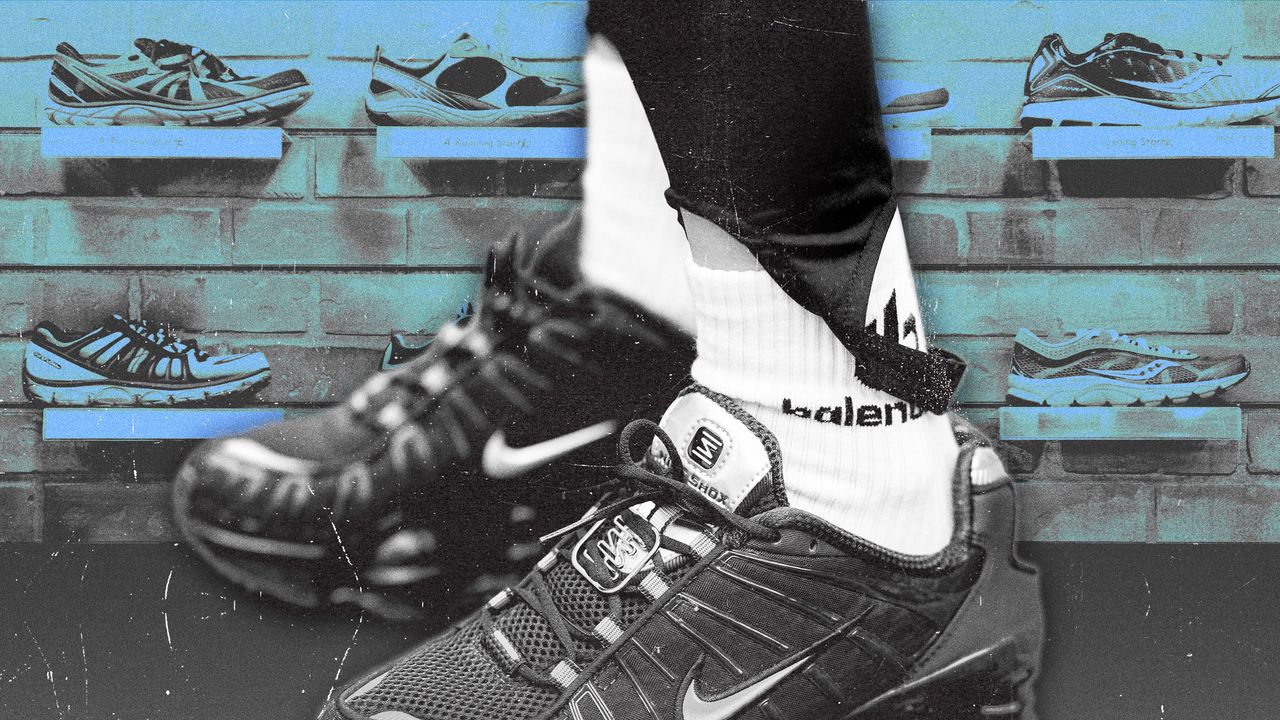
In a year in which Wiz Khalifa became a running influencer, On partnered with Kylian Mbappé, and Satisfy made it onto our Paris fashion week itinerary, it’s safe to say that the running boom has gone supersonic. So we figured this would be as good a time as any to talk about how to choose the right running shoes.The beauty of running—whether you’re getting into it for the first time or just looking to upgrade your gear—is that all you really need is a pair of shoes. (Ok, and some socks.) However, as poetic and simple as that may sound, identifying the best running shoes for you can quickly become complicated. Foams, outsoles, and plates are just a few of the factors to consider when looking for a new pair of kicks to lace up, whether that be on the road, trail, or starting line of your next race. And appearances can be deceiving. “One of the things that we always encouraged people not to do was to buy a shoe based on its color or its look,” says Mike Thomson, CSCS, a personal trainer and USATF-certified run coach at Life Time who got his start on the sales floor of his local running store.Speaking of which, this is a purchase that you’re probably going to want to make in person, not online. “If they're not comfortable in the shoe store, they're not going to break in and be comfortable later,” says Milica McDowell, PT, MSPT, DPT, associate vice president of education at US Physical Therapy and author of WALK. “The upper may soften a little bit, but the shape of the shoe and the ground feel are not going to change. If the shape doesn't quite fit, that should be a pass from a purchasing standpoint.”So, what are the most important things to keep in mind the next time you’re standing in front of a giant wall of running shoes? We asked the experts, and here’s what they had to say.Consider the surfaces you’ll be running onEvery running shoe’s outsole—the part that makes contact with the ground—is designed with a specific surface in mind, so one of your first considerations should be whether you’re looking to run mostly on roads, trails, or something in between. "You want to match your outsole to the surface that you are primarily running on,” Dr. McDowell says. Whereas road shoes tend to be mostly smooth underneath, and may even have areas of exposed foam, trail shoes wield jagged rubber lugs to give you traction on natural terrain. “Think of a running shoe as being like a tire,” says Thomson. “If you’re going off-road, you’ve got to have the right tread on the bottom so you're not slipping around.”If you had to pick one shoe to span the spectrum of smooth roads to gnarly trails, McDowell recommends a trail shoe. “You can always street run in a trail shoe, but it's very hard to trail run in a street shoe,” she says. But you’d ideally have a dedicated pair for each. The exception would be gravel shoes—a fast-growing category of running shoes designed to tackle equal parts road and light trail. With toothier tread than road shoes and flatter, more shallow lugs than trail options, gravel running shoes will give you a foothold in both worlds—provided you don’t veer too far off the beaten path.Skip the stratospheric foamMax-cushioned running shoes have become popular over recent years, with brands claiming that more foam equals less impact on joints and connective tissues. But that doesn’t mean a sky-high midsole is right for you—or anyone, for that matter. A 2018 study published in the journal Scientific Reports found that a thicker, foamier midsole actually increases impact loading on the body, compared to a lower, more traditional running shoe. More recently, a 2025 research review found that max-cushioned shoes may increase the risk of ACL injuries. “It's the exact counterargument to what all the marketing says,” says Dr. McDowell. “[Brands] have done a phenomenal job of telling that story, but the science does not support that story. It’s actually the opposite.”“Ideally, you want the minimum amount of cushion to do the job,” says Dr. McDowell, who points out that a thicker midsole can also weaken the connection between the nerves in your feet and your brain. “It diminishes your ground feel, so you start to lose connection with the surface you're running on,” she says. “You're essentially making it harder for your neurological system to manage your running.”The hard facts about carbon platesA lot of running shoes nowadays are being designed with carbon plates layered into the midsole. Generally, these shoes tend to be more expensive, but in certain use cases they’re well worth the investment. In a trail shoe, for example, a plate can dramatically improve comfort and performance over rocky terrain. "It allows you to step on unstable rocks, pebbles, and roots without throwing off your balance,” says Dr. McDowell. “From a trail running perspective, the more technical the terrain, the more I would advocate for somebody to consider it.”In road running shoes, carbon plates provide extra propulsion and are typically found in models designated for racing or tempo runs. “When we test on treadmills and things like that, we're really able to see that there is a mechanical advantage with carbon,” says Dr. McDowell. "If you're looking for a PR, carbon is one way to get it.” That said, it’s worth noting that because a plated road shoe is essentially doing some of your foot’s work for you, using it for the bulk of your mileage could gradually rob you of valuable gains. "I would say it's not advised as your daily driver, as it's going to limit some of the mobility that your foot should be going through,” Dr. McDowell says. "It is specifically designed for performance efforts.”Make sure you buy the right sizeThis may sound like an obvious one, but when was the last time you actually measured your shoe size? A review published in the Journal of Foot and Ankle Research found that more than 60 percent of adults wear the wrong shoe size for their foot, which can cause foot pain, corns, calluses, and other issues. “People think that when they stop growing vertically, their feet stop lengthening as well, which is not true,” says Dr. McDowell, who notes that changes in foot size, shape, and volume can result from things like fluctuations in body weight and muscle mass, and even certain medications. “If you think you're the same size that you've been wearing since college, you're probably wrong.”To make sure you’re always shopping with the right size in mind, Dr. McDowell recommends getting your feet measured at a running store at least once a year. “Length is priority number one,” she says, although you may benefit from an assessment of your foot’s width as well, as many running shoe brands now offer wide and narrow versions of some models.
How to Choose Running Shoes, According to Experts
Full Article
Original Source
Read the full article at Gq →KhanList aggregates and links to publicly available news content. We do not host full articles from third-party sources. Always verify important information with original sources.