
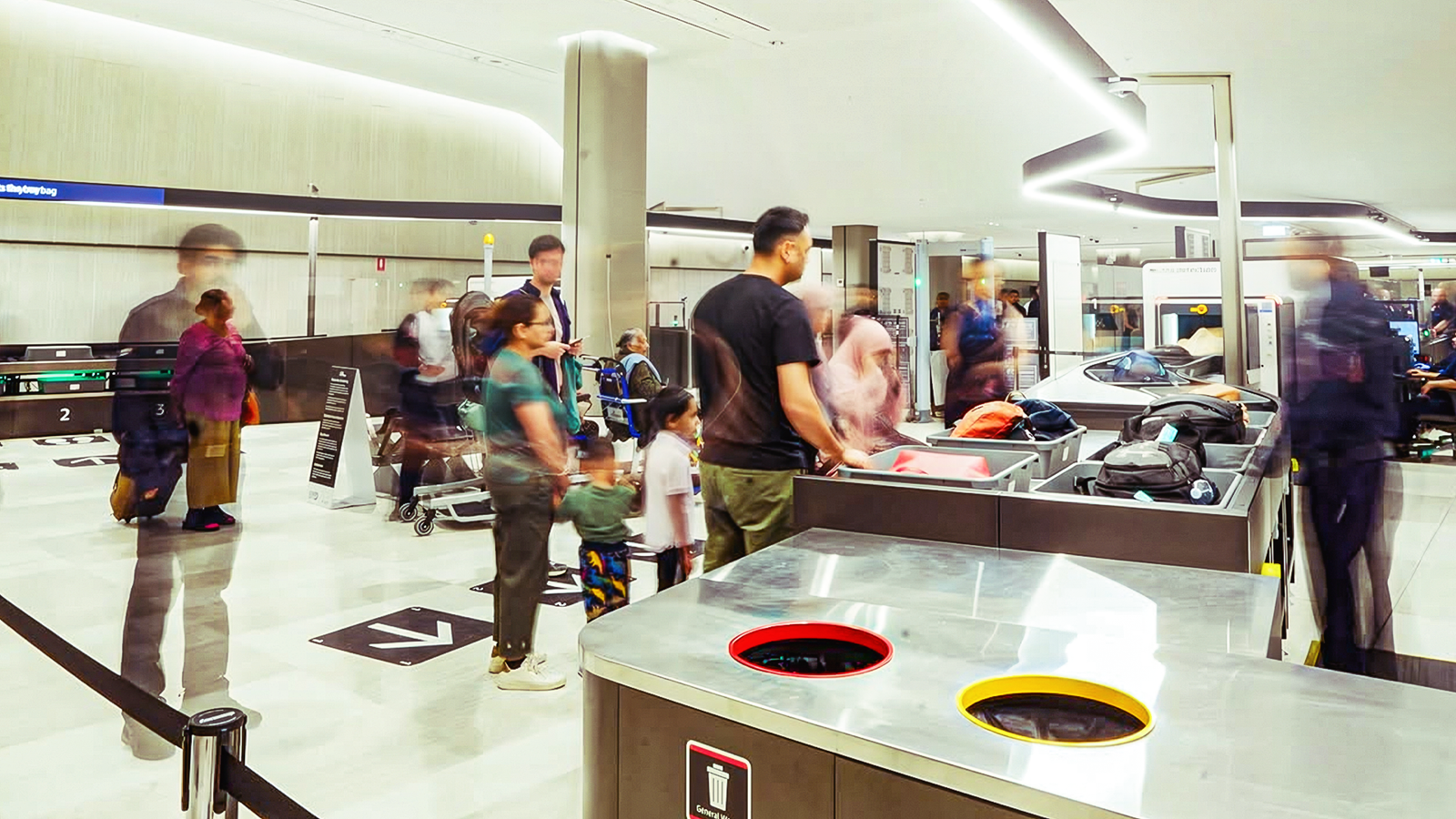
Credit: Sydney Kingsford Smith Airport | Simple Flying Published Aug 20, 2026, 1:00 AM EDT Louis is a military historian and the staff writer for History of War magazine, a leading military history monthly. He also has an interest in private and commercial aviation. Sign in to your Simple Flying account At the start of this year, Sydney Kingsford Smith International Airport (SYD) completed a government-mandated security overhaul. It introduced a range of new features, including mandatory body-scanner screening. The changes applied to all passengers across both domestic and international terminals. This rollout is part of a nationwide security overhaul that will cost $2 billion, both upgrading the level of security and the speed through which passengers travel through it. At the same time, the Transport Security Administration (TSA) is completing a $781 million scanner rollout with CT capabilities. These developments don't match the work put in by the Australians. It is possible that the US is still many years behind. The TSA's $781 Million Scanner Rollout Credit: Shutterstock In March 2022, the TSA announced that it had awarded a $781.2 million contract to Analogic Corporation. This firm would be responsible for replacing traditional X-ray machines with 3D CT scanners, with 469 base and 469 full-size systems included. TSA Administrator David Pekoske said: “They provide our dedicated frontline officers with one of the best tools available to screen passenger carry-on items and also improves the passenger experience by allowing passengers to keep more items in their carry-on bags during the screening process.” These scanners are an upgrade, as they incorporate sophisticated algorithms for prohibited items by creating 3D images of carry-on items. The full-size system features automated screening lanes and bin return, high-threat containment, and more. The technology also allows passengers to leave their liquids and electronics in their bags. As with the Sydney Airport development, the intention is to process passengers faster while increasing the thoroughness of security checks. The award was a continuation of a previous deal with Analogic. The company had been awarded $198 million to procure mid-size CT systems. Neither of these deals impacts the process of checking the passengers themselves. The Australian Security Upgrades Impact Bag And Person Checks Credit: Shutterstock The Australian Government's $2bn spending intends to improve and speed up security checks for carry-on luggage and passengers. Sydney Airport leads the charge. As of January 1, 2026, body scanner screening has been mandatory for all passengers. New CT scanners, much like those being introduced by the TSA, are also part of the measures. Passengers will not need to remove their liquids, electronics, and aerosols. This step has been both a frustration for frequent flyers and a slowdown in security processes. The International Terminal has brought in 15 of the three new high-tech security lanes. Meanwhile, Terminal Two includes seven new screening lanes. The Terminal Two changes are part of a broader $200 million redevelopment. Other features include self-service bag-drop and ticketless check-in. The overall Terminal Two redevelopment intends to cut the curb-to-gate journey to just 15 minutes. Such speed is only usually seen at niche airports like London City Airport(LCY). Sydney Airport CEO, Scott Charlton, explains the intention of these changes, beyond simply following government mandates, as reported by Australian Traveller: “The investments we are making in screening technology, terminal upgrades and digital services are improving the travel experience across all terminals." The Developments Have Also Made Security Faster Credit: Shutterstock Securing passenger buy-in for changes to security processes requires that part of the upgrade focus on speed. No passenger wants to spend their vacation waiting in security lines. The Sydney Airport upgrades have achieved this. The high-tech security lanes in Sydney Airport's International Terminal have doubled passenger throughput. The overall overhaul has increased capacity by nearly 30%, with the cuts to queues and congestion already benefiting millions of flyers. The table below shows the increase in passenger numbers at Kingsford Smith over the last ten years. It uses Sydney Airport and the Australian Bureau of Infrastructure and Transport Research Economics data. The return to pre-pandemic passenger numbers explains the need for such radical changes to Sydney Airport's security processes. They will become increasingly important in the coming years, with Sydney Airport aiming to handle 72 million passengers a year by 2045. Year Domestic passengers International passengers Total 2025 25,360,000 17,170,000 42,540,000 2024 25,090,000 16,300,000 41,390,000 2023 24,110,000 14,540,000 38,650,000 2022 20,872,921 8,110,953 28,983,874 2021 7,171,759 729,529 7,901,288 2020 7,444,780 3,782,912 11,227,692 2019 27,538,404 16,890,441 44,428,845 2018 27,667,273 16,762,485 44,429,758 2017 27,291,874 16,038,186 43,330,060 2016 26,905,944 15,111,977 42,017,921 2015 25,897,619 13,911,228 39,808,847 Passengers are already enjoying the expedited security experience. Sydney Airport has told 9News that the changes have reduced screening time by 50%. Sydney Airport also claims that 99.1% of international travelers and 99.9% of domestic travelers now clear security in under 10 minutes. Speed occurs on both sides of the scanners. 9Travel writer Sarah explains why: ""It's also much better when it comes to dealing with those slow people you generally get stuck behind, because nobody blocks the way as they slowly put everything back in their bag." The airport has installed new signage that it hopes will make it clear that passengers can keep their items in their bags. Work Is Also Underway At Australia's Other Major Airports As with the TSA investment, Australian spending is not all going to a single airport. Sydney Airport is leading the way, but destinations like Brisbane Airport (BNE) and Melbourne Airport (MEL) are close behind. Brisbane Airport has launched its Domestic Airport Transformation program, which introduced five new CT lanes in October 2025. The same technology was expanded to the International Terminal by the end of 2025. “The fact that passengers will be able to leave laptops and aerosols in their bags will make a real difference and remove one of the biggest frustrations for frequent travellers," Brisbane Airport head of terminal operations Stacey Pollard said, Australian Traveller reports. The impetus for improved, more efficient security systems is the same in Brisbane as in Sydney: a return to pre-pandemic passenger numbers. The table below shows the last ten years of passenger numbers at Brisbane Airport, making use of Bureau of Infrastructure and Transport Research Economics data: Year Domestic passengers International passengers Total 2024 17,106,783 6,146,538 23,253,321 2023 16,343,097 4,845,468 21,188,565 2022 14,374,443 2,531,254 16,905,697 2021 7,658,654 247,999 7,906,653 2020 6,386,797 1,388,291 7,775,088 2019 17,580,142 6,425,564 24,005,706 2018 17,354,529 6,112,234 23,466,763 2017 17,219,926 5,729,341 22,949,267 2016 17,055,852 5,449,744 22,505,596 2015 16,786,974 5,238,522 22,025,496 2014 16,982,836 4,964,981 21,947,817 Similar steps have been taken at Melbourne Airport. The hub has introduced new body scanners and CT lanes for baggage. Across all these airports, increased traffic from airlines such as Turkish Airlines, Etihad Airways, Virgin Australia and Qatar Airways raised passenger numbers. All major airports in Australia were in a race against time to have the technology ready. Western Sydney Airport's Approach Has Given New Impetus For Kingford-Smith's Security Upgrades Credit: Western Sydney International Airport | Simple Flying Sydney Airport will soon no longer be the only place you can fly from in the city. The $14 billion Western Sydney Airport (WSI) is scheduled to open in October 2026, located around 31 miles (50 km) west of the city center. If these airports have overlapping routes and airlines, it will be a battle of convenience that defines which option passengers use. There are reasons to choose each one. Sydney Airport is centrally located compared to its isolated rival. Meanwhile, Western Sydney Airport will not face the same noise restrictions, meaning people can choose flights around the clock. In that case, the isolated location is actually a perk compared to the highly central Kingford Smith. Security efficiency could be a key differentiator, especially for business travelers and frequent flyers who want to arrive at the airport as late as possible. Both airports will have to include government-mandated upgrades. Sydney Airport has clearly already introduced them to create a thorough and efficient security system. It remains to be seen if Western Sydney Airport will achieve the same results. The UK Is Another Country Concentrating On CT Upgrades Credit: Shutterstock It is far from just Australia and the US that is spending a huge amount of money on CT bag scanning technology to improve the safety and efficiency of their airport security systems. In the UK, Vinci Airports has worked with Belfast International Airport (BFS), Edinburgh Airport (EDI), and London Gatwick Airport (LGW) to roll out CT systems in the security lanes. Gatwick now has 19 security lanes, while Edinburgh and Belfast both have eight, an increase of two in each case. The changes have made manual bag searches far more infrequent and greatly improved efficiency. As in Australia and the US, passengers don't need to take out their liquids and electronic devices, with the liquid limit now increased to 0.5 gallons (2 liters). The upgrades are based on the work of a private company, Vinci Airports. This firm develops a network of 65 airports across 13 nations, including the UK, France, Portugal, Japan and the United States. It most recently purchased Budapest Ferenc Liszt International Airport (BUD) in collaboration with the Hungarian government. It will be interesting to see which other Vinci Airports developed and operated hubs also receive the upgrades in the years to come.
How This Australian Airport Is Setting The Global Security Standard The TSA's $781 Million Rollout Can't Match
Full Article
Original Source
Read the full article at Simpleflying →KhanList aggregates and links to publicly available news content. We do not host full articles from third-party sources. Always verify important information with original sources.