
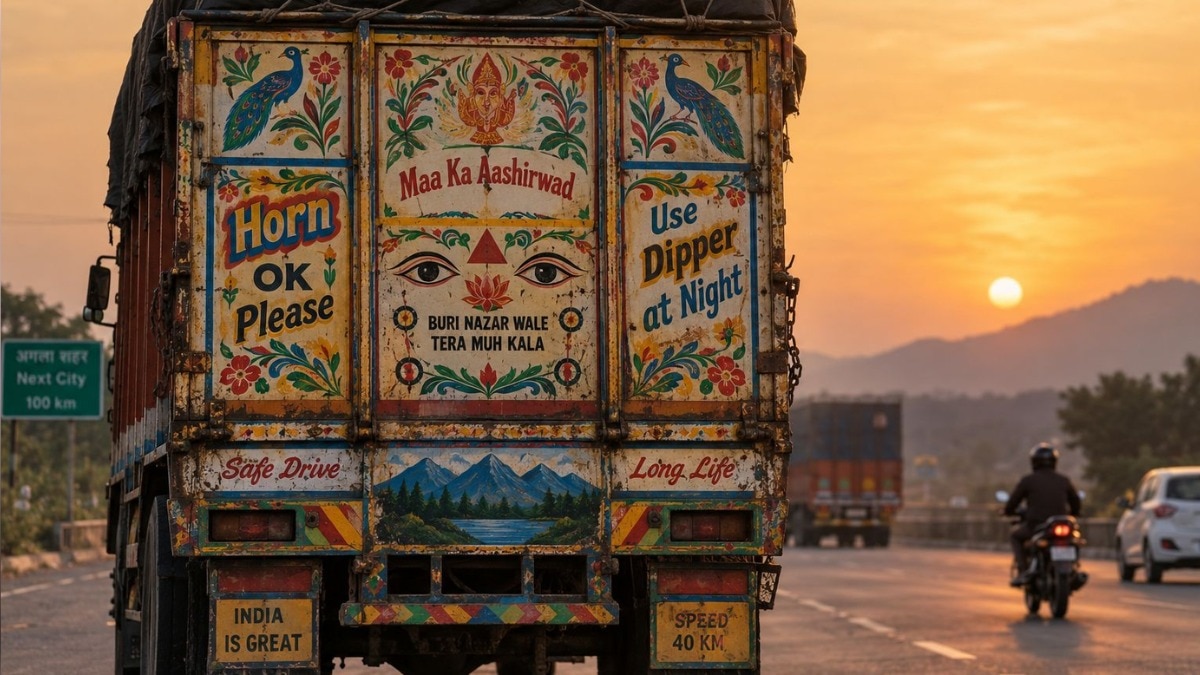
Conversations with truck drivers show that familiar road slogans and symbols often carry inherited rituals, family memories and practical instructions. Together, the paintwork and cabin keepsakes turn each lorry into a moving record of work, belief and home.Horn OK Please. Use Dipper at Night. Buri Nazar Wale Tera Muh Kala. Maa Ka Aashirwad.There is a peculiar thing about being stuck behind an Indian truck: you have enough time to read its entire biography.First the giant letters: Horn OK Please. Then the smaller ones: Use Dipper at Night. Somewhere beside them, a pair of painted eyes, a peacock, a temple or perhaps a particularly elaborate flower. There might be a line of poetry, a joke, a warning, the name of a village or the name of someone’s mother.The truck, which from a distance is simply a giant metal box carrying goods from one city to another, suddenly has a lot to say. For the rest of us, these phrases are part of the visual furniture of Indian roads. We have grown up seeing them so often that we rarely stop to wonder why a truck needs to announce Maa Ka Aashirwad to several hundred strangers a day, or why a driver feels the need to threaten anyone casting an evil eye with a blackened face.But spend time talking to the men who drive these vehicles and the painted words begin to reveal a much more intimate world. A phrase can be inherited from a father, a sticker can survive several repaints because removing it feels wrong, and a brand-new truck might make a detour to a temple before it is allowed anywhere near its first long-distance route. What looks like decoration from the outside can be a collection of rules, beliefs and memories from inside the cabin. “Humare liye ye sirf likha hua nahi hota. Jo cheez truck pe lagate hain, uska koi reason hota hai,” says Raghu Das, a truck driver from Bengal. “Maa ka naam hai toh ghar ki yaad hai. Nazar wala hai toh protection ke liye hai.”For him, the words are not random additions to the truck’s paintwork. His mother’s name is there because it connects him to home; the line about nazar is there because it offers protection. It is a remarkably simple explanation for something that, to someone passing by at 70 kilometres an hour, can look like a jumble of brightly coloured slogans.For many drivers, the relationship with a truck begins before the truck has travelled a single kilometre.A new vehicle can be treated almost like a new member of the family. Before it is sent out on a long route, some drivers take it to a temple or another place of worship, perform a puja, seek a blessing or carry out whatever ritual their family has followed for years. It isn’t necessarily presented as a matter of logic. In fact, asking for the logic can miss the point.Ravinder Singh, a truck driver from Uttar Pradesh, simply explained that since his father did it, his grandfather did it, therefore he does it too.“Mere pitaji ne bhi nayi gaadi pehle mandir le jaakar chalayi thi. Unke pitaji ne bhi. Main bhi wahi karta hoon,” he says. His father took a new vehicle to the temple before its first journey; his grandfather did the same. “Nayi gaadi hai, pehle bhagwan ko dikhani padti hai.” It is a new vehicle, he says, and first it has to be shown to God.There is something revealing about that ritual because of what the truck represents. For a driver or owner, this isn’t simply a shiny new possession. It is an investment, a workplace and often the thing on which a family’s income depends.Ask a driver why his truck says Maa Ka Aashirwad, and you might expect a conversation about religion or superstition. Sometimes the answer is much more personal: because his father had exactly the same words on his truck.One driver remembers seeing the phrase on his father’s vehicle when he was growing up and eventually having it painted on his own. Now, he says, his son has carried it forward too. “Mere pitaji ke truck pe ‘Maa Ka Aashirwad’ likha tha. Maine bhi wahi likhwaya. Ab mera beta bhi truck chalata hai, uske truck pe bhi wahi hai.”That is a peculiar kind of family heirloom. It isn’t sitting in a cupboard or wrapped in newspaper. It is moving between cities, covered in dust and diesel, visible to thousands of strangers. The truck might be repainted, repaired or modified, but the words remain because their importance has little to do with typography. They are a link to the people who drove before you.The same is true of objects inside the cabin. A photograph of a parent, a child’s drawing, a religious image or an old sticker may survive long after the rest of the truck has changed. One driver points to a sticker that has been with him for around fifteen years.The vehicle has been repainted three times, he says, but the sticker stayed. Another puts it more bluntly when talking about a photograph of his father: “Truck badal sakta hai, photo nahi.” The truck can change; the photograph cannot.It is easy to miss these details because the highway only gives us the rear few feet of the vehicle. But inside the cabin is a different landscape altogether, one made up of things that have accumulated over years rather than been chosen for an audience.Then there are the things that are very much intended for an audience, although perhaps not the human one.Buri Nazar Wale Tera Muh Kala is one of the most recognisable phrases in the truck vocabulary, and its logic belongs to the much older Indian belief in nazar, or the evil eye. A beautiful object attracts attention; too much attention can attract envy; envy can bring bad luck.The solution, depending on the person, might be a black dot, a lemon-and-chilli charm, painted eyes, a religious symbol or a phrase telling the person with bad intentions exactly what can happen to them.One driver sees no contradiction in this. “Agar truck bahut accha bana hai toh nazar lagne ka chance bhi zyada hai,” he says. If the truck looks especially good, he reasons, the chances of it attracting the evil eye are greater. So, the more elaborate the paintwork, the more reason there is to protect it.Another driver explains his own thinking even more directly: “Nazar toh hoti hai. Aap itna bada truck lekar nikalte ho, kabhi kabhi log dekhte rehte hain. Ye likhne se mann mein lagta hai ki buri nazar nahi lagegi.” The evil eye exists, he says. You take such a large truck out on the road and people stare at it; having the phrase painted there gives him the feeling that the truck will be protected.From the outside, this can sound like charmingly irrational highway logic. But perhaps that’s because we tend to think of superstition as something that has to replace reason. For the driver, it doesn’t. He can spend hours checking his brakes and tyres, worry about traffic, obey road rules and still hang a protective charm from the front of the truck. The practical and the spiritual aren’t competing systems. They are simply two ways of dealing with a journey where you cannot control everything.Not every phrase carries that emotional weight. Some exist because a truck and the vehicles around it have to communicate somehow.Horn OK Please is perhaps the most obvious example. Whatever its disputed history, the phrase has been associated with the practical etiquette of driving around large commercial vehicles. A truck driver can’t see everything happening behind him, and a vehicle trying to squeeze past without making its presence known can be a problem. The horn becomes a form of communication between strangers.“Horn se hum log ek dusre ko samajhte hain,” one driver says. “Aap peeche se aa rahe ho toh horn karo, driver ko pata chal jaata hai. Har cheez ke liye indicator ya phone thodi na use kar sakte hain.” We understand each other through the horn, he explains. If you’re coming from behind, honk and the driver knows you’re there. You can’t use an indicator or a phone for everything.The same logic sits behind Use Dipper at Night. For drivers spending long hours on poorly lit roads, the difference between dipped and high-beam headlights is not a technical detail. A vehicle approaching with full lights can temporarily wipe out the road from view. “Raat mein saamne se full light aaye toh kuch dikhta hi nahi,” another driver says.“Dipper ka matlab sab driver samajhte hain. Ye likhne ki zarurat bhi nahi honi chahiye, lekin truck pe likha hua hai toh yaad rehta hai.” When someone approaches with full lights, he says, you can’t see anything. Every driver understands what “dipper” means. It shouldn’t really need to be written, but when it is painted on the truck, the message stays with you. (Photo: Getty Images) This is perhaps what makes the language so interesting. Some phrases are addressed to the driver behind the truck, some to God, some to bad luck and some, apparently, to the driver’s own memory. They coexist on the same piece of metal without needing to agree with each other.The artwork around the words adds another layer.Spend enough time around trucks and you begin to notice that no two are quite alike. One has enormous flowers across the panels. Another has a landscape. Another carries a religious image. Another has a hometown painted prominently. The lettering itself can be elaborate, colourful and unmistakably personal.For the painters who work on these vehicles, the brief is often a window into the driver’s personality.“Driver apne truck ko apne hisaab se banwata hai. Koi maa ka naam lagata hai, koi bhagwan ka, koi apne gaon ka,” says Mahesh Kapoor, who has been painting such writings on trucks since the past 23 years. “Drivers decorate their trucks according to their own preferences,” he explains.Some want their mother’s name, some the name of a god, some their village. “Truck ko dekh ke kabhi kabhi pata chal jaata hai driver kis type ka hai.” Sometimes, he says, you can tell what kind of person the driver is just by looking at his truck.There is an obvious practical reason for wanting a truck to stand out. Drivers and owners spend enormous amounts of time with these vehicles, and a distinctive truck is easier to recognise in a crowded transport yard. But there is also pride involved. When the vehicle is your workplace for years, making it beautiful can be a way of making it yours.That is why the back of a truck can contain such a strange mixture of the personal and the public. A driver’s private beliefs are displayed to strangers. His family name travels further than he does. A sentence he finds funny is repeated to motorists who have never met him. A blessing intended for him is read by thousands of people who will never know whose mother it refers to. (Photo: Getty Images) Perhaps the best part of this culture is that not everything comes with an explanation.Ask an experienced driver why a particular ritual exists and sometimes the answer will be a story about his father. Ask why a particular object stays in the cabin and he may shrug and say it has always been there. Ask why a particular phrase is lucky and you may hear about an accident that didn’t happen, a journey that went smoothly or simply the fact that everyone in his family believes it.These aren’t always beliefs that have been carefully reasoned out. They are habits accumulated through years of work.One veteran driver describes how much of this knowledge is passed down: “Jab humne driving shuru ki thi tab bhi ye sab likha hota tha. Bade drivers se hi pata chalta tha ki kya likhna hai, kya nahi. Ab naye ladke apne style se bhi likhwate hain, lekin kuch cheezein same hain.”When I started driving, these things were already there. Older drivers taught us what people traditionally put on trucks and what they didn’t. Younger drivers now have their own styles, but some things remain.That makes truck language less like a set of slogans and more like an unwritten family-and-road tradition. Nobody appears to have appointed an authority to decide that a truck should carry a mother’s blessing or an evil-eye warning. The phrases simply keep being repeated until they become part of what a truck is supposed to look like.The trucks themselves are changing. Newer vehicles have more commercial branding, reflective markings, printed graphics and increasingly standardised designs. The old hand-painted aesthetic still exists, but it now shares space with a more corporate-looking road.Yet certain phrases refuse to disappear.“Aajkal trucks pe company ka naam, stickers aur bahut kuch hota hai,” says a younger driver. “Lekin maa ka aashirwad ya bhagwan ka naam log abhi bhi likhwate hain. Ye sirf purani cheez nahi hai.” Trucks may now carry company names, stickers and all sorts of new graphics, he says, but people still paint their mother’s blessing or the name of God. It isn’t simply an old thing.Maybe that is because the most enduring phrases aren’t really about fashion. They are about what drivers want to take with them.A road instruction helps them negotiate traffic. A religious symbol gives them faith. A family name keeps home close. A protective phrase gives superstition somewhere to live. A joke breaks the monotony of a journey. A faded sticker becomes a reminder of another time.Seen that way, the back of a truck is an unusually small canvas for an unusually large amount of life.We tend to encounter these vehicles from behind, at a distance, usually when we are impatient to get around them. The driver experiences the same truck from inside, for hours and days at a time. He knows its sounds, its quirks, its moods. He knows which photograph has been there for years, which ritual cannot be skipped and which words his father used before him.So perhaps the next time you find yourself staring at the back of a truck, don’t just ask what the words mean.Look at what the driver has chosen to keep.Because somewhere between Horn OK Please, a black dot to ward off nazar, a mother’s blessing and a sticker that has survived three paint jobs, the highway is carrying a very ordinary but very human record of the people who spend their lives travelling it.- EndsPublished By: Yashna TalwarPublished On: Sep 6, 2026 11:30 IST
How the writings on Indian trucks carry stories of faith, family and fear
Full Article
Original Source
Read the full article at Indiatoday →KhanList aggregates and links to publicly available news content. We do not host full articles from third-party sources. Always verify important information with original sources.