
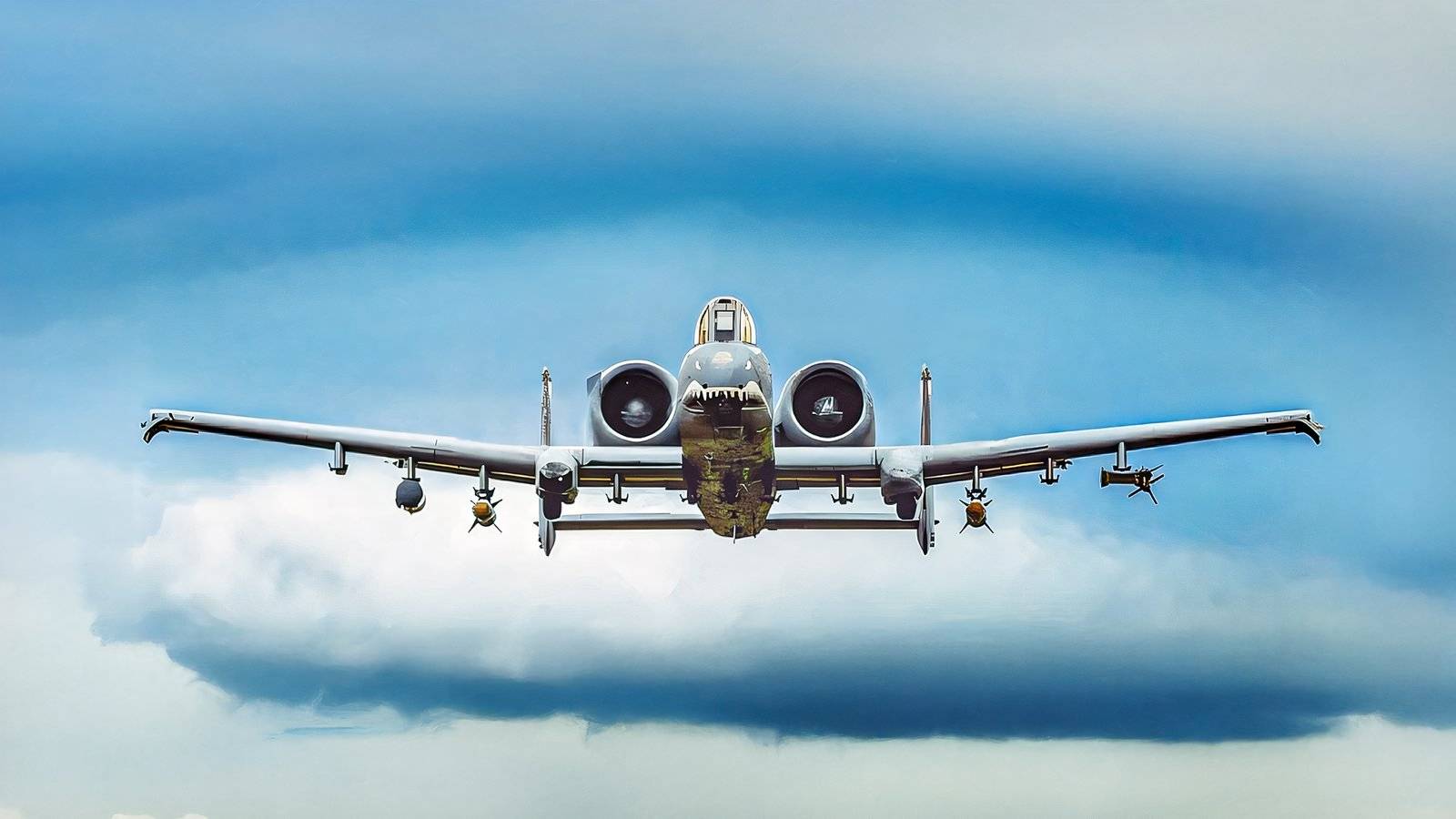
Published Aug 27, 2026, 1:00 AM EDT Chris earned a Master’s degree in Defense and Strategic Studies (Highest Honors) from the University of Texas at El Paso. His graduate work concentrated on Global and National Security, Low-Intensity Conflict, Modern Warfare, and US grand strategy. He also undertook extensive regional studies, analyzing how key regions integrate into the broader US security architecture. This rigorous program provided him with a comprehensive understanding of U.S. military operations, global strategy, and weapons systems. Additionally, he gained a strong appreciation for great power competition.—an increasingly central force shaping international relations and conflict for the foreseeable future. The Fairchild Republic A-10 Warthog was originally designed to target and attack large formations of Soviet armor that could have plowed their way into Western Europe, providing US ground forces with a heavily armed and armored aircraft capable of delivering sustained fire against enemy formations. Decades after the Cold War ended, however, these heavily armed aircraft have been undertaking a different yet complementary role: maritime overwatch for the United States (US) Navy's Ohio-class ballistic missile submarines. While the pairing of an aircraft designed to destroy tanks with one of the world's most powerful nuclear deterrence platforms may seem unusual, the A-10's low-speed maneuverability, long loiter time, and extensive weapons capability could make it surprisingly well suited to protecting submarines during their most vulnerable periods on the surface. While this mission is seemingly out of the ordinary for the A-10, its flight characteristics and armament make the role of overhead guardian particularly well-suited to the aircraft. The same attributes that made the Warthog effective against massed ground targets could also make it useful against the proliferation of small, fast maritime threats, including drone boats and fast attack craft. In light of the 2000 attack on USS Cole and the recent proliferation of drones, which have been used to significant asymmetric effect in Ukraine, the need for effective overwatch of Navy submarines has only grown. The Destructive Capabilities Of The Navy's Ballistic Missile Submarines And The Need For Enhanced Security Credit: US Navy The ability of the US to stave off nuclear attack or threats of nuclear coercion by adversarial states is rooted firmly in the time-tested theory of deterrence. This is the knowledge that if an enemy launches a nuclear attack, it would, without a doubt, be met with a devastating retaliatory response. The deterrent capability of the US military rests on its nuclear triad, composed of sea, air, and land-based nuclear assets. The sea-based leg of the triad is provided by the Navy's ballistic missile submarines (SSBNs). The latter are the 14 remaining Ohio-class vessels, which have a submerged displacement of 18,750 tons (17,010 metric tons). Each of these SSBNs cost $5.6 billion (£4.2 billion) per platform to procure, and they were built by General Dynamics' Electric Boat Division. In terms of strike options, submarines are armed with up to 20 UGM-133 Trident II D5 missiles, which are designed to carry up to 12 independently targeted nuclear warheads (mini-nuclear warheads), although current open-source estimates generally put their operational load at up to 8 warheads. The primary launch vehicle has a range of approximately 4,600 miles (7,400 km), and each smaller warhead mounted on it can enter Earth’s atmosphere at over 20 times the speed of sound, which is designed not only to hit multiple targets, but also to complicate interception measures. While these vessels are submerged at sea, they are incredibly difficult to track, making them the most unpredictable leg of the nuclear triad. While the bases housing America's nuclear silos and nuclear-capable Boeing B-52 bombers can be targeted and possibly destroyed, the SSBNs lurk in the depths, providing a silent and invisible, final, nuclear option. At issue, however, is the fact that when the Ohio boats surface, their visual, radar, and infrared signatures dramatically increase, and their location and direction of movement become much easier to detect. This clearly creates security issues not only for the lives of the sailors on board but also for the highly crucial deterrence platform, which is more vulnerable when operating on the surface. A New Bodyguard For The Navy's Ballistic Missile Submarines Credit: US Navy While the Ohio SSBNs are entering port or departing for sea duty, they are provided with escort, generally by Black Powder-class support vessels, which have a speed of 14 knots and a displacement of 2,850 tons (2,585 metric tons). These medium-sized craft are tasked with providing transit protection and support to the submarine. However, if required, the surface security detail of these SSBNs can be supplemented with enhanced aerial protection. In 2024, A-10s were seen conducting practice overwatch sorties for a nuclear submarine as it transited the Strait of Juan de Fuca on the Pacific Northwest coast, between Washington state and Vancouver Island, British Columbia, Canada. Months later, a formation of six Warthogs performed overwatch for USS Wyoming (SSBN-742). As recently as July 28, 2026, an A-10 was again spotted escorting USS Nebraska (SSBN-739) during an operation in the Pacific Ocean. This pattern appears to be a new mission in the Warthog's mission toolkit. This is particularly useful as long-term conflicts in the Middle East have subsided and the aircraft seemed set for the chopping block. However, the A-10 has reportedly been tested against small craft and has performed well when targeting speedboats, a capability that has been used to devastating effect in Ukraine, as numerous Russian naval vessels have been sunk by drone boats. The new asymmetric threat posed by such watercraft provides the A-10 with yet another valuable mission, at least for now. Given that the Warthog has outstanding maneuverability at low airspeeds and altitude, excellent loiter time, low stall speed, and flexible armament, it provides ballistic missile submarines with a powerful security asset when they are most vulnerable. Displaying the aircraft's well-rounded strike capability, released images show an A-10 equipped with a LITENING targeting pod, two AGM-65 Maverick air-to-surface guided missiles, two AIM-9M Sidewinder air-to-air missiles and a stand-alone LAU-131 pod containing seven Hydra 70 rockets. This is, of course, all in addition to the GAU-8 Avenger rotary cannon, which fires 30mm ammunition at a rate of 3,900 rounds per minute. This combination of weapons and sensors gives the Warthog considerable flexibility, allowing it to engage everything from larger surface targets with the Maverick to smaller craft with its rockets and cannon, while the Sidewinders provide a degree of protection against airborne threats. Combined with its ability to provide close air support, this makes the A-10 a potentially effective match for providing maritime overwatch for the SSBN fleet. The Beloved Ugly Bird That Refuses To Retire Credit: US Air Force In light of the successful security missions by USS Wyoming and Nebraska, the A-10 appears to have a renewed purpose beyond its traditional ground-attack roles, having proven itself highly capable in maritime interdiction missions near Iran. To this point, General Dan Caine (USAF) stated: “The A-10 Warthog is now in the fight across the southern flank and is hunting and killing fast attack watercraft in the Strait of Hormuz...” While Air Force Secretary Troy E. Meink has stated that the air service will extend the Warthog program to 2030, this is widely interpreted as a delay rather than a cancellation. This stay of execution means that, for the first time in more than a decade, the air service will not be actively attempting to significantly reduce the fleet or send it to the boneyard. However, critics often argue that the aircraft is siphoning funding and trained personnel away from other key programs, such as the Lockheed Martin F-35A Lightning II, B-21 Raider and its sixth-generation ventures. They point out that the aircraft in the A-10 fleet are more than 43 years old and require increased maintenance. According to the 2026 budget, the Air Force estimated that it would save more than $400 million (£300 million) by retiring the Warthog fleet. The Warthog's Unexpected Second Life at Sea Credit: US Air Force The A-10's emerging role in maritime overwatch could provide the aging Warthog with a valuable new purpose as the Air Force prepares to eventually retire the fleet. Its ability to remain on station, maneuver at low speeds, and employ a combination of cannon fire, rockets, and guided missiles makes it particularly well-suited to confronting the small, fast, and increasingly numerous maritime threats that could endanger an SSBN during its most vulnerable periods. Its recent operations against fast attack craft in the Strait of Hormuz demonstrate that this capability is more than theoretical. However, the A-10 may not necessarily be the only, or even the ideal, aircraft for this mission. Attack helicopters offer even greater low-speed maneuverability, can hover and carry a variety of guided weapons and cannons while remaining relatively close to the protected vessel. Whether the A-10 ultimately retains a lasting role in SSBN security or is replaced by helicopters, drones, or another platform, its unexpected transition from Cold War tank killer to maritime guardian demonstrates how an aging aircraft can remain relevant against threats its designers never anticipated.
How The US Air Force Is Extending The A-10's Retirement To 2030
Full Article
Original Source
Read the full article at Simpleflying →KhanList aggregates and links to publicly available news content. We do not host full articles from third-party sources. Always verify important information with original sources.