
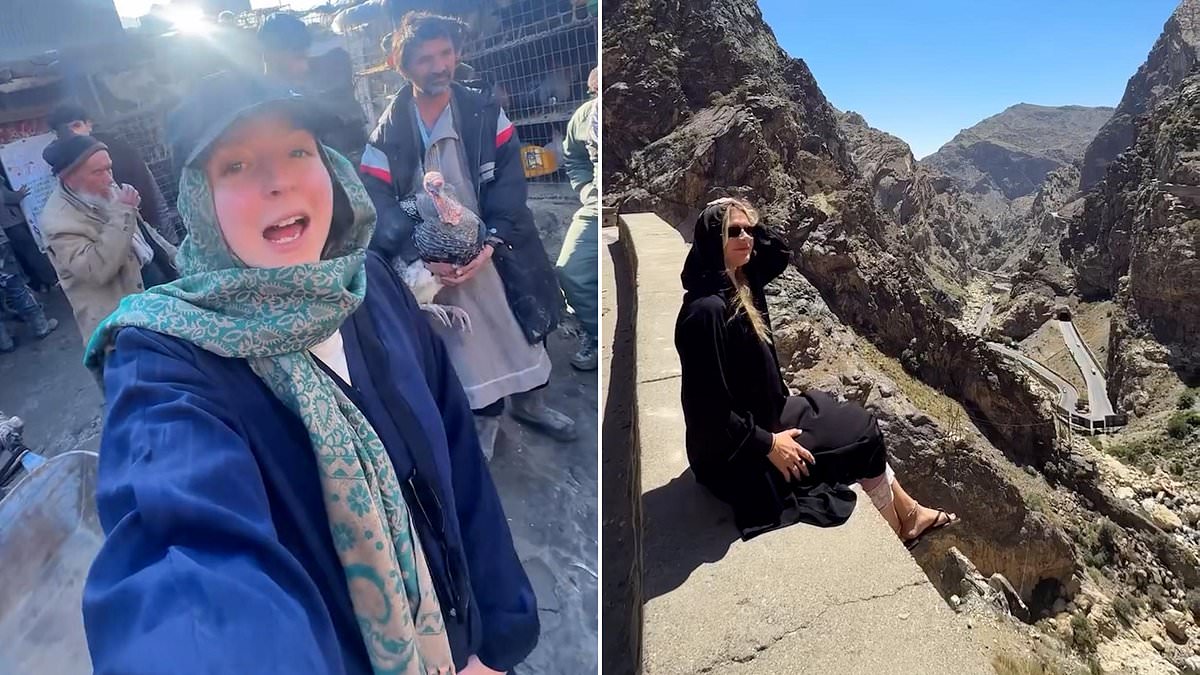
In a video mocking those who claim Afghanistan is too dangerous to visit, Polish travel influencer Izabela dangles her legs over the edge of a cliff and lets her hair blow in the wind, showing off the dramatic landscapes of the Taliban-controlled country.She is one of several influencers who have recently travelled to Afghanistan in an attempt to showcase the ‘true beauty’ of the country, despite warnings from most Western governments urging their citizens not to go.The UK currently advises against all travel to Afghanistan, but that has not stopped thrill-seekers such as British social media star Zoe from making the journey.In one video posted at the end of August, Zoe can be heard giggling as she wanders through Kabul’s bird market, while men attempt to speak to her.In another clip, she tells her social media audience that she has had 'the best experiences' travelling through the country.Australian influencer Josie is another female creator to have travelled to Afghanistan. In one video, she is seen laughing and chatting with Afghan men and boys as she sips a drink bought from a local vendor.Male travel creators have also flocked to Afghanistan, with tour operator Afghanistan on Tour sharing carefully curated posts of visitors from around the world exploring the country.In one particularly surreal video, captioned ‘Ryan from the UK Meets the Beauty of Afghanistan’, a young British man is seen smiling as he poses with rifles, walks through mosques and stands beside military tanks, all set to the sound of Alex Warren’s pop ballad ‘Ordinary’. In one video posted at the end of August, Zoe can be heard giggling as she wanders through Kabul’s bird market In a video mocking those who claim Afghanistan is too dangerous to visit, Polish travel influencer Izabela dangles her legs over the edge of a cliff A young British man is seen smiling as he poses with rifles, walks through mosques and stands beside military tanksAnother clip shared by Australian travel guru Chris shows him walking through a mosque while proclaiming ‘Bismillah’. ‘This place speaks to me, it’s very special. This is an ancient mosque here from one of the great caliphates,’ he says, filming himself in selfie mode.These travel influencers have shared numerous clips portraying Afghanistan as a country of warm and hospitable people, stunning landscapes and rich culture.Yet their videos are a shocking contrast to the reality faced by Afghans living under Taliban rule.The female influencers appear with their faces uncovered and often wear loose-fitting head coverings, freedoms that are largely denied to Afghan women, who are forced to abide by the Taliban’s strict interpretation of Islamic law.Just last month, the Taliban's morality police detained numerous women for allegedly violating dress codes. According to a Herat resident, women are becoming increasingly afraid to leave their homes, telling Amu TV: 'They harass women everywhere under the pretext of enforcing morality,' the resident said.'Women are being detained, intimidated and subjected to psychological abuse, yet no one is listening.'The US invaded Afghanistan after the Taliban refused to hand over Al-Qaeda leader Osama bin Laden in the aftermath of the September 11, 2001 attacks on the World Trade Center in New York City. American troops remained in the country for nearly two decades before withdrawing in 2021, allowing the Taliban to sweep back into power.The Taliban's return came just weeks before the 20th anniversary of 9/11, and since then the regime has embarked on a concerted effort to rebuild its image, using social media and foreign influencers to present a very different picture of life under its rule. Internationally renowned Afghan activist and scholar Orzala Nemat, currently a Senior Associate Fellow at the London-based think-tank Royal United Services Institute (RUSI), said that the surge of foreign influencers in Afghanistan was deeply concerning.'What we're seeing instead is a curated, sanitized version of the country that conveniently erases the brutal realities faced by Afghan women under Taliban rule,' Orzala told NBC News. Deputy Minister of Tourism Qudratullah Jamal said last year that 9,000 foreign visitors came to Afghanistan in 2024 – with 3,000 tourists in the first three months of this year.'Tourism brings many benefits to a country,' he said. 'We have considered those benefits and aim for our nation to take full advantage of them.' As the 25th anniversary of the September 11 attacks approaches, a movement once synonymous with the war on terror now portrays Afghanistan as a safe and attractive destination for international visitors. Josie is seen laughing and chatting with Afghan men and boys as she sips a drink bought from a local vendor A clip shared by Australian travel guru Chris shows him walking through a mosque while proclaiming ‘Bismillah’What online followers may not realise, however, is that many vloggers travel on tightly controlled itineraries. They are escorted around the country by tour companies working with the Taliban and, in some cases, even given official broadcasting licences allowing them to embed with government ministries.This inevitably allows visitors to experience a carefully curated version of Afghanistan, shielding them from the poverty and oppression faced daily by those living under Taliban rule. In reality, a staggering three in four Afghans cannot meet their basic daily needs.Unemployment is rife, healthcare systems are struggling and aid that once came in from across the world is now drying up.Perhaps the most stark cut comes from the US, a nation that was once the biggest donor to Afghanistan which has since slashed nearly all aid to the nation.Other countries, like the UK, have also followed suit, and the UN says that Afghanistan now gets less than 70 per cent of the aid it did last year.Women are disproportionately bearing the brunt of the worsening humanitarian crisis, with fathers resorting to selling their young daughters simply to afford food. The practice of selling daughters to older men for financial gain has become an unfortunately normalised response to deepening poverty in Afghanistan, a trend expected to rise as the economic crisis worsens.And in February of this year, the Taliban introduced a new penal code creating a caste system which puts women on the same level as 'slaves'.As part of the new law, husbands are permitted to beat their wives as long as there is no serious bodily harm.Article 32 states that only if the husband beats the woman with a stick and this act results in severe injury such as 'a wound or bodily bruising', and the woman can prove it before a judge, will the husband be sentenced to 15 days' imprisonment.However, the contradiction lies in that a woman must remain fully covered while simultaneously proving her injuries to a judge.
How the Taliban's Afghanistan is an influencer's playground 25 years after 9/11 as they heap praise on 'amazing' life under brutal regime
Full Article
Original Source
Read the full article at Dailymail →KhanList aggregates and links to publicly available news content. We do not host full articles from third-party sources. Always verify important information with original sources.