
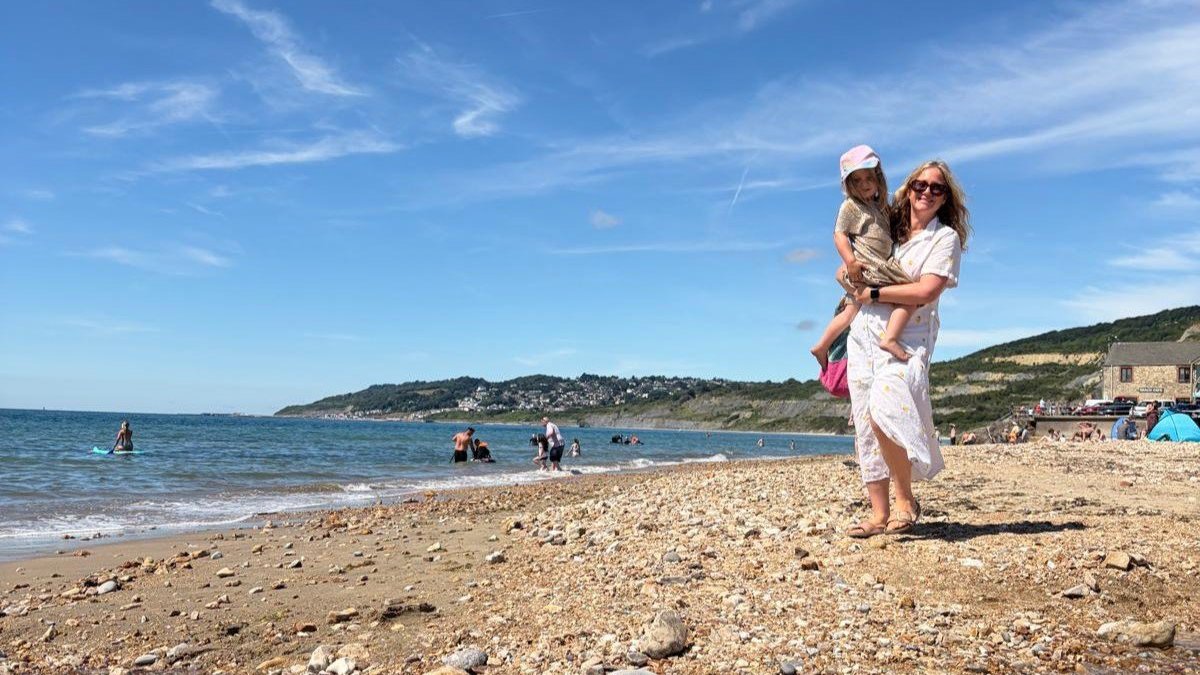
“We’re finding ancient dinosaur bones and you want to stop just because it’s hot?” my son Xavi asks incredulously, baffled at my misunderstanding of priorities. He’s already filled a fishing net with his precious haul of rocks, some bearing the coiled marks of ammonites – now-extinct sea creatures, closely related to octopus and squid, that lived between 200 million and 66 million years ago. We’ve walked across the sand and shingle to the far eastern end of Charmouth beach, where the crowds thin out. I hear the rhythmic metallic tapping of keen fossilers around us, their hammers chinking against rocks as they look for patterns from the past. This area is often considered the birthplace of palaeontology. It was in Lyme Regis, three miles (4.8km) south-west of Charmouth, that 19th-century pioneer fossil hunter Mary Anning found the first fossil of an ichthyosaur, a type of fish lizard that lived at the same time as the dinosaurs. Her find is now displayed in the Natural History Museum, sparking the imaginations of subsequent generations. Ammonite fossils can be found in rocks on Charmouth Beach (Photo: Ashley Cooper/Getty/Corbis RF Stills) A big part of why I love this stretch of Jurassic Coast, which runs for 96 miles from Dorset to east Devon, is that it’s never a washout. Rain brings the promise of fresh fossils falling from the soft mudstone and shale cliffs, particularly after a winter storm. In all seasons at low tide, fossilers gather at the shingle near the water’s edge. This is where you’ll find most of the ammonites, bullet-shaped belemnites and other creatures dating back about 150 million years. Many fossils sit loose among the gravel, but for those who want to split rocks, local fossil shops hire out pointed-tip fossil hammers. It’s illegal to hammer the cliffs, but anything loose on the beach can be collected and taken home as a memento. Or, as my children say, treasure. Shorts Some big rocks have been left exposed by low tide. Xavi and his two sisters, Astrid and Juno, have dug around them to create their own temporary rock pool. Every 20 minutes or so, I dip into the calm sea to cool off, usually joined by my daughters. Seven-year-old Xavi stays focused on the rocks. He might become an archaeologist, he tells me. “Will the museums identify our fossils? Will they give us money?” Fossiling in Dorset is a family tradition that we started five years ago, when I met my husband Mark and he told me it was his favourite place to holiday as a child. Our trips bring so much joy to our children, but this year I’ve been yearning for the simplicity of fossil hunting, too. The family sift for treasure among the stones and shingle My mum died in January and I had surgery in April; grief coupled with an inconvenient fear of hospitals have left my nervous system ever-vigilant, in a near-constant state of fight-or-flight. There’s something about sifting through handfuls of sand and tiny rocks, feeling for ridged textures and looking out for a glint of fool’s gold, that I hope will be calming for my soul. This is somewhere we all find especially restful. The pace of life slows and I feel this holiday is unchanged by time: Mark remembers the stones from when he was growing up; my mum or I could have spent a similar time here during our own childhoods. I feel connected to the past, to nature and history, in a way that I sometimes lose when rushing around packing school bags and dropping multiple children in multiple places. It’s a similar feeling I get when I stare out to the horizon, of being incredibly tiny compared to the vastness of the ocean. Searching for fossils is a soul-soothing activity I love the thought that these ancient worm-like creatures can bring joy to people thousands of years in the future; that the butterfly effect continues long after we’re around to witness it. As I sift through the stones buried in rockpools, my thoughts keep returning to my mum. I miss her and I know her love for my children will trickle down to any children and grandchildren they might have. Once off the beach, we look around the Charmouth Heritage Coast Centre – which also runs guided fossil walks – and see genuine dinosaur bones, including the vertebrae of a plesiosaurus. My children are enchanted by the “please touch” sign on a giant ammonite. We frequently glamp in Dorset but this year we’re staying at Moonfleet Manor, where our family room has a huge roll-top bath, and buckets and spades laid out on each of the children’s beds. The hotel has an enormous games barn – with trampolines, a bouldering wall, slack lines, arcade games and an indoor football pitch – as well as a playground where the children climb while we order dinner. When they’ve finished eating – and I’m still enjoying my delicious New Forest asparagus and sea bass with leeks – they run off to the movie room to lie on bean bags and watch a film with a side of popcorn and milk. The children peer out at the beach There are treasure hunts in the hotel and grounds; three-year-old Juno adores finding fairies in the forest in wooden boxes on trees. And we all spend an hour searching for mice (pictures, not the real deal, thankfully) along the corridors. For proper treasures, though, there is a path below the hotel along the Fleet Lagoon, part of the Chesil and Fleet nature reserve, where Xavi continues collecting rocks bearing prehistoric marks. It’s when we’ve returned home and I look at his table of finds, all laid out with pride, that I realise how good these stones are for my soul. Where to stay Moonfleet Manor has doubles from £140, including breakfast. More information Visit Dorset
How the simple pleasure of fossiling in Dorset helped soothe my grief
Full Article
Original Source
Read the full article at Inews →KhanList aggregates and links to publicly available news content. We do not host full articles from third-party sources. Always verify important information with original sources.