
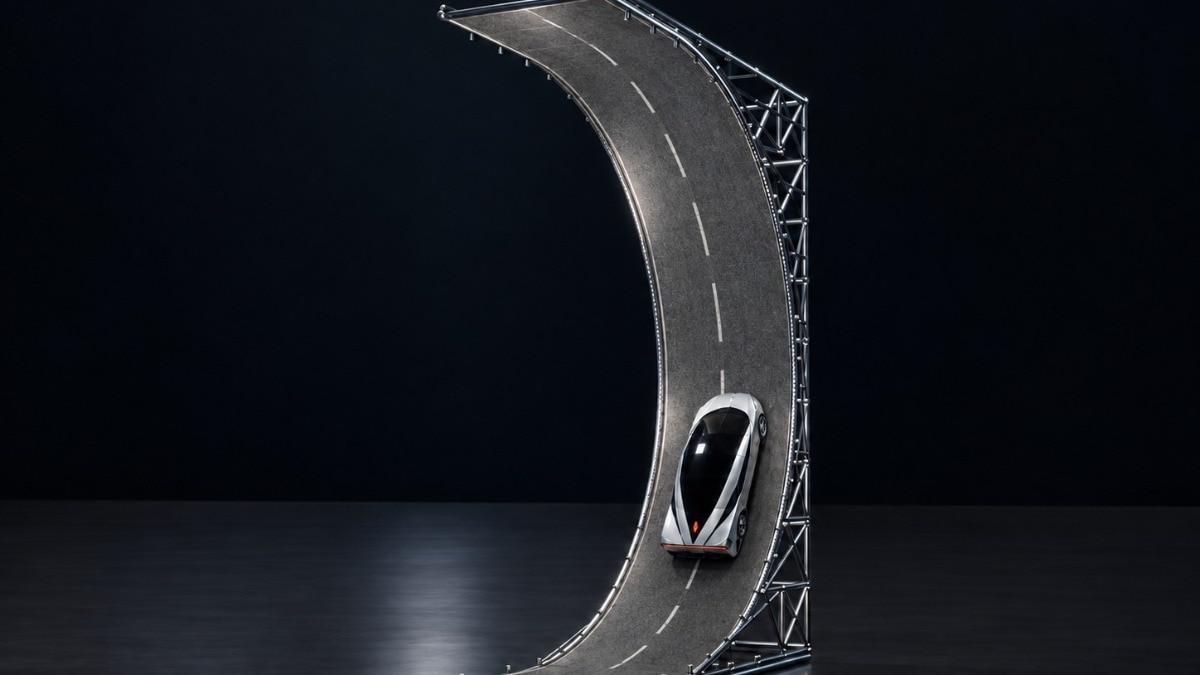
Rohit Shetty has flipped cars for years, with cranes and clever editing. Billionaire entrepreneur behind Tesla and SpaceX, Elon Musk, wanted to do it for real, and he did it on Thursday night. Tesla’s Roadster drove upside down on a curved ramp, flipped through the air, and landed, all in a live demo. 3D visualisation of Tesla's Roadster Three versions, one is the “Rocket”: Tesla unveiled the Roadster, Roadster Performance, Roadster Thrust, and Roadster Rocket. The top-end Rocket draws on SpaceX’s rocket expertise, adding an ambitious thruster system. Two giant tanks hold 250 kilograms of air, compressed so tightly that, at normal pressure, it would fill an entire flat. How it works: Three systems do the work. One moves it, one lifts and steers it, and one keeps it glued to the ground. And the amazing thing is, even to fly, you won’t need special fuel. The car races up a curved ramp, turns upside down, and keeps going Move: Let go of an untied balloon. Air rushes out the back, and the balloon zooms forward. Or picture a Diwali Rocket. That push is thrust. Four rear nozzles do the same, blasting air out faster than sound, as claimed by Tesla chief vehicle engineer Lars Moravy during the unveiling. Minus the burn, so it is called a "cold gas" thruster.Fly and steer: The top-spec Rocket version has more thrusters around the body, including underneath. They lift the car and nudge it left, right, and level in the airStick: Fans under the car suck air out from beneath it, pulling it towards the road, much like a vacuum cleaner sticks to a surface. Tesla claims this can push the car down with a force equal to twice its weight. Fans under the car pull air out from beneath it Below, the pressure drops. Above, the normal air keeps pressing down No special fuel stop: At the 2026 reveal, Musk said: “It’s not like you need special propellant or anything like that. The car can recharge its air tank.” He has been talking about this since 2019. He said the Roadster would use SpaceX’s cold-gas thrusters, powered by ultra-high-pressure air stored in a composite-wrapped pressure vessel. 600-litre tanks hold 250 kg of compressed air 600 litres: The combined capacity of the Rocket version’s two air tanks, roughly the size of three large oil drums.250 kg: The air squeezed inside the tanks. At normal pressure, it would fill a 2BHK flat.5,500 psi: The pressure shown in Tesla’s photos and cited in several media reports, indicating how tightly the air is compressed inside the tank, nearly double that of a typical CNG cylinder.80 kN: The rear thrust Tesla claims, enough to hold up more than 8,000 kg. Think two bull elephants.The speed and Thrust claim: Tesla says the Roadster can go from 0 to 96 km/h in 0.81 seconds in the Thrust version and just 0.59 seconds in the Rocket version. More than 80 kN of thrust - a force equivalent to the weight of roughly 8 tonnes under Earth’s gravity, or about five large SUVs. Multiple sensors work in sync to make the manoeuvre possible But here's the twist. A human is far too slow for what this car is doing. So behind the scenes, sensors keep watching speed, tilt and height. A computer makes tiny corrections to every thruster and fan, in millionths of a second. You choose where to go. The computer keeps you from falling out of the sky.The advantage: Musk’s business empire spans both electric cars and spacecraft, bringing expertise from two very different worlds to one vehicle. The car is not actually flying; it's a very, very smart jump. 3d visualisation of Tesla's space-tech vehicle, Roadster Between the lines: "Well, it worked,” Musk said. Then came the big claim: “Turns out the future does have flying cars.” But there’s a catch. Musk admits the Roadster is “not necessarily a safety-optimised car.”Reality check: Roadster Flies, an independent site analysing the thruster system, estimates full thrust could exhaust the 250 kg air supply in about two seconds. This is its calculation, not a Tesla specification. NASA describes cold-gas systems as “simple, mature, and safe,” but says they provide “relatively limited total impulse” - meaning they cannot sustain large amounts of thrust for long.The bottom line: Musk wants to make driving feel like science fiction, and he made it real one fine evening. But spectacular stunts are one thing; a safe, road-legal flying car is another. Tesla has yet to prove the latter. The Rocket version is not approved for public roads, and its price, driving range, and time in the air remain unknown. With production targeted for 2028, the real test is whether this dream can become a car people can actually buy and safely drive.Please rotate your deviceWe don't support landscape mode yet. Please go back to portrait mode for the best experience
How Tesla made gravity nervous
Full Article
Original Source
Read the full article at Indiatoday →KhanList aggregates and links to publicly available news content. We do not host full articles from third-party sources. Always verify important information with original sources.