
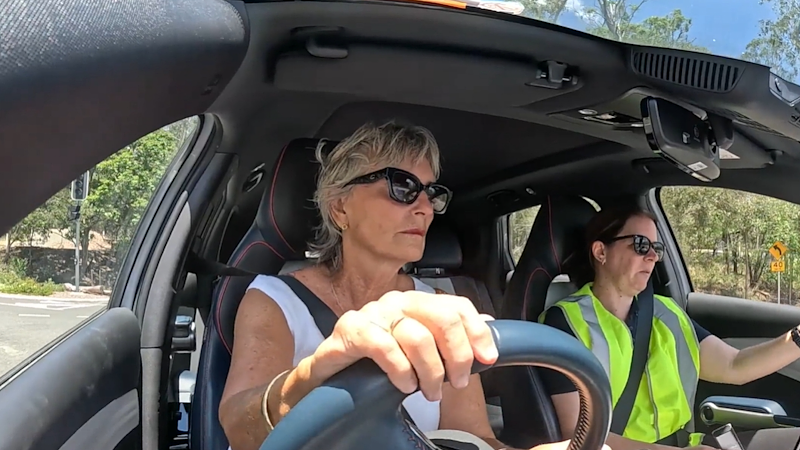
Advertorial for IAG AustraliaWhy are Australian drivers switching off vehicle safety technology that’s designed to keep them safe on the roads? It’s the question a year-long study into Advanced Driver Assistance Systems (ADAS) by insurer IAG set out to answer.IAG, whose brands include NRMA Insurance, CGU, WFI, Rollin’, RACV Insurance and RACQ Insurance, found ADAS safety technology has the potential to prevent more than 7000 road casualties each year, and yet many drivers are reluctant to embrace the rapidly evolving smart car features.Shawn Ticehurst, head of the IAG Research Centre. The findings come at a pivotal time for the automotive industry as the federal government begins to mandate the life-saving driver assistance technology. From August 1, 2026, all new passenger vehicles sold in Australia must be fitted with car-to-pedestrian Autonomous Emergency Braking (AEB).Shawn Ticehurst, head of the IAG Research Centre, says the recent widespread availability of these features should already be contributing to lower accident and casualty rates.“In a modernising vehicle fleet with driver-assist safety features as standard, we would expect to see a positive correlation in reduced accident and casualty rates, but that’s not happening and it needs to change if we want to see fewer accidents,” Mr Ticehurst says.He adds, “IAG’s study found full uptake of driver-assist systems in Australia has the potential to prevent 20 per cent of road casualties each year.”On-road reality checksIAG partnered with the Queensland University of Technology (QUT) and the iMOVE Cooperative Research Centre on the study, which comprised three components: a QUT analysis of almost 100,000 vehicle collisions, on-road field-testing involving 50 drivers using six ADAS technologies, and a national survey of more than 2000 drivers of ADAS-equipped vehicles.The crash data analysis delivered a clear message: every driver-assist system studied significantly reduced the type of crash it was designed to prevent. It found greater ADAS use has the potential to prevent 40 per cent of sideswipe crashes, 21 per cent of head-on collisions and 15 per cent of lane-change accidents.A participant driver testing vehicle safety systems alongside an instructor at Brisbane’s RACQ Mobility Centre. Despite the safety benefits, 60 per cent of drivers of ADAS-enabled vehicles reported switching off at least some driver-assist technologies when behind the wheel.Trust behind the wheel Sebastien Glaser, professor of Intelligent Transportation Systems QUT, says the challenge is not the technology itself, but driver acceptance.“We found that a single ADAS test drive, guided by an instructor, significantly increased drivers’ trust, confidence and intention to use each of the crash-avoidance systems tested,” Professor Glaser says.More importantly, the research found trust was the strongest predictor of whether drivers used the technology.IAG’s findings also revealed a gap in education. While two in three drivers receive some information about ADAS when purchasing a vehicle, only 19 per cent of motorists who recently completed driving lessons or licence testing reported receiving any education about the technology.The road aheadIAG’s research arrives at a crucial moment ahead of the next major ADAS mandate, with Lane Keep Assist (LKA) set to become compulsory in all new passenger vehicles from March 2029.Although the technology has the potential to prevent up to 40 per cent of sideswipe collisions, it was also the feature that generated the most negative feedback among participants. For IAG, that signals an urgent need for better education and collaboration across the road safety ecosystem.“Collaboration between vehicle manufacturers, governments, driver educators and all drivers will be critical to increasing the ongoing use of ADAS technologies and unlocking their full potential to reduce collisions, and ultimately, to save lives on Australian roads,” Mr Ticehurst says.Indeed, bridging this gap will require targeted training and clearer communication, so today’s motorists feel confident enough in leaving these life-saving features switched on every time they take the wheel.To learn more, download IAG’s Driving Safer Outcomes Report. From our partners
How smart car technology could prevent one in five road casualties
Full Article
Original Source
Read the full article at Smh →KhanList aggregates and links to publicly available news content. We do not host full articles from third-party sources. Always verify important information with original sources.