
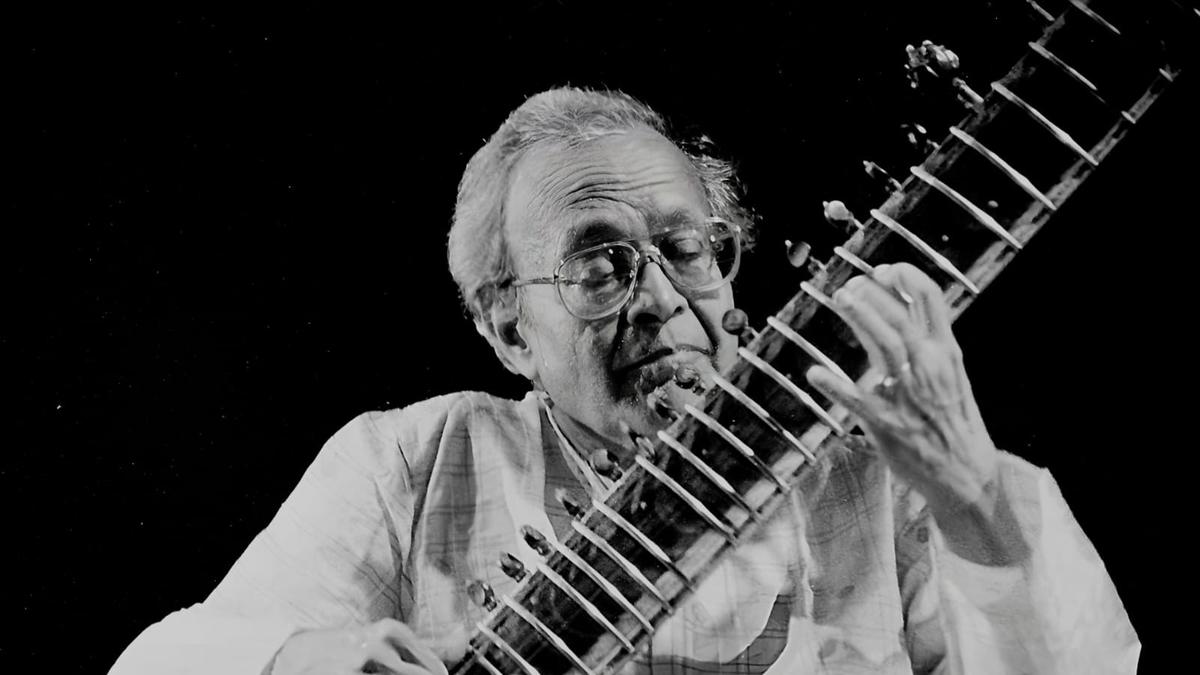
With the passing of sitarist Pt. Manilal Nag (August 16, 1939 to November 9, 2026), a link to an older musical culture has gone. Trained in the Bishnupur gharana of Bengal, which traces its lineage to Tansen’s Senia gharana, Manilal or ‘Moni’ as his friends called him, was a repository of an old instrumental tradition, the fifth generation in a family of musicians.Such was the music of the gharana that when he wrote to the towering instrumentalist of the time, Baba Allaudin Khan of the Maihar gharana, to additionally train under him, he gently refused saying, “Your father, Pt. Gokul Nag is a great musician”. A revered guru, Pt. Gokul Nag, who was primarily a sitar player, had equal dexterity in vocal music, esraj, sarod, rudraveena, surbahar, jaltarang, nyastarang, harmonium, tabla and pakhwaj. | Photo Credit: Courtesy: mitanag.com Manilal was born in Bankura, Bengal. His musical training was rigorous – he learnt a single raag over months. As he told his daughter and disciple Mita: “If you can play one raag properly, you will be able to pick up any raag.”Though he gave his first performance at the age of 14, in 1953, accompanied by the much older tabla exponent Pt. Samta Prasad of the Banaras gharana, he always told his disciples to focus more on learning.Pt. Manilal had the privilege of being accompanied by legendary tabla players. In an interview, he recalled playing with Ustad Ahmed Jan Thirakwa and Ustad Keramatullah Khan. His father told him to always try and be accompanied by the best.According to Mita, the torchbearer of the gharana, Bahadur Sen of the Senia family was invited to Bishnupur by the then raja, Raghunath Singha Dev II (1702-1712), as Aurangzeb’s court was no longer supportive of musicians. Thus, several musicians thronged Bishnupur.A century later, Jadunath Bhattacharya of the tradition (known as the Tansen of Bengal) additionally learnt from dhrupad vocalist Ganganarayan Bandhopadhyay of the Khandarvani style, thus adding to the existing Bishnupur repertoire. Another talented musician Ramprasanna Bannerji learnt the surbahar from Senia ustad Ghulam Muhammed and his son Sayyad Mohammed, who had moved from Lucknow to Kolkata after Wajid Ali Shah’s exile (1856). The gharana thus has an unusual and rich dhrupad vocal and instrumental tradition. Mita Nag is the sixth-generation sitarist of the Bishnupur gharana. | Photo Credit: Courtesy: mitanag.com The aalap is rendered in the true dhrupad style, with authentic ‘jor’, ‘taar paran’ and different ‘jhala’ patterns. “I am trying to revive ‘taar paran’; I need to work with a tabla player who is willing to experiment. It may be difficult to have a pakhawaj player for aalap and a tabla player for the gat.”Bishnupur’s Teen taal gats start from the seventh beat, representing an older tradition of Maseetkhani gats.Known for his simplicity, Pt. Manilal was a true representative of this unusual musical heritage. His last concert was in 2006 at the Symphony Space in New York.A dedicated teacher and mentor, he trained generations of disciples. Recalls sitarist Ayan Sengupta, who initially learnt from him: “At one time, every other sitar artiste in Kolkata was learning from guruji. I remember so many students used to come from Japan and stay through the winter months, learning from him. He was uncompromising even with junior disciples when it came to tuning the sitar.” Incidentally, Teiju Kato, one of his Japanese students, teaches the sitar in Tokyo.Other prominent disciples of Pt. Manilal include Pt. Soumitra Lahiri, Samanvay Sarkar, Amitabh Chatterji, Subrato Dey and Abhishek Malik.Samanvay Sarkar, one of the finest sitarists today shared: “What I am today is because of my 12-year training from my guru. His raag interpretations were unique. I still remember the way he explained to me the importance of proportion. “Looking at my little sister, who had accompanied me to the class, he said, ‘see her bindi is so beautiful but if she had worn more than one it would have spoiled the effect. In the same way, over-embellishment can spoil good music.”Though he was celebrated, he received the SNA award only in 2001, Bengal’s highest award Banga Bibhushan in 2015 and the Padma Shri in 2020.Pt. Manilal taught at ITC SRA, Kolkata from 2006 to 2011, an opportunity that came rather late in his career. He is on record saying musicians then had very few steady earning opportunities.Known for his candidness, he once told his disciple Ira Landgarten: “My art is what I believe in. I don’t expect everyone to understand my music.”
How Pt. Manilal Nag put Bishnupur on India’s musical map
Full Article
Original Source
Read the full article at Thehindu →KhanList aggregates and links to publicly available news content. We do not host full articles from third-party sources. Always verify important information with original sources.