
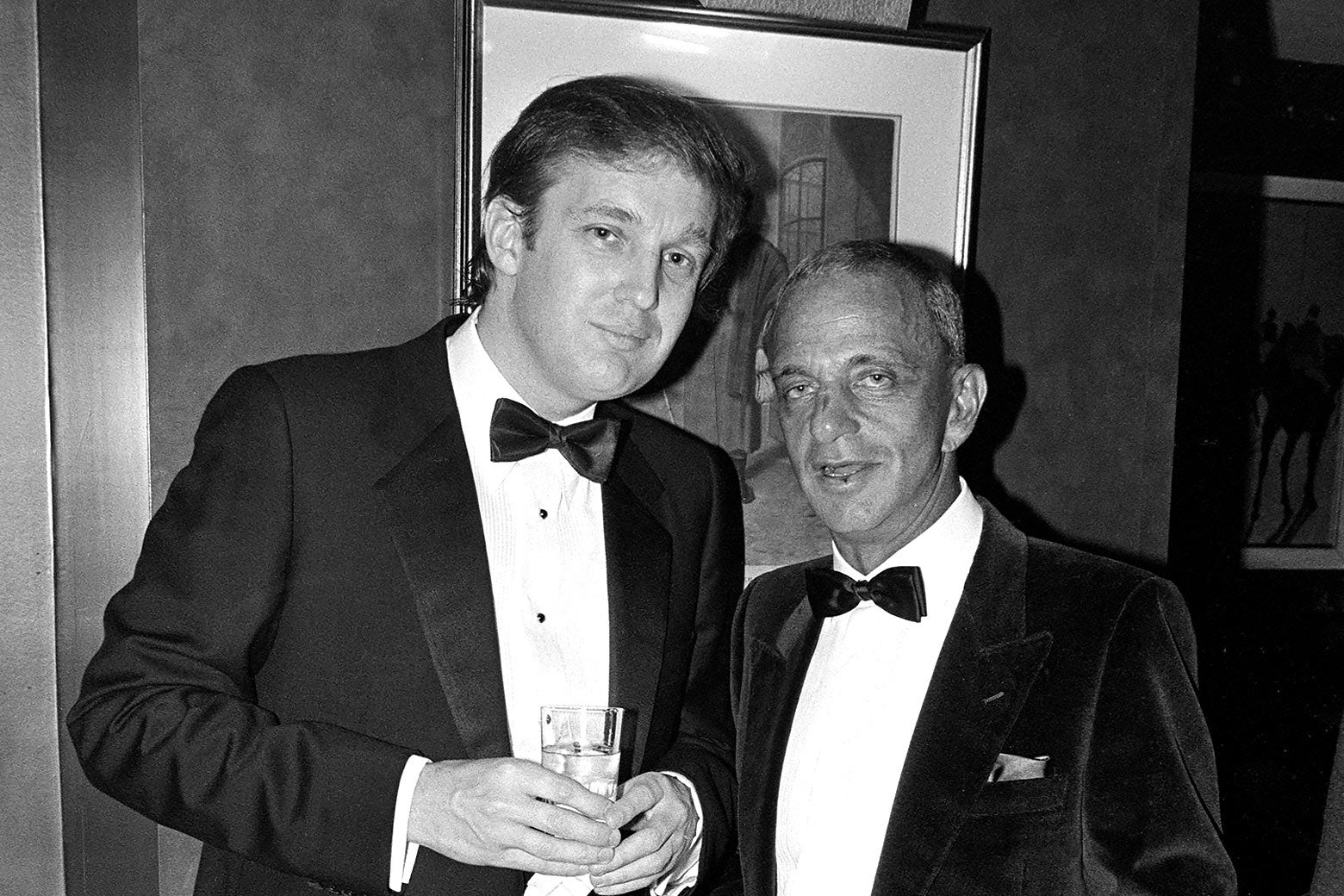
Books I devoured every page of Kai Bird’s riveting new book about the notorious grifter. By Enter your email to receive alerts for this author. Sign in or create an account to better manage your email preferences. Unsubscribe from email alerts Are you sure you want to unsubscribe from email alerts for Laura Miller? Aug 29, 202610:00 AM Guy DeLort/WWD/Penske Media via Getty Images Sign up for the Slatest to get the most insightful analysis, criticism, and advice out there, delivered to your inbox daily. I gobbled up every page of Kai Bird’s American Scoundrel: Roy Cohn’s Dark Journey from Joe McCarthy to Donald Trump, and I’m not sure how I feel about that. Bird, as he explains in the book’s acknowledgements, has considered himself “a biographer of the American establishment,” writing about such dimly remembered figures as John J. McCloy and McGeorge Bundy, as well as winning a Pulitzer for co-authoring, with Martin J. Sherwin, American Prometheus, the book on which Christopher Nolan’s 2023 film Oppenheimer was based. Roy Cohn, by contrast, was a mobbed-up and multiply-indicted lawyer in 20th-century Washington and New York City, a henchman of Joe McCarthy and J. Edgar Hoover, a frequenter of orgies (alleged, but convincingly) and a massive closet case hated by the city’s gay community for his active public homophobia. He was also the mentor and arguably the creator of Donald Trump. This is a dirty story, but as Bird acknowledges, one that has turned out to be seminal in American politics. “Americans love their gangsters,” Bird writes. We also love our conmen and rule-breakers, the bolder and more shameless, the better. Furthermore, we love our celebrities, and American Scoundrel is full of those, as well, although most of them are the long-gone stars of previous generations, the likes of Barbara Walters (a lifelong friend of Cohn’s), Andy Warhol, Norman Mailer, and Elizabeth Taylor. Even the acknowledgements section of American Scoundrel has its share of boldfaced names and remarkable anecdotes. The book—written by Bird but co-authored with his wife, Susan Goldmark, whom he credits with doing a sizable amount of the research—is a bounteous cornucopia of midcentury sleaze and uneasily addictive for just that reason. It’s got Mafia hits and frame jobs and blackmail and bribery and election tampering. It’s got forgery and insurance scams and perjury and espionage and sex trafficking and a lot of tax evasion. It makes James Ellroy novels look like Theo of Golden by comparison, and it makes for mesmerizing reading. Slate receives a commission when you purchase items using the links on this page. Thank you for your support. The son of an affluent appellate judge, Cohn grew up in the Bronx, hovered over by his doting mother, with whom he lived until her death in 1967, when Cohn was 40. His cousin, the writer Anne Roiphe (mother of the writer Katie Roiphe), described Dora Cohn as “small, hunched, grouchy, green,” adding that “she looked like a gnome from some German cutout.” Another cousin told Bird that Dora was “mean, vicious, ugly, and foul-mouthed.” No beauty himself and disfigured by a botched childhood surgery that left a prominent scar down the bridge of his nose, the diminutive Cohn was obsessed with tall, blond, muscular men, and one of his early forays into notoriety involved just such a figure, David Schine, heir to a hotel-chain fortune. By that point, Cohn, an assistant U.S. attorney, had played an instrumental role in the 1951 convictions and executions of Ethel and Julius Rosenberg, who were charged with spying for the Soviet Union. Later, a key witness would claim that Cohn had suborned perjury from him by threatening the witness’ wife. Cohn himself would boast of having convinced the judge to sentence Ethel to death, although to this day the extent of her guilt remains uncertain. Tony Kushner’s Pultizer-winning play Angels in America features Cohn as a central character, visited on his deathbed by the vengeful ghost of Ethel Rosenberg. The Rosenberg trial endeared Cohn to the commie-hating FBI director, J. Edgar Hoover, who in turn helped persuade Sen. Joseph McCarthy to hire Cohn as his chief counsel on the Senate Permanent Subcommittee on Investigations, passing over Robert F. Kennedy and making RFK a lifelong enemy of Cohn’s. Cohn, in turn, brought Schine in as a sort of unpaid consultant in 1953, and the two men traveled together through Europe, investigating the libraries at American agencies for books they deemed too friendly to communism. When Schine got drafted into the U.S. Army later that year, Cohn went ballistic, trying to get his friend exempted or, at the very least, made an officer. He was so persistent and unprincipled in this pursuit (at one point forging a series of memos) that his efforts led to the Army–McCarthy Hearings of 1954 and effectively ended McCarthy’s career. While far from the most famous of Cohn’s exploits, the Schine affair exemplified the lawyer’s modus operandi. As Bird writes, friendship and the trading of favors was the nexus of Cohn’s power. It also epitomizes what Bird can only describe as Cohn’s luck. In this case, as in so, so many to come, other people suffered the consequences of Cohn’s transgressions, while Cohn himself always seemed to get off scot-free. After Cohn returned to New York, he set up a practice of his own, headquartered in the townhouse he bought after his mother’s death. Virtually a character itself in American Scoundrel, the townhouse was a place where Cohn entertained visitors in a silk dressing gown or a skimpy swimsuit while sunbathing on the terrace, his body slathered in vinegar, which the political operative Roger Stone—another Cohn protégé—said “smelled like meat cooking.” A lack of basic materials and a chaotic filing system made conventional legal research virtually impossible, but this never troubled Cohn, who once said, “I don’t need files. I don’t need case histories, just give me the judge.” Sometimes, he had played a role in getting that judge appointed. Other times, it seems fairly obvious that he handed out bribes to get the rulings he sought. Cohn taught Trump a set of strategies for dealing with challenges and wielding power, very much as depicted in the 2024 film The Apprentice, directed by Ali Abbasi and starring Sebastian Stan as Donald Trump and Jeremy Strong as Cohn. Cohn’s directives, as listed by Bird, included: “Always respond in the public arena. Attack your critics personally, even if they be public officials. Delay the courts with repeated challenges and appeals. Accuse the accuser. Accuse your adversary of waging a vendetta. Loudly deny the facts and create your own counterfactual narrative. Above all, play the game aggressively—deny everything and never apologize.” Add to that refusing to pay off creditors and slapping insulting nicknames on people he didn’t like. One source marveled, upon first meeting Trump, that “Trump’s phrases are all Roy Cohn’s phrases,” and that Trump had even acquired Cohn’s habit of “plucking bits of food from the plate of his dining companion.” The scores of daring scams and rackets Cohn pulled off—from the parking lots that supplied him with a cash-only income that could be hidden from the tax man to “persuading” a political leader to get the third-party candidate John Anderson onto the ballot during the 1980 presidential election, thereby splitting the liberal vote and delivering the state to Ronald Reagan—are too numerous to list here. A particularly audacious grift involved getting a dementia-addled and intermittently comatose old friend to “sign” a document making Cohn an executor of his will. Finally, finally, Cohn was disbarred for this and other flagrant violations of professional ethics, but by that time he was gravely ill with AIDS, although he maintained until the last that he had liver cancer. Cohn also publicly denied being gay, although his sexual orientation was an open secret among his more cosmopolitan friends. Peter Manso, a journalist who, with Mailer, lived next door to Cohn in Provincetown, Massachusetts, and wrote a book about the attorney, told a radio interviewer that Cohn was “fiercely active sexually,” which when he was in Provincetown meant “very simply, three to four 15-year-old boys a night,” all of whom were sex workers. In one particularly grim passage, American Scoundrel tracks the history of an Irish orphan who was trafficked to Cohn in Venice, but Bird found little evidence that his subject consistently sought out underage partners. He mostly just liked them big, blond, and goyish. Bird argues that Cohn set the pattern for an angry, resentful, yet hypocritical populism to rise to power in the form of Donald Trump. Cohn, like McCarthy, saw himself as an enemy of the establishment that Bird usually chronicles, what one rich demagogue quoted in American Scoundrel reviled as “the socially pedigreed, the culturally acceptable, the certified gentlemen and scholars of the day, dripping with college degrees.” Never mind that Cohn, like Trump, relished his wealth and rubbing shoulders with the famous and powerful. Both recast their riche v. nouveau riche battles as a crusade on behalf of the working class, and many people, astonishingly, have fallen for it. “His values, his unethical behavior, and his political mindset have survived and replaced the values of the establishment he so resented,” Bird writes of Cohn. “Certainly, he gave us the narcissistic politics of Donald Trump.” As ugly and lurid as this saga is, American Scoundrel is consistently riveting, full of astonishing twists, ballsy plots, and eleventh-hour escapes from justice, like the legal version of the exploits of some Old West outlaw who is forever eluding the sheriffs by the skin of his teeth. It’s hard not to be impressed as well as horrified. Americans have long harbored a sneaking admiration for people who buck the system, who get to make their own rules instead of having rules imposed on them. It makes for a great story. Until, that is, we finally recognize that the real enemy and the ultimate loser in this scenario isn’t the system, but ourselves. Books Donald Trump Politics Slate Book Review
How One Notorious Figure Created the Likes of Donald Trump
Full Article
Original Source
Read the full article at Slate →KhanList aggregates and links to publicly available news content. We do not host full articles from third-party sources. Always verify important information with original sources.