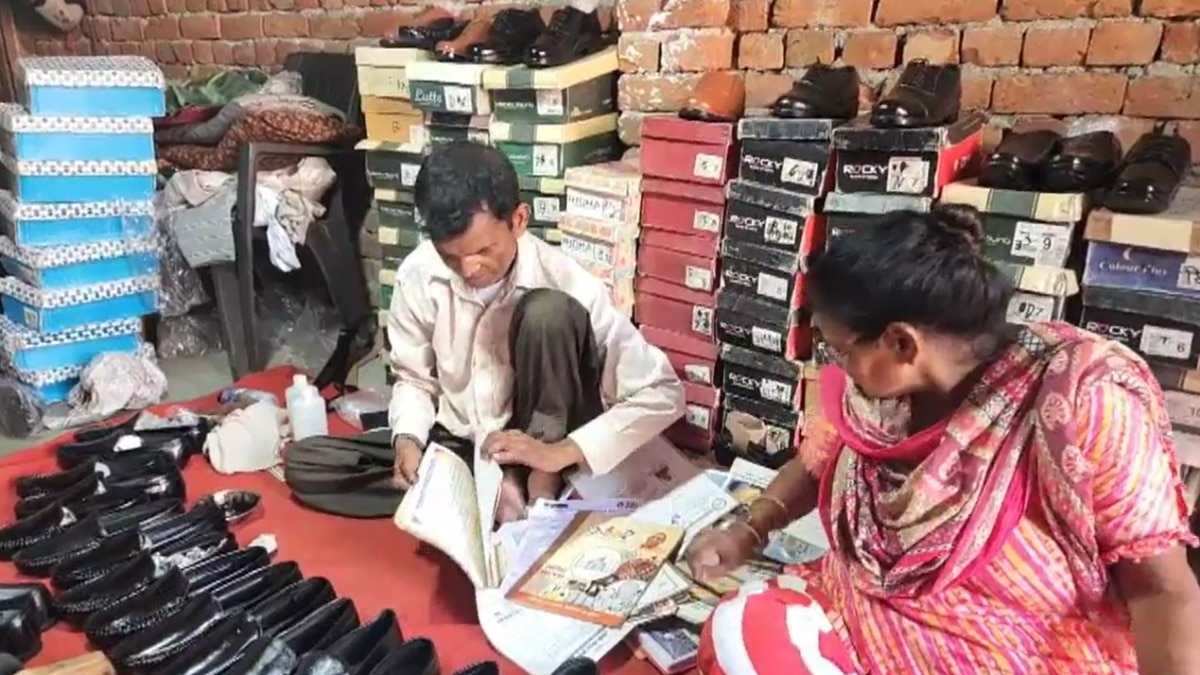
Uttar Pradesh's ODOP initiative is training Agra's footwear artisans, especially youth and women, at the Common Facility Centre. The effort aims to link inherited craft with credit, machinery and markets for a sustainable livelihood.The idea is to move beyond simply training workers for jobs. (Credits: Nitin Upadhyay)Agra is known around the world for the Taj Mahal. But beyond themonument and the millions of tourists who visit it every year, thecity has another identity — one built around leather, footwear andthe hands of generations of artisans.From shoes and sandals to traditional juttis, footwear made in Agra findsits way to markets across India and overseas. The industry has long been dominated by small workshops and home-based units, where skills are passed down through generations.Now,the Uttar Pradesh government's One District, One Product (ODOP)initiative is attempting to give that traditional ecosystem a moremodern foundation — through training, access to finance, machinery and markets.According to Anuj Kumar Singh, Joint Commissioner of Industries, Agra Division,the ODOP initiative is not a single scheme but a combination of government interventions. Agra was initially identified for leather products as well as stone and marble handicrafts, while non-leather footwear was subsequently brought under its ambit. The scale of the footwear and leather industry in the city is significant. Around Rs 4,000 crore worth of leather products are exported from Agra every year, according to the district industry department. The sector has around 150 export units and provides livelihoods to an estimated four to five lakh people.But for an industry that depends so heavily on manual skills, machines and capital are only part of the equation.The bigger challenge is ensuring that the next generation has the skills to keep the industry going.FROM TRADITIONAL SKILLS TO MODERN TRAININGAt the Common Facility Centre in Nawada village on Shamshabad Road, that transition is visible on the factory floor.Young men and women are being trained in cutting, stitching, finishing and packaging, while also learning how to operate modern machinery usedin footwear and leather-product manufacturing.The idea is to move beyond simply training workers for jobs.The centre is also intended to help trainees explore self-employment, giving them the skills needed to start working independently or build their own small businesses.Akash Tomar, a trainer at the centre, says the training is designed to give young people practical skills that can be directly applied in the industry.For some trainees, particularly women, the opportunity represents something more than acquiring a new technical skill.Lakshmi, who completed a 90-day training programme, says she had never imagined that she would be able to make products with her own hands that could eventually be sold on the market.The training, she says, has given her not just a skill but also confidence in her ability to earn independently.Her experience reflects a broader effort to bring more women into an industry that has traditionally relied heavily on family-based and informal labour.At the Common Facility Centre, young women can be seen making bags, purses, wallets and other leather and non-leather products.For them, the training offers a possible route into income generation without necessarily having to leave their communities.FROM WORKER TO ENTREPRENEURTraining is only one part of the ODOP model.The government is also trying to address one of the biggest constraints faced by small artisans — access to capital.According to the district industries department, beneficiaries can access bank loans, subsidies ranging from 10 to 25 per cent, toolkits and sewingmachines. Under the Chief Minister's Youth Entrepreneur Scheme, assistance of up to Rs 5 lakh is also available.The government is also attempting to connect artisans with markets by facilitating their participation in exhibitions across the country.The broader's objective is to help artisans move from being dependent on contractors or employers to becoming entrepreneurs themselves.That transition, however, takes more than a loan or a machine. It requires access to skills, buyers and a reliable market.The Common Facility Centre is intended to bring some of those pieces together.A BRIDGE BETWEEN GENERATIONSRavindra Singh Tomar, who runs the Common Facility Centre, says the traditional footwear industry was facing a generational challenge.Young people were increasingly moving away from the occupation, raising questions about how the skills that had sustained Agra's footwear cluster for generations would survive.The centre was launched in June 2022 with the aim of addressing that gap.In its first year, only around 90 young people received training. Sincethen, the number has risen sharply, with around 1,600 artisans trained through the centre so far.For Tomar, the centre has effectively become a bridge between the old skills of Agra's footwear makers and the technology and techniques required by a changing market.THE ARTISAN WHO TURNED A COTTAGE UNIT INTO A BUSINESSThe impact of such support is perhaps most visible in the city's smaller workshops.In Anguthi village in the Bichpuri area, Rajendra Soni belongs to a family that has been making footwear for generations.His business remains a small cottage industry, but government support has helped him expand its reach.Soni says he received a credit limit of up to Rs 3 lakh under the ODOP scheme. He also received a subsidy of Rs 10,000 twice a year.Today, he makes shoes, sandals, slippers and juttis from his home.But the business is no longer restricted to local customers.Soni has participated in exhibitions in Delhi, Lucknow, Meerut and Gorakhpur, where he has been able to meet larger buyers and secure new orders.For small artisans, access to such markets can make a significant difference. Instead of relying entirely on local demand or intermediaries, the producer gets an opportunity to showcase products directly to potential buyers.Soni says his income has increased enough to allow him to buy a house for his family.Earlier, he lived with his five brothers in their ancestral home.For him, the change is therefore not merely about producing more footwear. It has translated into a tangible improvement in his family's standard of living.CANAGRA'S TRADITIONAL INDUSTRY FIND A NEW GENERATION?Agra's footwear industry is already large. The bigger question is whether it can remain competitive while retaining the artisans and skills that built it.The answer may depend on whether traditional craft skills can be combined with modern production methods, better training and wider access to markets.The ODOP model is attempting to make that combination possible.At the Common Facility Centre, young people are learning to work with machines alongside traditional techniques. Women are acquiring skills that can potentially translate into independent incomes. Artisans such as Rajendra Soni are getting access to credit and exhibitions beyond their immediate markets.None of this changes the nature of the challenge overnight. Small manufacturers still have to compete for buyers, manage costs and keep up with changing consumer demand.But the shift is visible.Agra's footwear story is no longer only about an inherited skill passed from one generation to another.It is increasingly about whether that skill can become a sustainable modern livelihood.The shoes made in Agra may travel thousands of kilometres before reaching their final customers. But behind every pair is a network of artisans, trainees, small entrepreneurs and families whose livelihoods depend on keeping that industry moving.Forthem, ODOP is ultimately less about a government label and more about whether a traditional craft can create a viable future for the next generation.- EndsWith inputs from Nitin UpadhyayPublished By: Ritaban MisraPublished On: Aug 16, 2026 19:45 IST
How One District One Product is breathing new life into Agra's footwear industry
Full Article
Original Source
Read the full article at Indiatoday →KhanList aggregates and links to publicly available news content. We do not host full articles from third-party sources. Always verify important information with original sources.