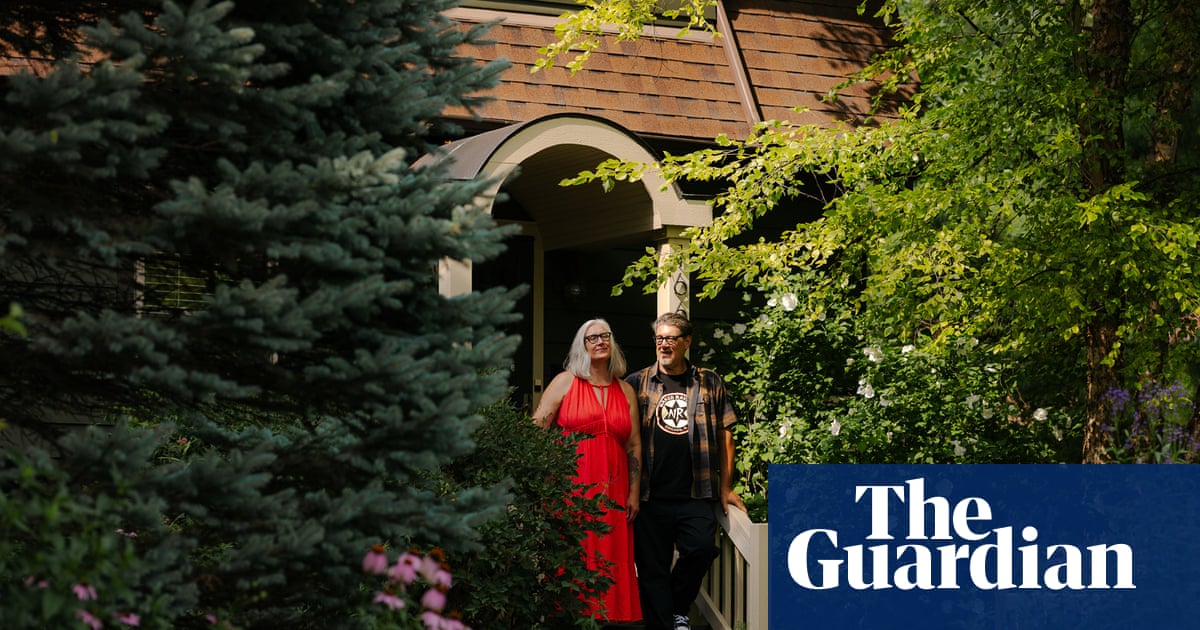
When James Reed McGuire and Crystal Fritz first decided to replace their lawn with native plants, they did not really know what they were doing. As former city-dwellers who had moved from Chicago out to the suburb of Highland Park, Illinois, they had never done much gardening together beyond growing some planters of herbs and flowers on their balcony.But for McGuire, an avid birder who did not want to live with a sea of turf that does “absolutely nothing for the environment”, figuring out an alternative to the suburban status quo was imperative. Crystal Fritz and James Reed McGuire’s Highland Park front garden before they transformed it with native plants The couple’s early attempts to rewild their lawn were full of what they now deem missteps. They bought mixed wildflower seed packets and sprinkled them about aimlessly, rather than identifying specific species native to their area and planning where they should go. They tried digging up the turf by hand with a shovel, labour so difficult that McGuire laughs when he thinks about it now.But with each mistake, they learned. Despite having no horticultural training – Fritz works as a personal assistant, while McGuire is a creative director and writer – they slowly figured out how to identify native plants for their region and experimented with the best ways to grow them from seed to keep the project economical. Now, Fritz and McGuire’s garden is a thriving native ecosystem in the middle of the suburbs They designed layouts for their garden that would allow them to enjoy blooms for as much of the growing season as possible. Every year, they added a few more native plants and every year they watched as more pollinators and birds were drawn to the garden.Quick GuideHow to rewild your lawnShowHow to rewild your lawn• Start small. You do not have to dig up the whole lawn at once; you can just pick one corner to work on and remove a small piece of turf.• Remove any invasive species.• When researching which native plants and wildflowers to use, look for ones that attract pollinators. In the US, you can source your plants using the native plant resource directory at Homegrown National Park.• While it might take some effort to establish the plants at the beginning, many gardeners find that less exotic plants actually take less maintenance in the long run because they have evolved to live in the same conditions in which you are planting them. Photograph: David Kilpatrick/www.alamy.comToday, McGuire and Fritz’s lawn has been transformed from a monoculture of turf to a thriving native ecosystem in the suburbs. The abundance of native plants provides food and habitat for a plethora of wild critters: sightings of birds, butterflies, bees, rabbits, bats and foxes are now common occurrences.“It’s really a stunning environment,” says McGuire. “It brings us a lot of peace and tranquility in a very troubled world.” McGuire and Fritz in their yard: ‘It’s so rewarding,’ says Fritz As the first in the neighbourhood to make this switch, McGuire and Fritz have received an “unbelievable amount of positive feedback” from passersby. Families go out of their way to walk by the house so their children can see the abundance of fireflies there. One couple nearby asked for McGuire’s help in converting their own yard into a native habitat.The house has been featured in a local garden walk for the past few years, and the city granted the couple permission to landscape the city-owned roadside verge in front of their home to extend the habitat they created.And it is not just McGuire and Fritz’s human neighbours who love what they’ve done with the place. In 2023, their garden was designated a Certified Wildlife Habitat by the National Wildlife Federation, proof that their landscaping is a boon to wildlife, too.“It’s so rewarding,” says Fritz. “We’ve done this little tiny thing with this little piece of property, but it’s made a huge impact, at least in our little corner of the world.”Fritz and McGuire might have been the first on their block to convert their lawn, but they are far from alone. All over the US, people are beginning to dig up pesticide- and fertiliser-hungry lawns in favour of planting that is more biodiverse and better suited to the local climate and needs of wildlife. The abundance of native plants provides food and habitat for wildlife: birds, butterflies, bees, rabbits, bats and foxes are common According to Doug Tallamy, an entomologist who has become one of the country’s biggest advocates for what he calls “conservation landscaping”, lawns first came to the US from Europe.“We copied the aristocracy,” Tallamy says. “We wanted to show that we were rich and had high status, and back then the only way you could have a lawn is if you had enough property that you didn’t have to farm at all, and you had enough wealth that you could either have slaves or sheep to manage that lawn.”With the invention of the lawnmower, as well as the arrival of pesticides and fertiliser, lawn maintenance became accessible to a much wider range of people, and by the mid-20th century, turf had become an entrenched status symbol for suburbanites. Today, an estimated 160,000 sq km (40m acres) of the US are turf – including golf courses – with more surface area given over to lawns than individual irrigated crops such as maize or wheat. Butterflies are naturally attracted to the native plants While it might seem better than concrete, for example, grass lawns are environmentally problematic, Tallamy says. First off, US lawns usually consist of European grass species with short roots, which do little to draw carbon and water deep into the soil. When it rains, water runs off the top of these lawns rather than being absorbed, taking pesticides and fertiliser with it and depositing the chemicals in nearby rivers and lakes, where they wreak havoc on watercourses. Second, non-native turf grasses do not support pollinators or a viable food web, which starts with insects.Tallamy says: “We’ve got parks and we’ve got reserves, but we are headed towards a sixth extinction event, because those are too small, they’re too isolated and there’s too few of them. And the way we landscape in between the parks and reserves does not sustain biodiversity.”The good news is that it does not take much to begin righting these environmental wrongs. From Tallamy’s perspective, it does not even necessarily mean eliminating lawns entirely – if short grass is useful in one part of your garden so your children can play, that’s great. A wide variety of native species thrive in Fritz and McGuire’s garden For him, it is about shifting the balance so native plants become the norm and lawns are created specifically to serve a purpose. If everybody in the country cut their lawn in half and planted the other half with native species, it would go a long way towards creating and connecting the kind of habitats that would allow wild species to survive today’s ecological crises, he says.That is the idea behind Homegrown National Parks, an American conservation initiative founded by Tallamy that advocates bringing the wilderness to your home by planting native.Camille Dungy, an American poet and academic, is also known in her neighbourhood in Fort Collins, Colorado, for her gorgeous garden. Dungy spent a decade converting her single-species lawn into a biodiverse haven of native plant species that supports birds and pollinators year-round and uses less water. Poet and academic Camille Dungy in her bird- and pollinator-friendly garden in Fort Collins, Colorado. Photograph: Ben Ward/The Guardian But she has also left room for a few non-native (though still non-invasive) species such as irises, which remind her of a loved one, as well as some lawn space for her child to play on (although she swapped the Kentucky bluegrass for native grasses). Her garden is now about 70% native plants to 30% non-native.Even that has been enough to make a marked difference in her garden’s ability to support biodiversity, says Dungy, who wrote about the process in her 2023 book Soil: The Story of a Black Mother’s Garden. Along the way, she has also seen the culture around lawns slowly change.When she first moved to Fort Collins in 2013, a member of the Homeowners’ Association (organisations that manage and set rules for shared spaces in US residential areas) would walk around with a ruler, measuring whether residents had plants growing above a permitted height, which favoured lawns. By 2023, Colorado had passed legislation prohibiting the associations from banning “water-wise” landscaping, which often uses native plants to conserve water in the chronically drought-stricken state.“We started as the first house on the block, and now everybody has some elements of this kind of low-water, pollinator-supporting landscaping,” Dungy says.The change is also happening elsewhere. Some parts of California now offer rebates to homeowners for every square foot of lawn replaced with a “xeriscaped” (dry landscape) garden, which use drought-tolerant plants, more efficient watering techniques and mulching to use less water.Minnesota and Pennsylvania pay residents to replace lawns with native plants, and Virginia has banned the sale of invasive species (some of which used to be considered exotic ornamental plants). Marco Island in Florida implemented a successful programme to pay residents to let the endangered burrowing owl build a nest in their lawns. Attracting pollinators is one of the reasons people are choosing to plant native gardens Now, evidence is emerging that even if state governments do not reward the choice to plant native, homebuyers might – real estate agents are finding that native gardens can be a selling point.Once you get started, and see the flood of pollinators and new birds showing up at your door, you may never look back. This is one of the things that Tallamy finds most powerful about the movement: for all the very real good you can do by installing solar panels or switching to an electric vehicle, it can be hard to see the impact your good choices have had.But when you rewild your lawn, “you get to see the results, and that empowers you”, he says. “You see the biodiversity come back to your yard, and even though you’re not saving the whole planet, you are saving the piece of the planet that you ‘own’ in a very functional way.” The Guardian receives support for visual climate coverage from the Outrider Foundation. The Guardian’s coverage is editorially independent
How one American couple ditched their lawn and created a wildlife haven – and you could too
Full Article
Original Source
Read the full article at Theguardian →KhanList aggregates and links to publicly available news content. We do not host full articles from third-party sources. Always verify important information with original sources.